
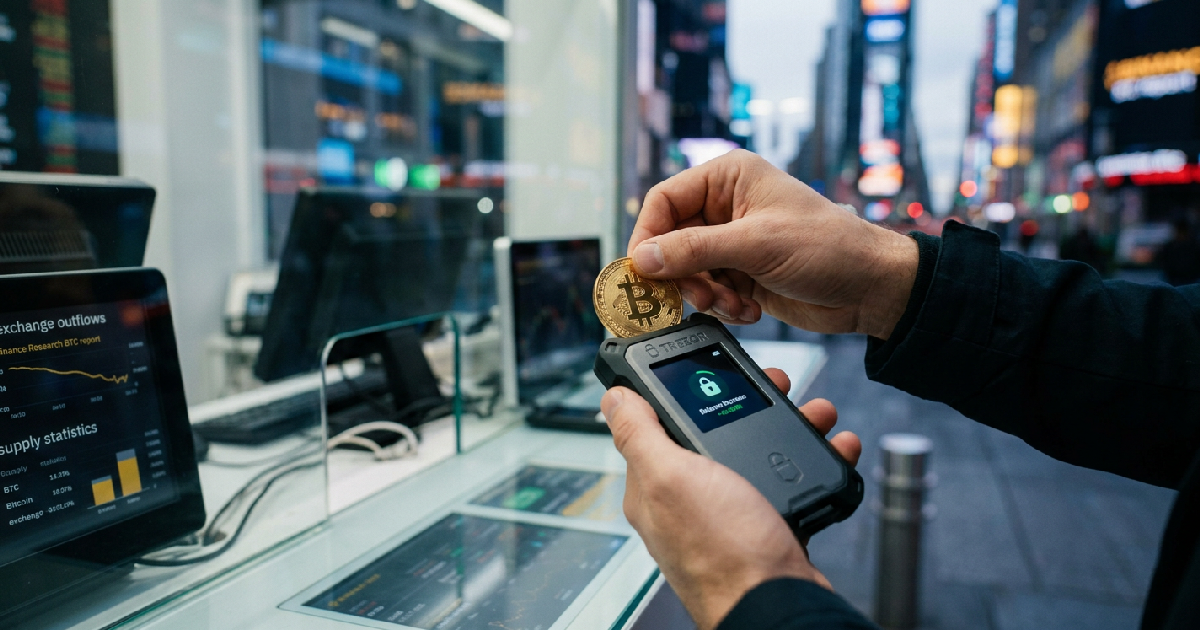

Binance Research has revealed that approximately 500,000 Bitcoin (BTC) have left trading venues since the peak of the COVID-19 era. This cumulative outflow has driven exchange balances to a six-year low, signaling a shift in market structure toward a supply-constrained environment. In a report published on May 17, the research arm of Binance identified four on-chain signals suggesting that sell pressure is largely exhausted.
The total share of Bitcoin supply held on exchanges now sits at roughly 15.0%, a drop from the pandemic-era peak of 17.6%. Binance Research analysts noted that “supply is tightening and sell pressure is exhausted,” as assets move off centralized platforms. This trend points to a market moving away from forced selling, even as broader economic factors continue to pressure risk assets.
On-chain data shows that Bitcoin exchange supply maintains multi-year lows, a development that coincides with high levels of supply dormancy. Currently, nearly 60% of the total BTC supply has not moved in over a year. While this is down from a record peak of 69.5% in January 2024, the researchers noted that dormancy remains at “historically elevated levels.”
Dormancy and seller exhaustion signal long-term conviction
The report emphasizes that current holder behavior underscores a significant amount of “sustained long-term holder conviction.” Despite the price fluctuations following the U.S. spot Bitcoin ETF approvals, investors have largely kept their assets out of active trading circulation. Binance Research stated that “despite the subsequent sell-the-news reaction, supply dormancy has remained near historically elevated levels.”
Several technical metrics support this view of a cooling sell side. The SLRV ratio remains in a historical bottom zone, which typically indicates that short-term speculative activity is subdued. Meanwhile, the Short-Term Holder Market Value to Realized Value (STH MVRV) metric has risen above 1.0. This change suggests that short-term investors are beginning to exit loss-making trades and are rebuilding unrealized profits.
However, the tightening supply faces a challenging macroeconomic environment. U.S. Treasury yields have been rising, with the 10-year yield hitting 4.52%, while oil prices have surged above $110 per barrel. These factors have historically weakened the appetite for risk, which may be reflected in the Bitcoin price analysis as the market faces persistent resistance at key levels.
Institutional outflows test market resilience
Institutional interest has shown signs of cooling recently. Spot Bitcoin ETFs recorded $635.23 million in outflows on May 13 alone, the largest single-day exit since late January. Total ETF outflows for the week prior to May 18 exceeded $1 billion. This negative flow ended a six-week streak of positive movement, though it has not yet reversed the multi-year trend of dwindling exchange supply.
Specific platform data also reflects these broader movements. Binance experienced a net Bitcoin outflow of $400 million month-to-date as of May 14. This follows a much larger event on February 12, 2026, when the exchange processed nearly $17 billion in withdrawals. During that 24-hour period, Binance’s specific BTC supply dropped from 1.23 million BTC to 1.21 million BTC.
While Bitcoin flows outward, other assets are seeing different patterns. Wrapped Ethereum (WETH) saw an inflow of $887 million to Binance month-to-date. This activity is likely linked to de-risking following an incident involving KelpDAO in April. The divergence in these flows highlights a unique period where Bitcoin holders appear focused on long-term storage while other sectors of the market react to specific decentralized finance risks.
The combination of low exchange balances and high dormancy suggests a shift in the market’s inner workings. With 500,000 BTC removed from trading venues over the last few years, the market is increasingly set up for a supply squeeze. According to Binance Research, current indicators collectively point toward a market where the immediate available supply is at its thinnest level in over half a decade.