
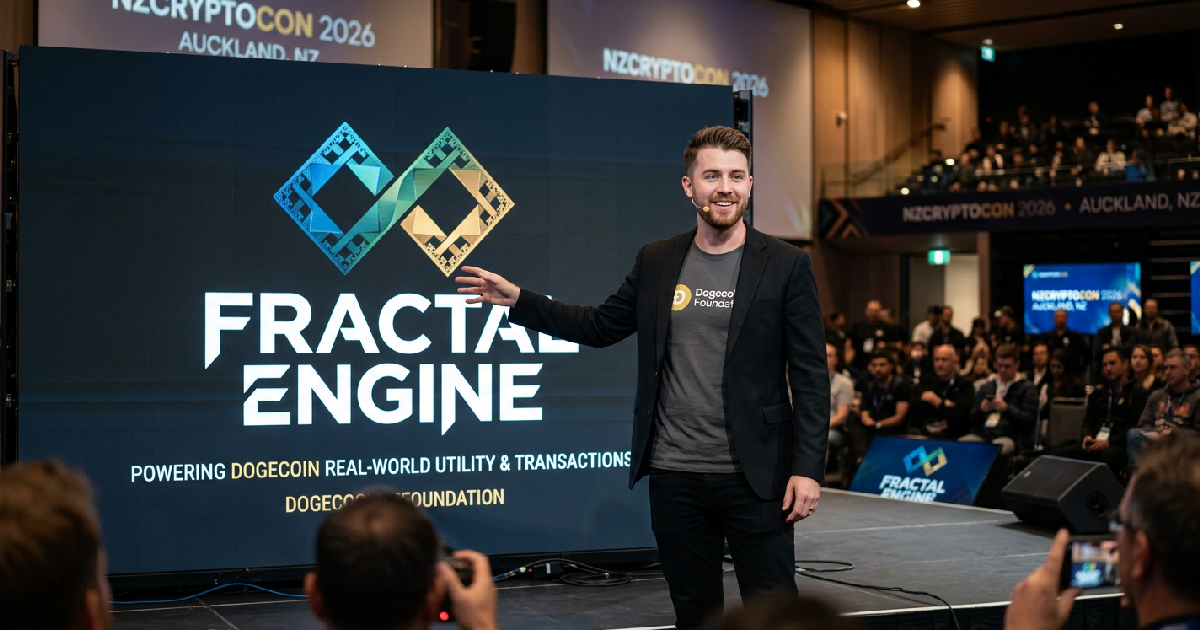

Timothy Stebbing, Product Lead at the Dogecoin Foundation, addressed the inaugural NZCryptoCon in Auckland on June 7, 2026, as the digital asset community shifts its focus toward Dogecoin utility. The event, held at the New Zealand International Convention Centre (NZICC), marks the first large-scale cryptocurrency and blockchain conference in the country’s history.
Stebbing was among more than 100 estimated speakers who gathered to discuss the practical evolution of decentralized networks.
The conference arrives as the global market increasingly demands fundamental value from digital assets. While originally created as a parody, Dogecoin is being repositioned as a functional tool for real-world transactions through projects like the “Fractal Engine.” This infrastructure represents a sidechain designed for tokenized assets, focusing on scalability and interoperability.
Professional 2026 market analysis shows that Bitcoin signals indicate shifting market structure, mirroring this broader trend of moving away from pure speculation toward technical infrastructure.
Organized by the Web3 Australia Group, the Auckland summit tapped into a growing regional interest in digital finance. Local research indicates that nearly half of New Zealand citizens have owned, currently own, or are actively considering digital assets.
This high level of curiosity has turned the Pacific nation into a notable testing ground for blockchain adoption. The two-day program provided a platform for education and connection across a variety of sectors including DeFi, security, and NFTs.
Dogecoin Foundation highlights practical applications at NZICC
The Dogecoin Foundation’s presence in Auckland signals a deliberate attempt to professionalize the ecosystem. Timothy Stebbing has previously highlighted how the Fractal Engine could expand Dogecoin’s real-world utility by enabling tokenized assets on a scalable sidechain. By participating in NZCryptoCon, the Foundation is aligning the coin with major industry platforms like Swyftx and Binance, the latter of which served as the event’s Keynote Theatre Partner.
Technical maturity is becoming a prerequisite for market longevity in the current cycle. For instance, developers are increasingly focused on complex protocols, such as when David Schwartz details XRP Ledger’s Doomsday protocol to ensure network resilience. Similarly, Dogecoin’s transition involves creating a multi-layer approach where the core blockchain remains lightweight while secondary layers handle more complex financial applications.
The shift toward utility is also a response to a maturing investor base. Many participants at the Auckland event expressed interest in long-term viability rather than short-term price swings. Analysts participating in the “best altcoin to buy now” debate often look for coins that can demonstrate actual ecosystem growth.
This suggests that Dogecoin’s future success may depend more on its developer tools and merchant integration than on social media sentiment.
Auckland emerges as a regional hub for blockchain education
The NZCryptoCon event drew an estimated crowd of over 4,000 attendees, supported by more than 400 companies. This level of participation from both retail and corporate sectors highlights New Zealand’s growing role in the Web3 space. Sponsors including Swyftx, Binance, and Blackbull provided the financial backing to host the multi-stage program, which ran from 8:00 AM to 5:00 PM daily on June 6 and 7.
Visibility for the event was bolstered by a heavy marketing presence in Auckland. Binance conducted a two-week digital billboard campaign across the city, displaying real-time Bitcoin pricing to coincide with the conference. This programmatic advertising effort reflects the increasing competition among global exchanges to capture the attention of the “Kiwis” who are exploring digital finance for the first time.
Ticketing for the event was split across several tiers, ranging from $59 for general admission to $799 for VIP access. The variety of price points allowed for a diverse mix of participants, from students and hobbyists to institutional developers.
Following the final sessions on Sunday, the conference concluded with an official after-party at 7:00 PM, capping off the country’s most significant entry into the global crypto-conference circuit to date.
Infrastructure and the long-term outlook for meme assets
A recurring theme at the NZICC was the necessity of “hardened” infrastructure to support mass adoption. For Dogecoin, this means proving the network can handle high loads and sophisticated sidechain applications without losing the simplicity that made it popular. Stebbing’s contributions to the event emphasize that these technical hurdles are the current priority for the Foundation as it moves into the second half of 2026.
This focus on the “plumbing” of the crypto world is essential for navigating modern regulatory environments. By building out legitimate use cases, decentralized projects can better justify their presence in the global economy.
As the dust settles on the Auckland event, the message from the Dogecoin Foundation is clear: the era of the “joke” is being replaced by a serious effort to build a durable payment infrastructure.