
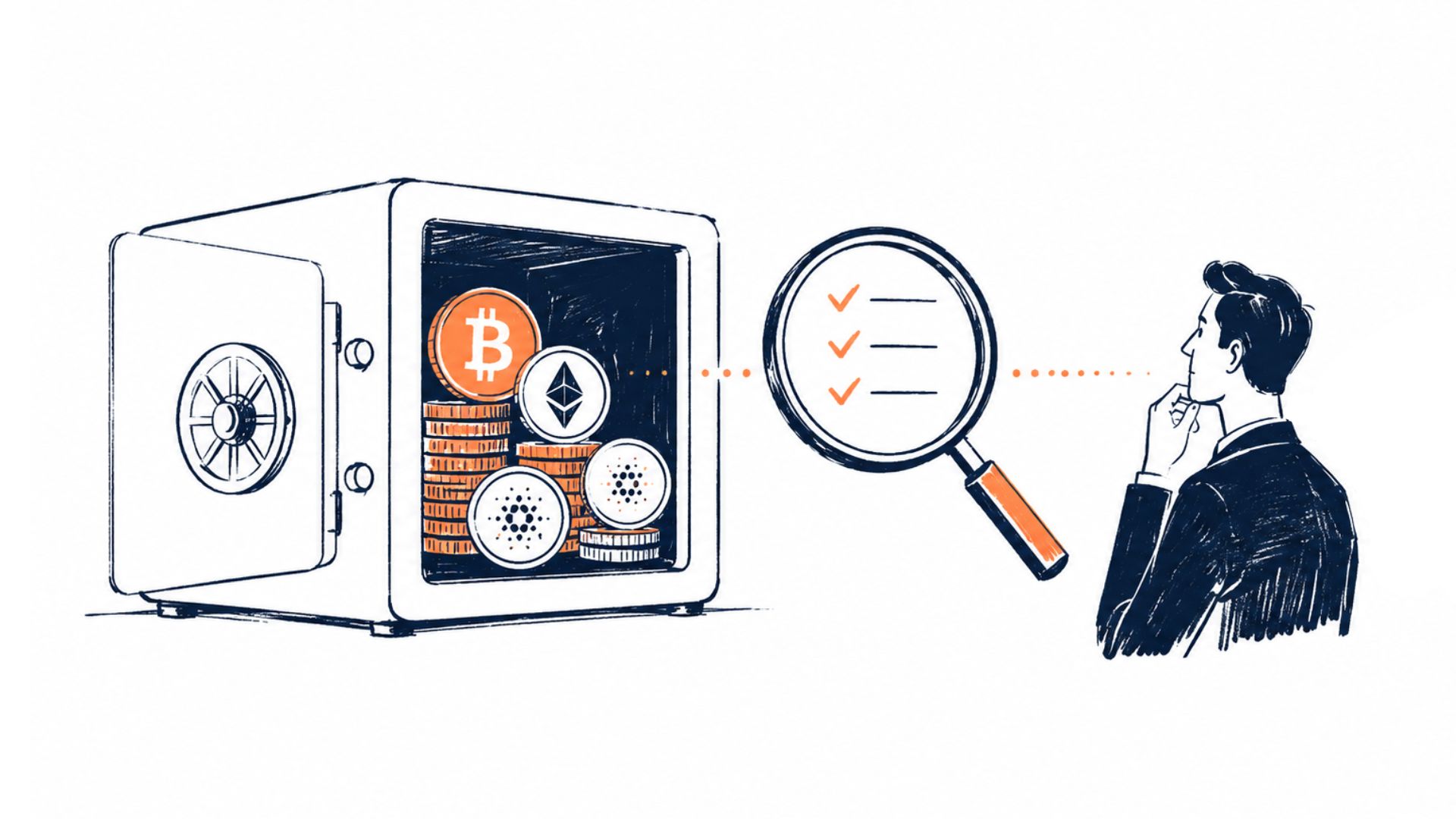

Seeing a Bitcoin balance in a crypto exchange account tells you what the platform says you own. It does not, by itself, show whether the exchange actually holds the corresponding assets.
That is the problem proof of reserves is designed to address.
The idea is relatively simple: an exchange provides evidence that it controls certain cryptoassets, often by revealing wallets whose balances can be checked on a public blockchain. But that evidence answers a narrower question than many people assume.
It can help establish that an exchange holds particular assets. It does not automatically prove that the company can meet every obligation it has.
That distinction is what makes Proof of Reserves useful — and also where its limits begin.
Why proof of reserves exists in the first place
When cryptoassets are kept on an exchange rather than in a self-custody wallet, the user does not control the private keys directly. The exchange does.
This creates an unavoidable layer of trust. Customers expect the platform to hold enough assets to process withdrawals when they ask for them.
The difficulty is that users cannot normally look inside the exchange’s internal systems and verify that assumption for themselves. A balance displayed in an account interface is ultimately information provided by the company.
Blockchain networks offer a different kind of evidence.
Because transactions and wallet balances can be observed publicly, an exchange can demonstrate control over certain addresses and the cryptoassets held in them. A Proof of Reserves process uses that transparency to give users something more tangible than a statement from the company itself.
In other words, it tries to turn “trust us, we have the assets” into “here is evidence that we control these assets”.
That is an important improvement, but it is not the same as proving the exchange is financially healthy in every respect.
How a proof of reserves becomes verifiable
At its core, a Proof of Reserves exercise is a snapshot of assets controlled by a company at a particular point in time.
The process can involve identifying wallets associated with the exchange, checking their balances on the blockchain and comparing those holdings with the cryptoassets attributed to customers.
This is where the transparency of public blockchains becomes particularly useful. Instead of relying entirely on private company records, part of the evidence exists on infrastructure that other people can inspect.
Suppose an exchange says it holds a certain amount of Bitcoin for its customers. If the relevant wallets can be identified and their balances independently checked, there is a way to test that particular claim.
But notice what has — and has not — been established.
The evidence shows that the exchange controls a certain amount of Bitcoin. It does not necessarily show what the company owes elsewhere, whether those assets are encumbered, or whether its broader financial position would allow it to meet every obligation.
That distinction is easy to miss because the number on the blockchain is visible and concrete.
The technical layer: where Merkle trees fit in
There is another problem to solve.
An exchange needs to demonstrate that the assets it holds correspond to its customers’ balances without publishing everyone’s individual holdings to the world.
One way Proof of Reserves systems address this is through a Merkle tree, a mathematical structure that allows large amounts of data to be organised and verified efficiently.
In simplified terms, individual customer balances are converted into cryptographic hashes. Those pieces of information are then combined repeatedly until they produce a single value known as the Merkle root.
The structure allows a customer to verify that their balance was included in the dataset used in the proof without requiring the exchange to publish every customer’s balance.
That matters because transparency and privacy can pull in opposite directions.
The point is not for every user to see what everyone else owns. It is to create a mechanism through which inclusion in the reported balances can be checked without exposing unnecessary personal information.
The technology, however, does not change the fundamental question the proof is answering. It helps verify the relationship between reported customer balances and the assets being demonstrated. It does not turn the exercise into a complete financial audit.
Why reserves are not the same thing as solvency
This is the most important distinction in understanding Proof of Reserves.
Imagine two exchanges that can each demonstrate control over 10,000 units of the same cryptoasset.
On the surface, their reserves look identical.
But suppose one exchange also has significantly larger liabilities — perhaps from loans, contracts or other financial obligations. The two businesses now have very different financial positions, even though the amount of cryptoassets they can demonstrate is the same.
This is why proof of reserves is not automatically proof of solvency.
Reserves describe assets. Solvency depends on the relationship between assets and liabilities.
A company could therefore present substantial reserves while still having financial obligations that are not visible in a wallet-based exercise.
This is also why the idea of proof of liabilities matters. If users want to understand whether an exchange can cover what it owes, knowing what the company controls is only one side of the equation.
The distinction sounds obvious when stated this way, yet it is one of the easiest things for a reader to overlook when a reserve figure is presented as a simple, reassuring number.
The snapshot problem: what happens after the proof?
There is another limitation hiding in plain sight: time.
A Proof of Reserves report represents a situation at a particular moment. It is closer to a photograph than a live feed.
An exchange could demonstrate a certain quantity of assets on the day the verification takes place. That does not automatically tell users what those reserves will look like weeks or months later.
The same applies to methodology. The value of the evidence depends on which wallets were examined, which assets were included, how customer balances were calculated and what fell outside the scope of the exercise.
This does not make Proof of Reserves meaningless.
It simply means that the date and methodology are part of the evidence itself.
A reader should therefore be more interested in what was actually verified than in the existence of a Proof of Reserves label alone.
What a useful proof of reserves should make clear
For users, the practical question is not whether an exchange has published the words “Proof of Reserves”.
It is what those words represent.
A useful exercise should make it possible to understand which assets were included, which wallets were considered and when the verification took place. It should also be clear whether the process looked only at reserves or considered liabilities as part of a broader assessment.
Those details determine how much confidence the evidence deserves.
The most useful way to read a Proof of Reserves report is therefore not as a certificate saying that everything is safe, but as a collection of evidence that answers a specific question.
That shift in perspective matters.
A reserve figure can tell you considerably more than a company’s unsupported claim that it holds customer assets. But treating that figure as a complete picture of the business can recreate the very trust problem the exercise was intended to reduce.
Proof of reserves is valuable precisely because it does not prove everything
Proof of Reserves does not eliminate the need to trust a crypto exchange. What it can do is reduce the amount of information that users have to take on faith.
That is its real value.
A blockchain can provide evidence that certain assets are controlled by an exchange. Cryptographic structures such as Merkle trees can help connect that evidence to reported customer balances without publicly exposing every account. But neither mechanism, on its own, establishes that the company has no hidden liabilities or that its financial position cannot deteriorate.
The most useful question is therefore not simply “Does this exchange have Proof of Reserves?”
It is: “What exactly does this Proof of Reserves prove?” That is a much narrower question — and, for anyone leaving cryptoassets with a third party, a much more useful one.