
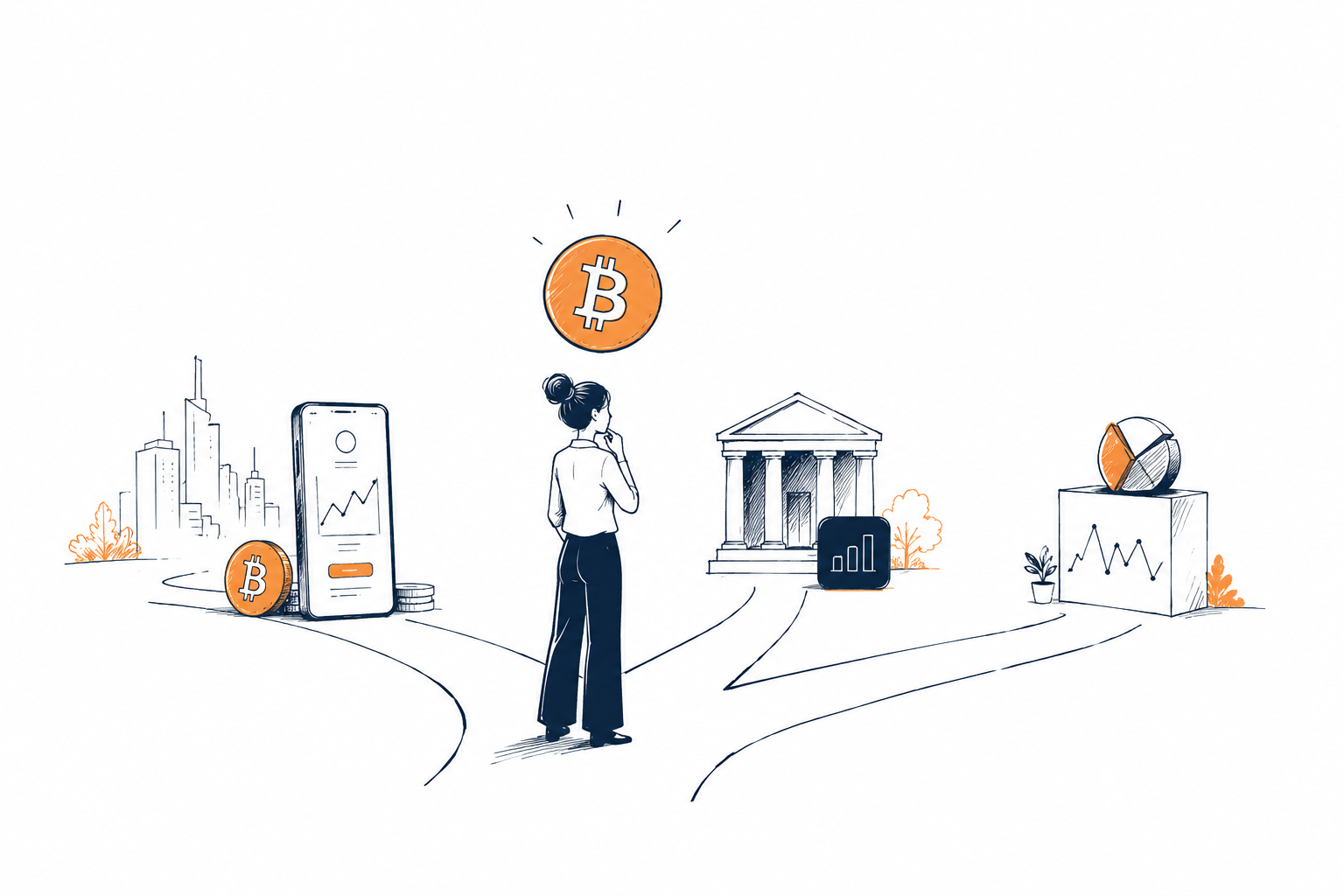

Buying Bitcoin has become remarkably simple. A few taps on a banking app, an account with a cryptocurrency exchange or even a purchase through a traditional brokerage can all provide exposure to the world’s largest digital asset.
That convenience, however, hides an important reality: not every way of buying Bitcoin gives you the same thing.
Some methods on how to buy Bitcoin give you direct ownership of the asset. Others provide access to its price without allowing you to move or spend it. Fees vary between providers, as do security responsibilities and the level of control you have after the purchase.
For someone buying Bitcoin for the first time, comparing platforms is only part of the decision. The more useful question is what you expect your Bitcoin to be once you’ve bought it: an investment held inside a financial account, or an asset that you ultimately control yourself.
Understanding that distinction makes every other choice easier.
Buying Bitcoin starts with a question most people never ask
When people search for how to buy Bitcoin, they often expect to find a list of recommended platforms.
In reality, the decision starts much earlier.
Before comparing exchanges, mobile apps or investment products, it’s worth asking a simpler question:
What exactly do you want to own?
Although they all provide exposure to Bitcoin, the available options are built around different ideas of ownership.
A cryptocurrency exchange generally allows you to purchase Bitcoin directly. Depending on the platform, you can leave it under the exchange’s custody or transfer it to your own wallet later.
A financial app may also let you buy Bitcoin, but the experience is often designed around convenience rather than flexibility. Some apps restrict withdrawals or offer fewer features for users who want to interact with the Bitcoin network itself.
Bitcoin exchange-traded funds (ETFs) work differently again. Rather than purchasing Bitcoin directly, investors buy shares in a fund whose value is linked to Bitcoin’s market price. The fund holds the underlying assets while investors own units of the investment vehicle.
Each option has its own purpose.
The mistake is assuming they all represent the same kind of purchase.
Why owning Bitcoin doesn’t always mean controlling it
One of the biggest sources of confusion for beginners is the difference between owning Bitcoin and having exposure to Bitcoin.
At first glance, they may seem identical. If Bitcoin’s price rises, both can benefit financially.
The similarities become less obvious once you consider what happens after the purchase.
Someone who owns Bitcoin directly can usually transfer it between wallets, use it for payments where accepted or simply hold it independently from the platform where it was purchased.
An ETF investor cannot do any of those things because they do not own individual bitcoins. Instead, they own shares in a regulated investment product whose performance is designed to track Bitcoin’s price.
Neither approach is inherently better.
They simply solve different problems.
For some investors, particularly those already comfortable using traditional brokerage accounts, an ETF may feel familiar and easier to manage alongside other investments.
Others see Bitcoin’s appeal precisely in the ability to hold an asset outside conventional financial infrastructure.
Understanding which of those outcomes matters to you is often more important than deciding which company has the most polished app.
This is one reason why experienced Bitcoin users often distinguish between price exposure and asset ownership.
The two may move together in financial terms, but they offer very different experiences.
Convenience, control and responsibility rarely come together
Technology has made buying Bitcoin dramatically easier than it was in the past.
Identity verification can often be completed within minutes. Bank transfers are faster. Mobile interfaces are simpler than ever.
All of that reduces friction for newcomers, which has helped expand access to digital assets.
Yet every layer of convenience usually involves a trade-off.
Platforms that prioritise simplicity often make decisions on behalf of the user. They may handle custody, streamline security settings or limit certain functions to reduce complexity.
That approach can be reassuring for someone making a first purchase.
At the same time, it usually means accepting a greater reliance on the platform itself.
By contrast, services designed for more experienced users tend to offer greater flexibility. They may allow withdrawals to external wallets, advanced trading tools or broader access to blockchain transactions.
Those additional options come with a steeper learning curve.
This isn’t unique to Bitcoin.
Many financial products balance convenience against personal responsibility.
The difference is that Bitcoin makes that trade-off much more visible because the technology allows users to become their own custodian if they choose.
As a result, buying Bitcoin is never just about choosing the easiest interface.
It is also about deciding how much control you eventually want over the asset.
The price you pay isn’t always the one on the screen
Many beginners focus on one question before making their first purchase:
“Which platform has the lowest fee?”
It’s a sensible question, but not always the most useful one.
The advertised trading fee is only one part of the overall cost.
Different providers structure their pricing in different ways. Some charge explicit commissions, while others build part of their revenue into the spread — the difference between the price at which Bitcoin can be bought and sold.
Because the spread is less visible than a transaction fee, two purchases that appear identical can produce noticeably different outcomes.
Payment methods can also influence the final cost.
A debit card purchase may offer instant access but carry higher charges than a bank transfer. Currency conversion fees may apply when buying Bitcoin through international platforms. Later, withdrawal fees or blockchain network fees could affect the total amount received.
Looking only at the headline fee can therefore give an incomplete picture.
A platform that appears cheaper at first glance may ultimately cost more once all the moving parts are considered.
For that reason, experienced buyers often compare the total cost of completing the purchase, rather than a single number displayed on the pricing page.
Buying Bitcoin is only the first decision
Completing your first Bitcoin purchase can feel like the finish line.
In practice, it’s the beginning of a different decision altogether.
Once the transaction is complete, an important question remains: who is responsible for keeping that Bitcoin safe?
The answer depends on where you bought it and how you choose to hold it.
Many platforms automatically keep customers’ Bitcoin on their behalf. This is known as custodial storage, meaning the provider secures the private keys — the cryptographic credentials that prove ownership of the coins.
For someone buying Bitcoin for the first time, this arrangement can be perfectly reasonable. It removes much of the technical complexity involved in managing digital assets and usually includes account recovery options, customer support and additional security measures.
Others eventually decide to move their Bitcoin into a wallet that they control themselves, a model known as self-custody.
The appeal isn’t simply about security. It’s about independence.
Bitcoin was designed to allow people to hold and transfer value without relying on a central institution. Self-custody makes that possible, but it also transfers responsibility from the platform to the individual.
That trade-off is often summarised by a well-known phrase within the Bitcoin community:
“Not your keys, not your coins.”
The expression isn’t meant to discourage people from using exchanges or regulated platforms. Instead, it highlights an important distinction: buying Bitcoin and taking full control of Bitcoin are separate decisions.
For many newcomers, there is no need to make both at the same time.
Understanding the difference is enough to make a more informed choice when the time comes.
Why every regulated platform asks for your identity
Another surprise for many first-time buyers is the identity verification process.
Opening an account often involves uploading official identification, confirming personal details and, in some cases, providing proof of address before purchasing Bitcoin.
This process is known as Know Your Customer (KYC).
Although it may seem at odds with Bitcoin’s reputation as a decentralised asset, KYC is a standard requirement for regulated exchanges, financial institutions and many investment platforms operating under anti-money laundering regulations.
For beginners, it can feel like an unnecessary hurdle.
In reality, it says more about the platform than it does about Bitcoin itself.
Bitcoin, as a network, does not require users to identify themselves before sending or receiving transactions. The identity checks take place because regulated businesses must comply with financial rules in the jurisdictions where they operate.
This distinction is worth understanding because people often confuse the two.
Buying Bitcoin through a regulated service means interacting with both the Bitcoin network and the legal obligations of the company providing access to it.
Neither exists in isolation.
For most people purchasing Bitcoin for the first time, completing KYC is simply part of using a regulated financial service, much like opening a brokerage account or applying for a new bank account.
The real question isn’t where to buy Bitcoin
It’s tempting to search for the “best” place to buy Bitcoin, hoping there’s a single answer that applies to everyone.
There isn’t.
An investor looking for exposure alongside a traditional portfolio may value a Bitcoin ETF. Someone interested in learning how Bitcoin works may prefer buying directly through an exchange. Others may prioritise a simple mobile app because convenience matters more than technical flexibility.
Each approach reflects a different set of priorities.
That’s why comparing platforms alone rarely answers the question that matters most.
The more useful comparison is between the kinds of ownership they offer.
Buying Bitcoin is not just a financial transaction. It is also a choice about how much responsibility you’re prepared to take, how much independence you want after the purchase and how closely you intend to interact with the technology itself.
The easiest option isn’t necessarily the wrong one.
Nor is the most technical option automatically the best.
The right choice is the one that matches your goals — not only on the day you buy Bitcoin, but also in the months and years that follow.
Because in the end, learning how to buy Bitcoin isn’t really about finding the fastest platform or the lowest advertised fee.
It’s about understanding what you’re actually buying, who controls it after the purchase and whether that outcome aligns with the way you want to own one of the world’s most distinctive digital assets.