
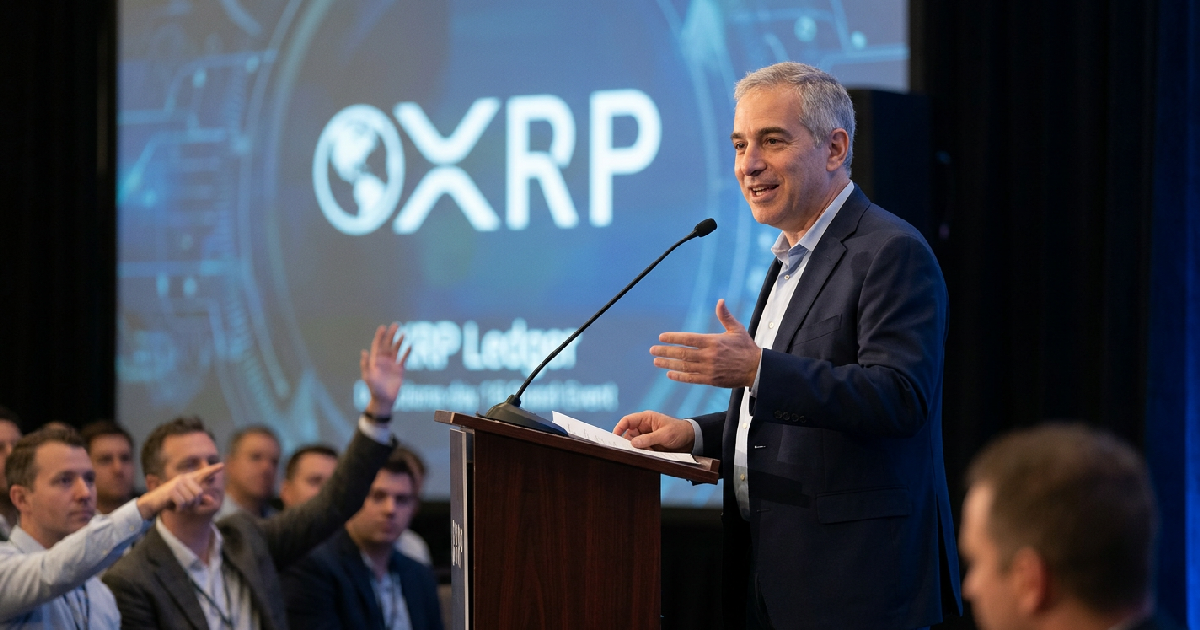

Ripple Chief Technology Officer Emeritus David Schwartz has addressed the long-standing debate regarding whether the XRP Ledger (XRPL) could survive a direct, physical assault by a powerful authoritarian state. During a recent technical discussion on May 31, 2026, Schwartz noted that while intelligence services could theoretically cause local disruptions by raiding validator nodes, long-term control over the network remains effectively impossible. He suggested that if the pressure reached a terminal stage, the community could technogically pivot to maintain operations underground.
The “XRP to Tor” concept, which has circulated in recent headlines as a “Doomsday” protocol, involves moving the network’s infrastructure behind anonymous layers like Tor and I2P. Schwartz indicated that if validators were physically targeted, they could transition to an anonymous status, and the software’s inherent flexibility would allow the community to replace compromised nodes from the dUNL list of trusted validators. This type of adaptability has historically driven XRP speculative activity during periods of heightened regulatory or technical scrutiny.
Infrastructure resilience in the face of state pressure
The core of this theoretical defensive strategy is a radical shift in how the ledger handles consensus during a crisis. If state-level interference led to the arrest of node operators, Schwartz described a scenario where the XRPL could adopt a two-layer structure. This would involve high-performance nodes processing current transactions that could be automatically replaced by reserves if a seizure occurred. The second layer would consist of an ultra-light governing committee, operating through anonymizers, that would only activate periodically to adjust the network’s validator list.
Schwartz argued that the network will continue to live and evolve so long as even one developer remains interested in maintaining its code. He highlighted that the system is designed to treat compromised nodes essentially as bugs to be patched, effectively rotating them out of the active network. This emphasis on survival aligns with legislative shifts such as when the CLARITY Act advances, prompting developers to double down on the decentralization and persistence of blockchain payment rails.
Adaptability and the Bitcoin consensus comparison
To put the network’s potential “DNA” rewrite into perspective, Schwartz drew a parallel to Bitcoin’s structural resilience. He posed a rhetorical question: if an unfixable fatal flaw were discovered in Bitcoin’s Proof-of-Work algorithm, would the asset simply die? His conclusion was that the community would likely burn the old rulebook and migrate to a Proof-of-Stake model to ensure survival. According to Schwartz, the XRPL possesses a similar “survival instinct,” allowing it to accept tectonic changes to its positioning if the external environment becomes sufficiently hostile.
This focus on long-term sustainability comes as Schwartz has taken on a more strategic role, having transitioned to CTO Emeritus at the end of 2025 and joined the Ripple board of directors. During his tenure, he has frequently guided the community toward technical realities rather than speculation. For example, Schwartz recently joined the XRPL Foundation to better support wallet adoption and network health, emphasizing that the ledger’s true strength lies in its independence from any single centralized authority.
Future-proofing the ledger against quantum threats
Beyond resisting political interference, Ripple is actively preparing the XRPL for future technological shifts. On April 20, 2026, the company published a four-phase roadmap aimed at achieving full post-quantum cryptography by 2028. This plan includes an emergency protocol—referred to as “Q-Day preparedness”—intended to block classical signatures and force a migration to quantum-safe accounts if current cryptographic standards are compromised earlier than expected.
Despite the “Doomsday” framing often seen in social discussions, Schwartz remains a vocal critic of secret government theories. In a live audio broadcast on April 24, 2026, he dismissed speculation that XRP is part of a hidden central bank master plan, stating plainly that there is “no secret plan.” Instead, he maintains that the network’s survival rests on transparent, developer-led evolution and the ability to go underground technologically if the “break glass” scenario ever becomes a reality.