
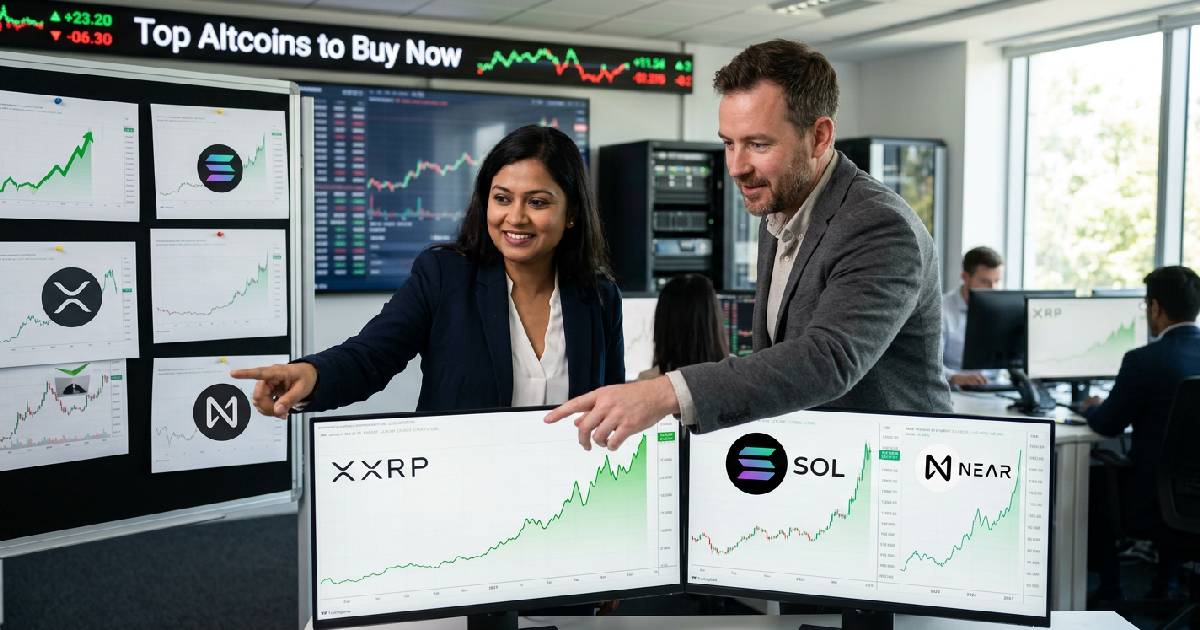

Cryptocurrency analyst Debashree Patra and Real Vision Chief Crypto Analyst Jamie Coutts have identified a select group of digital assets, including XRP, Solana (SOL), and Near Protocol (NEAR), as primary candidates for accumulation during the current market correction.
While Bitcoin struggles to maintain a bullish structure, these experts suggest that capital is increasingly rotating into projects with verifiable on-chain activity and institutional utility. The data highlights a growing divergence between speculative tokens and those with established ecosystems or legislative tailwinds.
The broader crypto market has faced sustained pressure in early June 2026, driven by a combination of profit-taking from large investors and sustained outflows from Bitcoin exchange-traded funds. Additional liquidity drain has occurred as technology and semiconductor stocks hit record highs in traditional markets, pulling capital away from the digital asset space.
According to Jamie Coutts, the market has remained in a downtrend since January 2026, with the recent 25% to 30% rally behaving more like a typical bear market bounce than a definitive reversal.
XRP (XRP) has emerged as a top pick for June 2026, largely due to strong spot ETF inflows and growing momentum around the CLARITY Act. Analysts view the token as undervalued, noting that it has lagged behind other altcoin rallies despite its improving regulatory standing in the United States. While the com/bitcoin-price-77000-market-confidence-geopolitics-2026-analysis/”>market monitors geopolitical shifts that often trigger volatility, XRP’s case is strengthened by recent tokenization initiatives on the XRP Ledger, which signal growing real-world utility.
Institutional interest targets high-utility blockchain ecosystems
Solana (SOL) continues to attract significant institutional attention as it prepares for the Alpenglow upgrade. This upcoming network improvement is expected to bolster the network’s appeal alongside rising ETF demand. An unnamed analyst suggested that investors look for parallels between Solana’s historical recovery from the 2022 bear market and the current trajectory of Sui (SUI).
Sui’s developing network and expanding user base have positioned it as a candidate that could follow a similar path from extreme lows to new highs.
Ethereum (ETH) remains a core recommendation for long-term portfolios due to its dominance in stablecoins, DeFi, and tokenized real-world assets. As major upgrades progress and financial activity migrates on-chain, Ethereum’s ecosystem remains a focal point for institutional investors. Experts suggest that while Bitcoin provides a safety net for portfolios, Ethereum, Solana, and XRP offer diversified exposure to the underlying infrastructure of the digital economy.
Hedera (HBAR) and Stellar Lumens (XLM) are also positioned to benefit from future capital rotations. Hedera is favored for its enterprise adoption stories, while Stellar has already shown outperformance due to tokenization developments. These assets reflect a shifting market structure where investors prioritise projects showing measurable growth in business use cases over purely speculative volume.
Infrastructure and AI protocols lead through revenue metrics
The intersection of artificial intelligence and blockchain has placed Near Protocol (NEAR) at the forefront of market interest. NEAR has climbed nearly 190% from its recent lows, driven by its work on AI infrastructure and interoperability. Jamie Coutts highlighted the protocol’s progress in solving cross-chain challenges, which positions it for future AI-driven applications.
This strength persists even as analysts forecast late-2026 breakout potential for the broader sector once current consolidation ends.
Revenue-generating protocols like Hyperliquid (HYPE) are gaining traction as fundamental triggers for price appreciation. Hyperliquid reportedly generated approximately $50 million in fees over the past month, a figure that validates its utility in a crowded market. The platform’s mechanism of burning HYPE tokens also creates a deflationary effect that strengthens its token economics.
Such performance metrics provide a concrete basis for valuation that many peers lack.
Similarly, Render (RNDR) continues to capitalize on the demand for GPU rendering services, generating roughly $8 million in annual revenue. Along with projects like Ondo Finance (ONDO), which gained over 114% from February lows through its focus on real-world asset (RWA) tokenization, these protocols represent a “utility-first” investment thesis.
Experts suggest that while the market bottom may not yet be confirmed, accumulation of these assets during periods of fear often precedes the most significant gains in the next cycle.
Market indicators require caution despite accumulation signals
Jamie Coutts has expressed caution regarding the “bear market” status of the current environment, noting that Bitcoin failed to break and hold the mid-$80,000 range. Activity across most major blockchains has weakened, though stablecoin transfers remain a notable exception to the negative growth trend.
This lack of broad-based on-chain growth suggests that while certain altcoins are showing early strength, the overall market requires a more definitive shift in liquidity to confirm a new bull phase.
The current correction follows a period where Bitcoin rallied 40% from its lows before large-scale investors began extracting profits. This volatility is a reminder that Bitcoin targets specific support levels such as $70,000 to maintain its structural integrity.
Until the broader market stabilizes, the focus for many remains on selective entries into fundamentally sound altcoins like NEAR, XRP, and Solana, rather than broad exposure to the wider speculative market.