
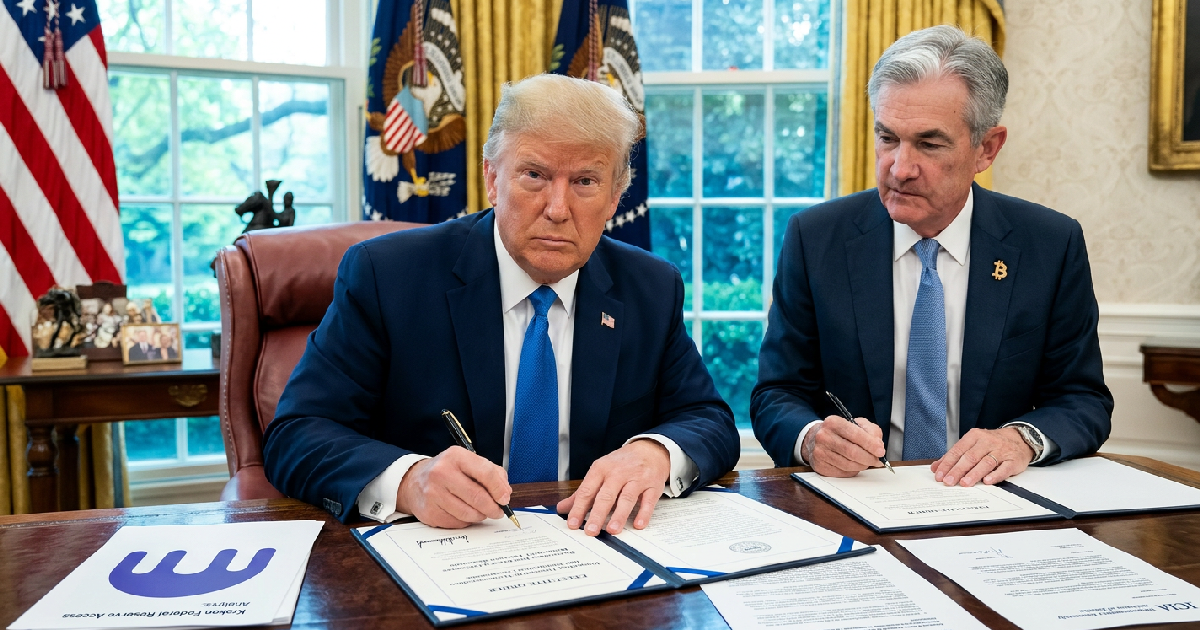

President Donald Trump signed an executive order on Tuesday, May 19, 2026, directing the Federal Reserve and other financial regulators to dismantle barriers that prevent cryptocurrency and fintech firms from accessing the U.S. payment system. The directive, titled “Integrating Financial Technology Innovation into Regulatory Frameworks,” requires federal agency heads to audit existing rules within three months to identify regulations that “unduly impede” fintech firms from partnering with federally regulated institutions.
The order sets a strict timeline for the central bank, giving regulators six months to act on the findings of their audit. This move places the Federal Reserve at the center of a long-standing conflict over who should have direct access to the nation’s financial plumbing. Historically, these gateways have been limited to traditional banks, forcing many digital asset companies to operate on the fringes of the system.
At the heart of the order is the Federal Reserve’s control over master accounts. These accounts serve as the primary entry point to payment rails like Fedwire, which handle high-value dollar settlements. Because these accounts have traditionally been reserved for licensed depository institutions, crypto firms have often been forced to pursue expensive state or federal banking charters to gain similar access.
Trump challenges Federal Reserve control over payment rails
The executive order specifically asks the Federal Reserve to evaluate whether its current framework can be extended to include non-bank fintech and crypto companies. Such a change would allow these entities to settle transactions directly through the central bank. This is a significant shift for an industry that has frequently seen its bitcoin price analysis and market stability impacted by the difficulty of moving funds between digital and traditional systems.
A second major requirement of the order is for the Federal Reserve to clarify the authority of its 12 regional banks. President Donald Trump has tasked the central bank with determining if these regional branches can independently approve or deny master account applications. Without clear direction from the Board of Governors in Washington, crypto firms might seek out specific regional branches perceived as more friendly to the industry.
This concern is not theoretical. In March, the Kansas City Fed approved a limited-purpose account for Payward, the parent company of the crypto exchange Kraken. This made Kraken the first crypto exchange to secure any form of Federal Reserve payment access. Kraken Co-CEO Arjun Sethi described the move as the “convergence of crypto infrastructure and sovereign financial rails,” highlighting how closer integration could bridge the gap between digital assets and traditional finance.
Banking groups warn of significant regulatory gaps
The move toward including crypto firms in federal payment rails has met resistance from traditional financial institutions. The Bank Policy Institute, which represents large U.S. banks, expressed deep concern over the timing of the Kraken approval. They noted that the decision occurred before the Federal Reserve had finalized a broader, unified policy framework for such access.
Rebecca Romero Rainey, president and CEO of the Independent Community Bankers of America (ICBA), said the order exposes “significant gaps in regulation” between traditional banks and non-bank entities. She argued that the Federal Reserve should pause any new policies regarding stablecoins, master accounts, and trust charters to assess their combined impact. “Like activities should be subject to like regulation,” she said, echoing a common sentiment among community bankers.
The debate comes as some financial institutions in Europe are already ramping up their crypto involvement. For instance, Italy’s largest bank exceeds $200M in Bitcoin exposure through ETFs, illustrating that traditional finance is already finding ways to interact with digital assets despite the regulatory hurdles in the United States.
The Federal Reserve and the “skinny” account proposal
In response to the growing pressure for access, the Federal Reserve previously published a proposal in December for “skinny” master accounts. These restricted accounts would provide access to the payment system but would not offer features like interest on reserves or the ability to borrow from the discount window. However, this proposal has faced criticism from both sides, with the crypto industry and community banks pushing the rules in opposite directions.
The executive order now imposes a political clock on this deliberative process. The Federal Reserve has 120 days to deliver a formal report to the White House regarding its progress and findings. This deadline transforms a slow-moving regulatory discussion into a high-priority mandate from the administration, potentially testing the independence of the central bank.
As the administration pushes for modernization, it must balance these goals with the stability of the existing financial system. Supporters believe that integrating crypto into the payment rails will streamline the economy. Meanwhile, traditional bank representatives maintain that skipping full banking supervision for fintech firms could introduce new risks into the U.S. financial framework.