
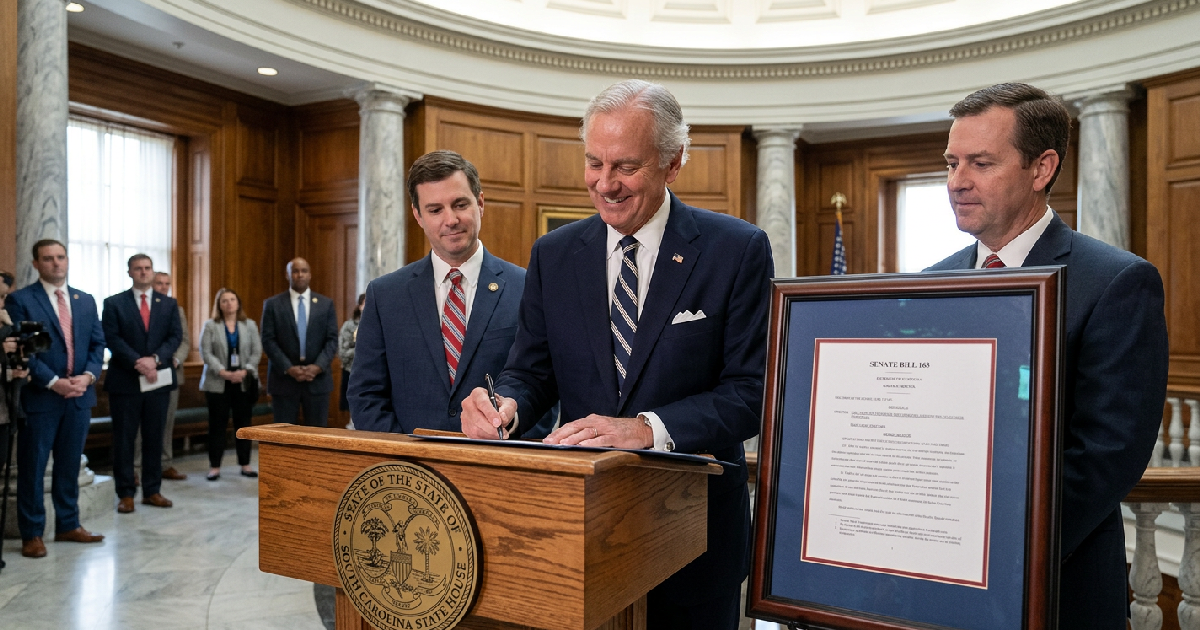

Governor Henry McMaster signed Senate Bill 163 (S.163) into law on May 19, 2026, establishing a new regulatory framework that prohibits South Carolina state entities from using central bank digital currencies. The legislation also provides sweeping protections for digital asset mining and self-custody. Sponsored by Senator Daniel “Danny” Verdin and Senator Matthew “Matt” Leber, the law adds a new Chapter 47 to Title 34 of the state code, making South Carolina a key battleground in the push against federal digital currency initiatives.
The move comes at a time when several states are asserting authority over digital assets as investor sentiment shifts toward decentralized alternatives. South Carolina’s approach handles two goals at once: it blocks federal oversight through digital currencies while creating an environment meant to attract industrial blockchain infrastructure. The law explicitly defines Central Bank Digital Currency (CBDC) as any digital currency issued directly by the U.S. Federal Reserve or a federal agency.
State entities barred from central bank digital currency use
The primary function of S.163 is to prevent any state agency, board, commission, or department from requiring or accepting payments in CBDC. Furthermore, state governing authorities are now legally prohibited from participating in any CBDC testing conducted by the Board of Governors of the Federal Reserve System. This effectively prevents the state from becoming a testing ground for federal digital financial products. However, the law makes a clear distinction for private digital assets. The definition of CBDC specifically excludes digital assets backed by legal tender or government treasuries that are issued by a private entity, such as treasury-backed stablecoins. This allows South Carolina businesses to continue using and accepting stablecoins while resisting a state-managed federal digital dollar.Protections for digital asset mining and self-custody
Beyond its anti-CBDC stance, the law provides robust legal safeguards for individuals and businesses engaging in the crypto economy. It prevents any state or local prohibition against using self-hosted or hardware wallets for self-custody. Additionally, local governments cannot stop businesses from accepting digital assets as payment for goods and services. This legislation also addresses how these assets are treated at the till. Digital assets used for payment are exempt from any additional taxes or charges based solely on the currency medium. While transactions remain taxable, the rate applied must be identical to that used for U.S. legal tender. This ensures that legislative progress at the state level provides parity for digital asset users.New standards for South Carolina crypto mining operations
The law provides specific guidelines for industrial-scale mining. Local governments are now prohibited from restricting mining operations in industrial zones or imposing sound limits that are stricter than general area noise regulations. In exchange for these protections, mining businesses must ensure they do not place undue stress on the electrical grid. Under S.163, mining companies must provide the Public Service Commission (PSC) with a copy of their power purchase agreements when requested. This is to prove they can reduce power consumption during times of high grid stress. Meanwhile, individuals participating in mining or node operations win exemptions from certain money transmitter licenses. The legislation also provides seven essential legal definitions to clarify the scope of the new rules. According to the official text, Chapter 47 now provides statutory definitions for:- Blockchain
- Digital assets
- Crypto mining
- Staking
- Wallets
- Nodes
- Central Bank Digital Currency (CBDC)