

Securities and Exchange Commission (SEC) Commissioner Hester Peirce has used her farewell address, titled “Peirce Out,” to challenge the agency’s current strategy regarding digital asset regulation. The address, recently published by the SEC, highlights a deep-seated divide over whether the regulator should prioritize enforcement actions or establish a clearer rulemaking framework for the cryptocurrency industry.
Peirce confirmed she will transition out of her role to join the faculty at Regent University School of Law in November 2026.
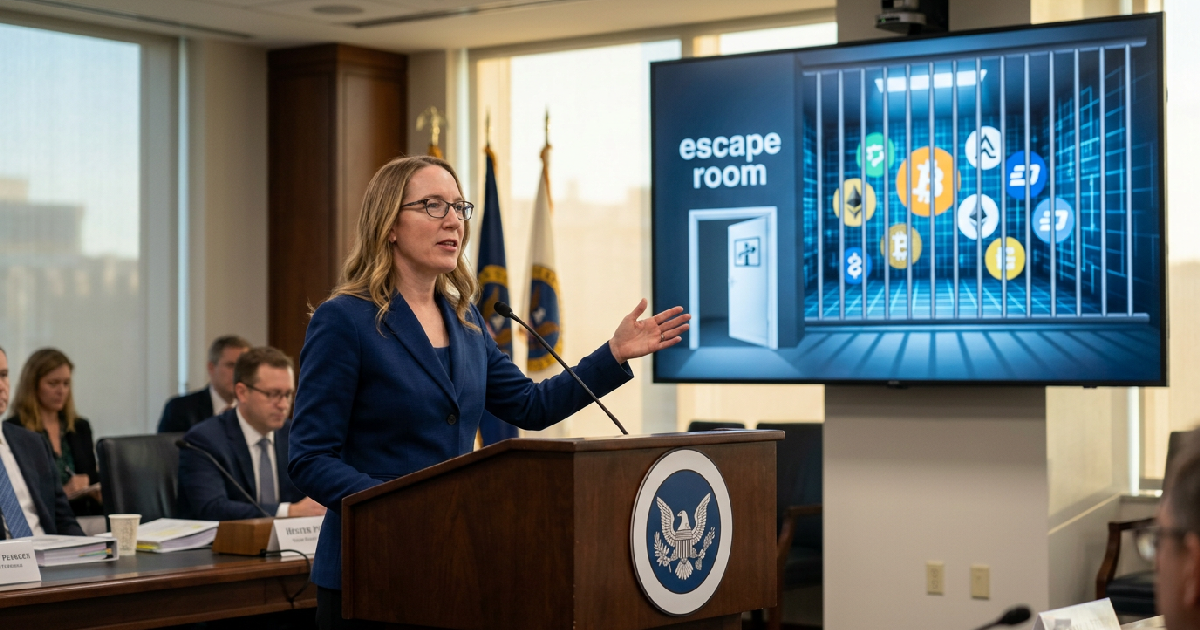
Widely recognized by the industry as “Crypto Mom” for her open stance on digital asset innovation, Hester Peirce compared the current regulatory environment to an “escape room.” She argued that builders and investors are often forced to navigate a system where rules are unclear and risks are defined primarily by the threat of litigation.
This friction comes at a time when policy is still being debated through a mix of court rulings and Bitcoin signals market structure shifts that demand more definitive guidelines.
The departure of Commissioner Hester Peirce marks a significant shift for the SEC, as the industry loses one of its most consistent internal advocates for reform. While her speech does not immediately alter existing policy, it underscores the ongoing tension between regulators and the private sector.
The upcoming transition raises questions about who will fill her seat and whether the agency’s posture will soften or become more rigid in her absence.
Hester Peirce critiques the SEC enforcement-led approach
During her tenure, Commissioner Hester Peirce has remained a vocal critic of what she describes as a reliance on enforcement rather than transparent rulemaking. In her “Peirce Out” address, she noted that the lack of clear pathways for registration and compliance has hindered legitimate innovation within the United States.
She suggested that rather than fostering a safe environment, the current “escape room” dynamic creates unnecessary hurdles for firms attempting to operate legally.
Traders and institutional investors are watching these developments closely, as the regulatory tone can influence everything from listing risks to the approval of new financial products. Institutional flows have become a critical factor in how Bitcoin and large-cap assets are priced. Consequently, movements in SEC leadership often impact Bitcoin price stabilization and market confidence as participants gauge the likelihood of a more favorable compliance environment.
The “Crypto Mom” moniker reflects the industry’s hope for a regulator who understands the technical nuances of blockchain. Hester Peirce has repeatedly called for a framework that addresses custody, stablecoins, and tokenized securities. Without such clarity, proponents argue that the U.S. may lose its competitive edge to international jurisdictions that are moving faster to integrate digital assets into their financial systems.
Transition to Regent University School of Law scheduled
While the “Peirce Out” speech serves as a formal farewell, Hester Peirce is not vacating her post immediately. She expects to remain in a holdover capacity at the SEC until she joins the faculty at Regent University School of Law in November 2026. This timeline provides a window for the administration and the Senate to identify and vet a successor for her five-member commission seat.
The SEC’s internal views on crypto will likely be the most scrutinized aspect of the appointment process for her replacement. Historically, the commission has been divided on whether digital tokens should be classified as securities under decades-old laws. This disagreement has led to high-profile legal battles, occasionally causing ripples where com/bitcoin-supply-on-exchanges-bitcoin-exchange-supply-six-year-low-binan/”>Bitcoin supply on exchanges drops as users move assets toward self-hosted wallets or other venues to mitigate regulatory risk.
Market implications of a leadership void
The absence of Hester Peirce’s dissenting voice could embolden the commission to continue its enforcement-heavy strategy. For many market participants, her presence provided a counterbalance to the agency’s chair-led initiatives. Her departure creates a vacuum of specialized technical support for the crypto sector, which could slow down the pace of regulatory approvals for innovative exchange-traded products or custody solutions.
Investors are now focusing on the broader operating environment, where primary-source developments like SEC transcripts carry more weight than speculative rumors. The focus remains on whether the “escape room” Peirce described will eventually be replaced by a more predictable legal structure. For now, the crypto industry must prepare for a landscape without its most prominent ally within the federal government’s top securities watchdog.