

Blockchain has long been associated with digital assets. It records cryptocurrency transactions, supports decentralised finance and allows smart contracts to execute automatically without intermediaries. But one question has become increasingly important as the technology has matured: can blockchain coordinate something beyond digital networks?
That question sits at the heart of Decentralised Physical Infrastructure Networks, better known as DePIN.
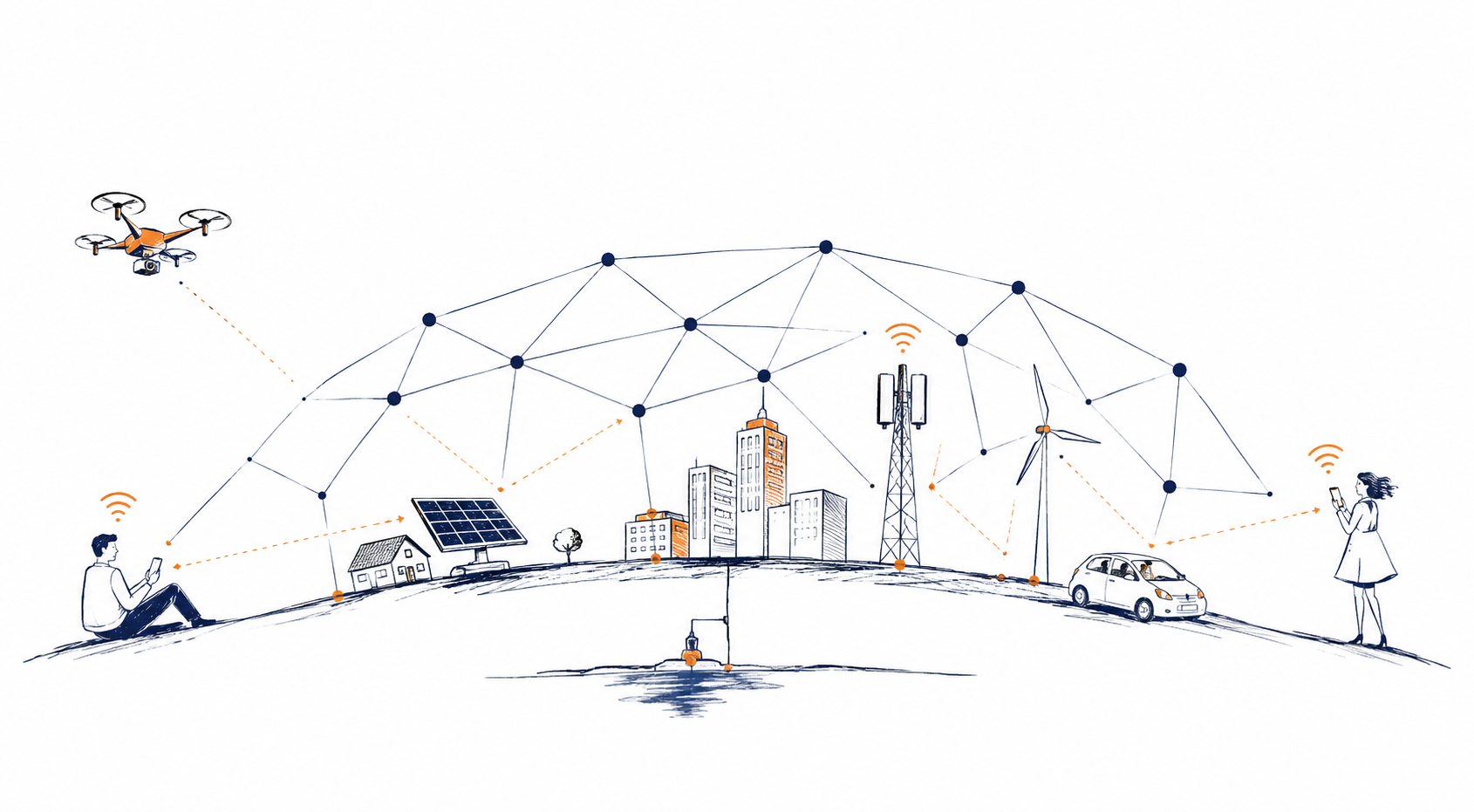
Rather than creating another financial application, DePIN projects aim to organise real-world infrastructure through decentralised participation.
Storage capacity, wireless coverage, computing power and mapping data, resources traditionally built and managed by large companies, can instead be provided by thousands of independent contributors, each rewarded for supplying useful hardware or services.
The idea is ambitious because it moves blockchain into a space that has historically depended on significant capital, complex logistics and centralised ownership.
The industries DePIN is trying to rethink
Most digital services rely on physical infrastructure that users rarely notice.
Cloud storage depends on servers housed in data centres. Video calls travel through networks of communication equipment spread across different regions. Artificial intelligence workloads require powerful graphics processors capable of handling enormous volumes of data. Online maps are constantly updated through vast collections of geographical information.
Although these services feel digital, they all depend on expensive physical assets that must be purchased, installed and maintained.
For decades, that economic reality has favoured large organisations. Building global infrastructure requires substantial upfront investment, specialised expertise and the ability to expand capacity as demand increases.
As a result, sectors such as cloud computing, telecommunications and data infrastructure have become concentrated among relatively small numbers of providers.
That concentration brings obvious advantages. Central operators can standardise hardware, maintain consistent service levels and respond quickly when problems occur. For many businesses, reliability matters far more than the ownership model behind the infrastructure.
Yet centralisation also introduces trade-offs.
When one organisation controls the underlying infrastructure, it also controls pricing, network expansion, operational policies and, in many cases, access to the service itself. A technical outage, cyberattack or business failure affecting a single operator can also disrupt millions of users simultaneously.
DePIN is not built on the assumption that centralised infrastructure is inherently flawed. Instead, it asks whether some forms of infrastructure could be coordinated differently, allowing ownership and operation to become more widely distributed without sacrificing functionality.
That distinction is important because DePIN is not trying to eliminate physical infrastructure. It is attempting to decentralise who provides it.
From building infrastructure to coordinating participants
The most significant innovation behind DePIN is not new hardware. It is a different method of organising existing resources.
Traditionally, infrastructure grows because a company invests capital to acquire equipment, deploy it across multiple locations and operate the network itself. Every server, antenna or processing unit belongs to the same organisation, which remains responsible for maintenance and expansion.
DePIN reverses that relationship.
Instead of asking one company to purchase all the necessary equipment, the network invites individuals and businesses to contribute resources they already own — or choose to acquire independently. Those participants receive token-based rewards when their hardware provides useful services according to the network’s rules.
Blockchain plays an important role, but not necessarily the one many people expect.
Rather than acting as the service itself, the blockchain functions as a coordination layer. It records contributions, verifies activity and distributes rewards without relying on a central administrator. Participants who supply storage space, computing power or wireless connectivity are compensated automatically when they meet the protocol’s requirements.
The infrastructure, however, remains entirely physical.
Someone still needs to install a wireless hotspot on a rooftop. Storage devices must remain online. Graphics processors consume electricity while performing computational tasks. Unlike many blockchain applications that exist entirely within software, DePIN networks rely on equipment operating continuously in the real world.
This subtle distinction explains why DePIN has attracted attention beyond the cryptocurrency industry.
Many blockchain projects aim to decentralise digital services that already exist online. DePIN, by contrast, attempts to decentralise ownership of the physical infrastructure that makes many digital services possible in the first place.
In other words, blockchain becomes less visible to the end user. The technology operates behind the scenes, while the service people actually use remains something tangible: internet coverage, cloud storage, computing capacity or real-world data.
That shift changes how blockchain is evaluated. Rather than asking whether the protocol is technically innovative, users are more likely to ask a simpler question: does the infrastructure perform as well as the traditional alternative?
The answer depends not only on software, but also on thousands of independent participants choosing to keep contributing resources over time.
The biggest obstacle isn’t blockchain but the physical world
Many newcomers assume the technical complexity of DePIN lies in the blockchain itself.
In reality, blockchain is often the simplest part of the equation.
Modern blockchains are already capable of processing transactions, executing smart contracts and distributing rewards with a high degree of reliability. While technical improvements continue, these functions are relatively well understood.
The harder challenge begins once software interacts with physical infrastructure.
Unlike purely digital networks, DePIN depends on hardware that can fail, disconnect or require maintenance. Storage servers may go offline unexpectedly. Wireless hotspots can lose coverage because of poor installation or local interference. Computing hardware eventually becomes outdated and consumes electricity that carries real operating costs.
None of these issues can be solved by blockchain alone.
This creates an important distinction between decentralising governance and decentralising infrastructure.
A blockchain network can often continue operating even if some validators leave the system, provided enough participants remain to secure consensus. A DePIN network, however, depends directly on whether sufficient physical resources continue to exist where users actually need them.
For example, a wireless network offers little value if hotspots are concentrated in only a handful of locations. Likewise, a decentralised storage platform cannot compete effectively if too few providers remain available to guarantee reliable access to data.
The protocol may continue functioning exactly as designed while the underlying service gradually becomes less competitive.
That makes operational execution just as important as cryptographic design.
The real test will happen outside the crypto industry
Much of the discussion surrounding DePIN focuses on decentralisation, token incentives and blockchain architecture. Those elements certainly matter, but they are unlikely to determine whether these networks achieve widespread adoption.
End users rarely choose infrastructure because it is decentralised.
They choose it because it is reliable, affordable and easy to use.
For DePIN projects, that means competing with industries that have spent decades refining operational efficiency. Cloud providers offer predictable uptime. Telecommunications companies maintain extensive support networks.
Traditional infrastructure operators benefit from economies of scale, established supply chains and long-term customer relationships.
Matching those standards requires far more than distributing tokens.
Economic incentives must remain attractive enough to encourage participants to provide hardware over the long term, without making the network financially unsustainable. At the same time, service quality needs to remain consistent even though infrastructure is owned by thousands of independent operators with varying levels of technical expertise.
Regulation also introduces additional complexity. Questions around liability, data governance and infrastructure standards become more complicated when no single organisation controls the network. Responsibilities that are straightforward in centralised systems may become significantly harder to define in decentralised ones.
These challenges do not mean the model is fundamentally flawed. Rather, they highlight that decentralising physical infrastructure is inherently more difficult than decentralising software.
That distinction is often overlooked in conversations about DePIN.
Blockchain can coordinate participants efficiently, but it cannot repair faulty hardware, replace broken equipment or guarantee that enough contributors will continue supporting the network in every location where demand exists.
Ultimately, DePIN’s success will not be measured by the number of protocols launched or the size of their token ecosystems. It will be judged by something much simpler: whether people and businesses willingly choose these services over established alternatives.
If decentralised infrastructure becomes so dependable that users barely notice the blockchain operating beneath it, DePIN will have achieved its original goal. If, however, the decentralisation itself remains the main selling point, the sector may struggle to move beyond crypto-native audiences.
In that sense, the future of DePIN is likely to be decided not on-chain, but in server rooms, on rooftops, inside vehicles and anywhere else real infrastructure must prove that it can deliver the same reliability people already expect from the centralised world.