
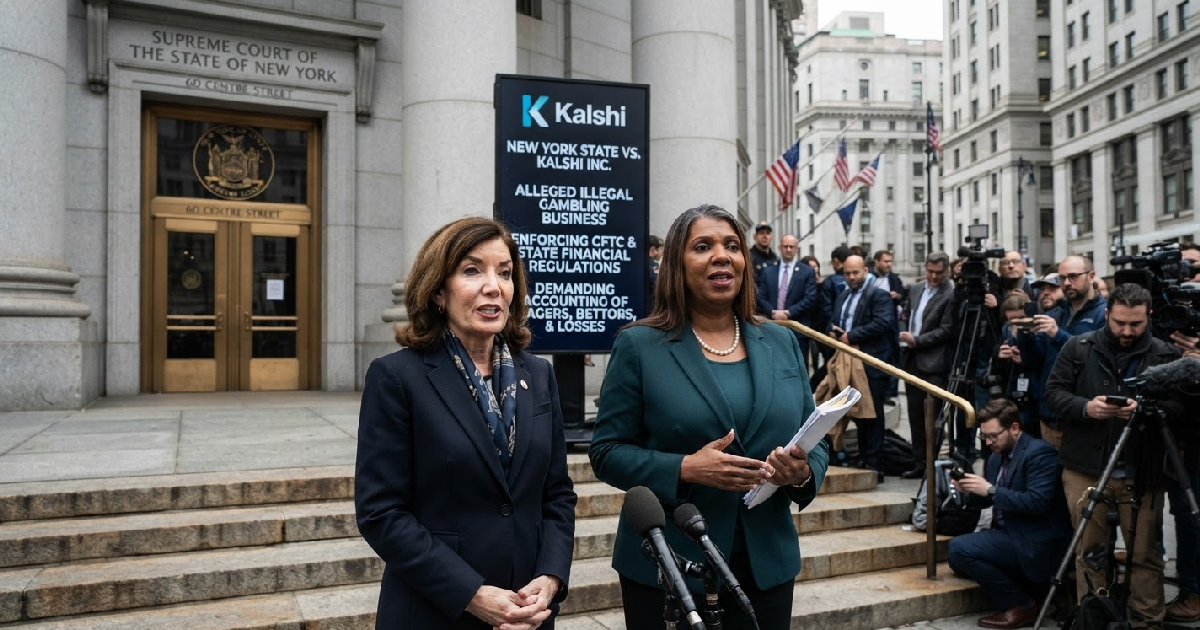

New York State has launched a new lawsuit against prediction market platform KalshiEX, LLC (Kalshi), alleging the New York City-based company operates an illegal, unlicensed gambling business within the state. Filed on Friday, July 31, 2026, in a Manhattan state court, the action, led by Governor Kathy Hochul and Attorney General Letitia James, seeks to halt Kalshi’s operations in New York. They also aim to compel an accounting of customer wagers and restitution for affected users.
The state accuses Kalshi of offering prediction markets on events like sports, elections, and cultural outcomes without a state gambling license. This move marks an escalation in the ongoing regulatory dispute over whether federal commodities oversight shields prediction markets from individual state gambling laws.
New York pursues Kalshi wager accounting
New York’s legal filing outlines aggressive demands beyond just an injunction against Kalshi’s activities. The verified petition asks the court to order Kalshi to identify affected customers and itemize their wagers, losses, and the company’s gains. The state also seeks customer restitution, damages, disgorgement, prejudgment interest, and costs.
The most aggressive demands within the petition include a penalty equal to three times Kalshi’s alleged gains and $100,000 for each unauthorized offer or attempt to offer sports wagering or mobile sports wagering within or from New York. It’s crucial to note that these financial remedies are requests in a petition, not adjudicated facts or awarded sums. The petition provides neither an adjudicated gain figure nor a count of covered offers, making any aggregate estimate of Kalshi’s potential exposure speculative.
The filing also points to Kalshi’s scale, citing a $22 billion valuation and $178 billion in annualized transaction volume. These numbers came from Kalshi’s May fundraising announcement and are company-reported metrics, not audited findings by New York.
Federal preemption battle continues for prediction markets
This latest state action follows a contentious regulatory path for Kalshi, which launched in 2021 and began offering sports “trading” in 2025. The core of Kalshi’s defense against state prohibitions rests on its assertion of federal regulatory preemption.
Kalshi contends that its status as a federally regulated exchange under the Commodity Futures Trading Commission (CFTC), chaired by Michael Selig, should shield it from state gambling laws. This argument sets up a critical legal showdown with broad implications for the burgeoning prediction market industry.
The New York State Gaming Commission issued a cease-and-desist demand to Kalshi in October 2025 over alleged unlicensed mobile sports wagering. Kalshi responded by suing state officials in federal court, a legal challenge that remains pending.
On July 7, the U.S. District Court for the Southern District of New York denied Kalshi’s request for temporary and preliminary protection from state enforcement. The judge found that all four factors governing preliminary relief weighed against the company.
That ruling was an interim decision, not a final judgment on Kalshi’s preemption claims. Kalshi opened an interlocutory appeal in the Second Circuit on July 8, leaving the broader federal dispute unresolved while New York presses its separate state action.
Kalshi spokesperson Elisabeth Diana called New York’s lawsuit “political theater.” She also said in a statement reported by the Associated Press that states cannot shut down a federally licensed exchange. This directly contrasts with the state petition, which asks a court to reach the opposite practical result for Kalshi’s New York operations.
Broader implications for crypto regulation
The unfolding legal drama in New York casts a long shadow over the future of prediction markets. It particularly affects those, like Kalshi, co-founded by Tarek Mansour and Luana Lopes Lara, that delve into real-world events.
Attorney General Letitia James brought the case under Executive Law Section 63(12), which allows the state to pursue alleged repeated or persistent illegality. This highlights the state’s intent to use all available legal avenues against what it views as unlicensed operations.
For now, Kalshi’s ability to keep serving New Yorkers is a contested legal question. The immediate risk is concrete: New York is seeking an order that would stop the activity, force a detailed accounting of customer wagers, and attach potentially large penalties to conduct the state alleges was unauthorized.