
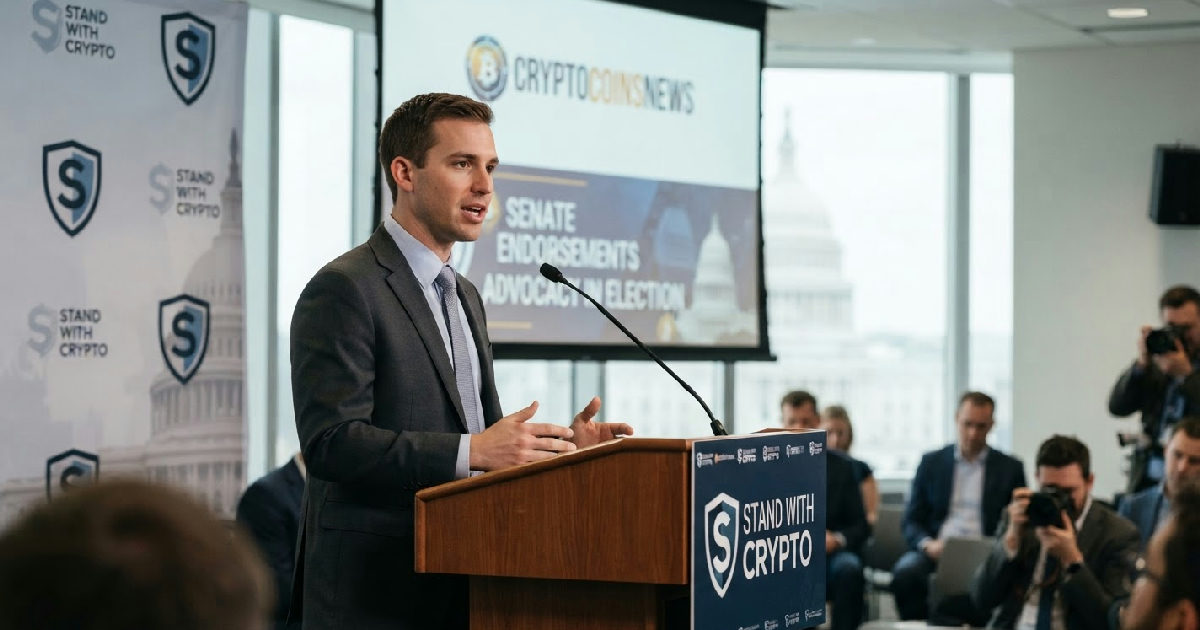

The Coinbase-backed advocacy group Stand With Crypto announced its first round of Senate endorsements on Wednesday, a direct pivot toward electoral politics following the narrow failure of a landmark crypto regulation bill. This move, widely reported by cryptocoinsnews outlets, signals an aggressive new phase in the industry’s campaign for clear rules, targeting key political races to build a more favorable legislature.
This strategic shift comes just weeks after the Digital Asset Market Clarity (CLARITY) Act stalled in the Senate on September 15, falling one vote short of advancing.
Cryptocoinsnews reports on the Clarity Act’s failure
In a statement, Stand With Crypto’s executive director, Mason Lynaugh, said the group’s more than three million members are now shifting their focus to ensuring “pro-crypto champions” are in office. The group’s influence is notable, given the significant resources available for things like Coinbase corporate payments and other ventures.
The endorsement strategy is a direct consequence of the legislative disappointment on September 15. The Clarity Act, which aimed to create a comprehensive regulatory framework for digital assets in the United States, failed to secure the 60 votes needed to overcome a procedural cloture vote. The final tally was a stark 49-50, a major setback for an industry that has long sought legal certainty.
The bill’s defeat was attributed to a mix of partisan politics and specific policy objections. Senate Democrats largely refused to support the legislation, citing concerns that it could personally benefit President Donald Trump due to his reported income from digital asset ventures.
Senator Cory Booker was among those who stated he could not support a bill without stronger ethics provisions. Furthermore, the bill faced opposition from community banking groups over provisions that would have allowed stablecoin issuers to compete with traditional bank deposits.
The White House expressed its frustration with the outcome. Patrick Witt, a crypto adviser to the administration, called the vote a “major disappointment” and warned that the failure to act could cede leadership on global financial standards to “Brussels or Beijing, rather than Washington and New York.”
With the bill stalled indefinitely, the Securities and Exchange Commission (SEC) and Commodity Futures Trading Commission (CFTC) are expected to continue defining policy through enforcement actions and existing rulemaking authority, a situation the industry finds untenable.
Targeting key senate and house races
Stand With Crypto’s initial endorsements focus on critical races where the outcome could influence future legislative efforts. The group is backing Republican Senator Jon Husted in Ohio, who is challenging the crypto-skeptical former Senate Banking Committee Chair Sherrod Brown. This matchup represents a clear test of the crypto lobby’s ability to unseat a powerful incumbent who has been critical of the industry.
In addition to the Ohio race, the group endorsed Ashley Hinson in Iowa and Chris Pappas in New Hampshire, broadening its support across different regions. The organization is also increasing its investment in House races. After endorsing over 30 candidates last month, it added Rep. Shomari Figures of Alabama and Rep.
Mariannette Miller-Meeks of Iowa to its list. This move is part of a larger push to secure a solid base of support in both chambers of Congress, expanding beyond simple financial infrastructure to political infrastructure.
The group also announced it would increase advertising spending in six House contests, supporting incumbents like Democratic Rep. Don Davis and Republican Rep. Bryan Steil.
A key unifying factor among all the newly endorsed House candidates is their previous vote in favor of the Clarity Act when it passed the lower chamber in July 2025 with a bipartisan 294-134 vote. This demonstrates a clear litmus test for receiving the group’s support.
Stand with crypto’s growing political influence
Launched by the crypto exchange Coinbase in 2023, Stand With Crypto has rapidly grown into a significant political force. The non-profit organization claims an online membership of over three million U.S. advocates, a base it aims to mobilize through its candidate scorecards and a dedicated voter information hub.
The crypto industry’s political spending has become a major factor in recent elections. In 2024, the super PAC Fairshake reportedly spent $12 million in Ohio to support the successful campaign of crypto-friendly Republican Bernie Moreno, who defeated Sherrod Brown. This demonstrated the financial power that pro-crypto groups can bring to bear in a tight race.
However, the political landscape remains complex. Fairshake had previously backed two Senate Democrats, Ruben Gallego and Elissa Slotkin, both of whom ultimately voted against advancing the Clarity Act. This highlights the challenge for single-issue advocacy groups in navigating partisan divides.
By endorsing candidates directly and running targeted ad campaigns, Stand With Crypto is adopting a more direct approach to building a reliable coalition for when it comes time to manage crypto model portfolios within a regulated environment.
The regulatory path forward without federal legislation
Without a federal framework like the Clarity Act, the U.S. crypto market remains in a precarious position. The bill was designed to resolve long-standing questions over which agency has primary oversight of the market—the SEC or the CFTC. It also included foundational rules for stablecoins and the tokenization of real-world assets, areas where regulatory clarity is desperately needed.
In the absence of new laws, companies must continue to navigate a patchwork of state regulations and the ever-present threat of enforcement actions from federal agencies. Industry proponents argue this environment stifles innovation, creates unnecessary legal costs, and risks pushing development to other countries with more welcoming regulatory regimes. This reality underscores the urgency behind the industry’s intensified political engagement.
Stand With Crypto’s electoral pivot is an explicit acknowledgment that changing the law requires changing the lawmakers. By mobilizing its large membership and directing financial resources toward key electoral contests, the group aims to fundamentally alter the political calculus in Washington.
The goal is to ensure that the next time a comprehensive crypto bill reaches the Senate floor, it will have the votes needed to become law.