
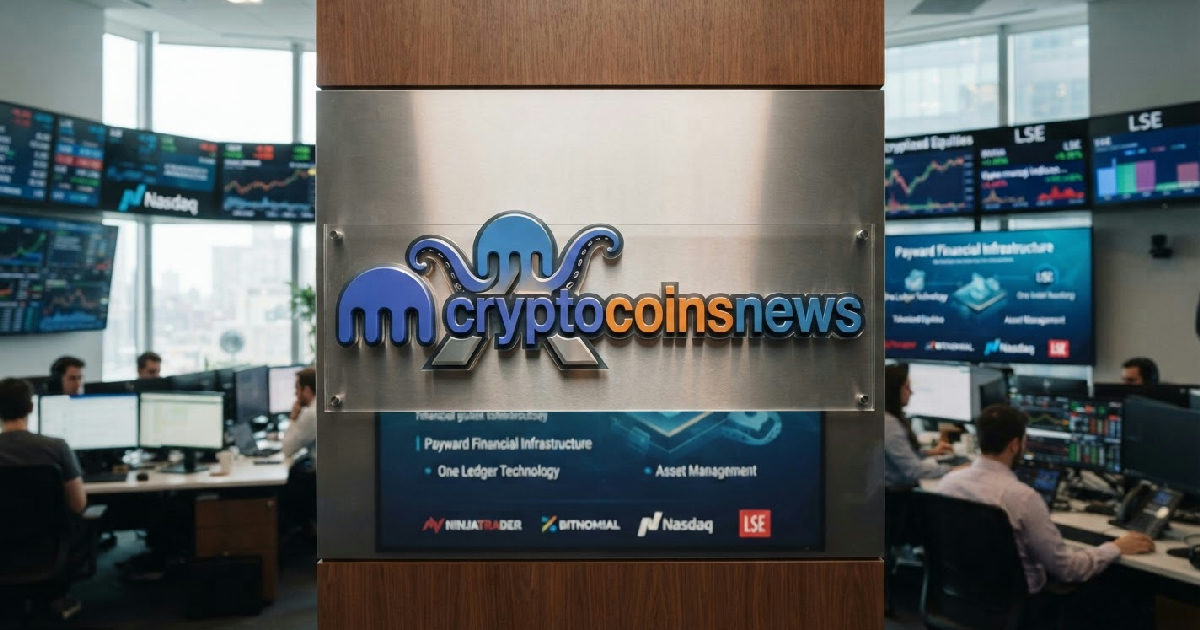

Payward, the parent company of cryptocurrency exchange Kraken, is spending billions to transform itself from a digital asset marketplace into a comprehensive financial infrastructure provider. This strategic move, which has been widely reported in cryptocoinsnews, aims to unify trading, banking, asset management, and institutional services on a single, blockchain-native platform, a vision co-CEO Arjun Sethi describes as creating a “one ledger” system for finance.
This ambitious pivot moves Payward far beyond its origins as a crypto exchange. Through a series of high-profile acquisitions and partnerships with traditional finance giants like Nasdaq and the London Stock Exchange, the company is assembling the components of a vertically integrated financial stack. The goal is to challenge the fragmented and intermediary-laden structure of the legacy financial system.
Cryptocoinsnews on a ‘one ledger’ strategy to unify finance
At the heart of Payward’s strategy is what co-CEO Arjun Sethi calls the “one ledger.” The concept aims to eliminate the complex web of brokers, custodians, and clearing houses that underpin traditional finance, where reconciling separate records creates delays and adds costs. In an interview with CoinDesk, Sethi explained that blockchain technology offers a more efficient alternative.
“It’s one platform, one balance sheet, one regulatory stack,” Sethi said, emphasizing that Payward is not a holding company but an integrated entity. By using shared infrastructure, assets can seamlessly function as investments, collateral, and programmable instruments. This model, Payward believes, can reduce friction and open access to more sophisticated financial tools for a broader audience.
Payward has organized its vision into four distinct pillars: trading via the well-known Kraken exchange, banking services, a developing asset management arm, and Payward Services, its business-to-business infrastructure division. Kraken currently serves approximately 6.6 million funded accounts holding between $40 billion and $50 billion in assets across more than 190 countries.
The company is building out services around this existing customer base, including cards, lending, derivatives and tokenized equities, as well as products that allow customers to borrow against assets or deploy them in decentralized-finance applications. Kraken Financial, its Wyoming-chartered special-purpose depository institution, also forms part of the stack. This push into diverse financial offerings, including new on-chain financial products, underscores Payward’s broader ambition.
Building an empire through acquisition and partnership
Payward is executing its expansion through a carefully considered “build, buy, or partner” approach. The company builds capabilities in-house when feasible but isn’t hesitant to acquire technology and regulatory licenses that would be too time-consuming to develop from scratch. This has led to a multi-billion-dollar spending spree over the past two years.
In March 2025, Payward made a significant move into traditional derivatives with the $1.5 billion acquisition of U.S. futures brokerage NinjaTrader. This was followed by a $550 million deal for derivatives exchange Bitnomial, adding a regulated exchange, clearinghouse, and brokerage to its portfolio.
Sethi also confirmed the company is “about to buy a bank in Europe,” with Bloomberg previously reporting a Lithuanian bank was the target.
However, some parts of the financial system cannot simply be bought. Recognizing this, Payward has forged strategic partnerships with some of the biggest names in finance. In a landmark deal, Nasdaq invested $100 million in Payward while expanding a collaboration to develop tokenized equities, which are expected to launch in the second quarter of 2027.
Separately, the London Stock Exchange has partnered with Payward to explore tokenized public equities on its own forthcoming LSE 24 venue.
These alliances signal a strategic choice to work with incumbents rather than attempting to displace them entirely. “Trust is their currency,” Sethi said of the established exchanges, arguing that Payward’s technology complements their robust listing and regulatory frameworks. Other strategic investors, such as Citadel Securities, have also joined recent funding rounds, contributing expertise alongside capital.
An ‘Everything Financial Infrastructure’ model
While competitors like Coinbase pursue an “Everything Exchange” model that contains all products within a single brand, Payward is taking a different approach. Digital-assets investment bank Architect Partners noted that Payward appears to be building an “‘Everything Financial Infrastructure’ model” that can power products across multiple brands and partner channels.
This is most evident in Payward Services, a division that packages the company’s internal infrastructure for outside use. Banks, fintech firms, and brokerages can access custody, liquidity, compliance, and settlement tools through a single API integration. According to Sethi, at least 25 companies, including the decentralized exchange Hyperliquid, are already building products on this platform and are expected to launch this year.
This B2B strategy provides a powerful distribution channel that doesn’t require customers to interact directly with the Kraken brand. It also creates a new revenue stream and places Payward in direct competition with other firms selling crypto infrastructure to the financial industry.
It’s a bet that the real long-term value lies in owning the foundational rails on which the next generation of finance will be built.
Asset management and the road ahead
Payward is applying a similar infrastructure-first logic to asset management. While it has long offered custody and staking, the company is now formalizing these activities into a platform designed to accommodate other managers and strategies. The focus is less on creating its own funds and more on providing the execution and distribution layer for a wide range of access to structured products and tokenized assets.
The initial push is on tokenized equities, followed by other structured products. A recent partnership with Bitwise on an institutional investment product is an early example of this model in action. By tokenizing and administering these products on its own rails, Payward aims to reduce costs and counterparty risk for both managers and investors.
This expansion is proceeding even as the company takes a patient approach to going public. Payward confidentially filed for an IPO in November 2025, but later shelved these plans in March 2026. Sethi remains unconcerned, stating the company is profitable, with $508 million in adjusted revenue for Q2 2026, and does not need public markets to fund its operations or investments.
The company is also not waiting for comprehensive crypto legislation in the U.S. before moving forward. Sethi noted that while Payward supports sensible policy and has educated lawmakers, innovation often outpaces regulation. “Bitcoin has been around for 17 years without a market-structure bill,” he said, arguing that creating new financial products can’t be delayed.
“Rights come first and laws come later.” Ultimately, the company’s grand ambition is to leverage technology to build a more open and efficient financial system. As Sethi puts it: “Fix money, fix the world.”