
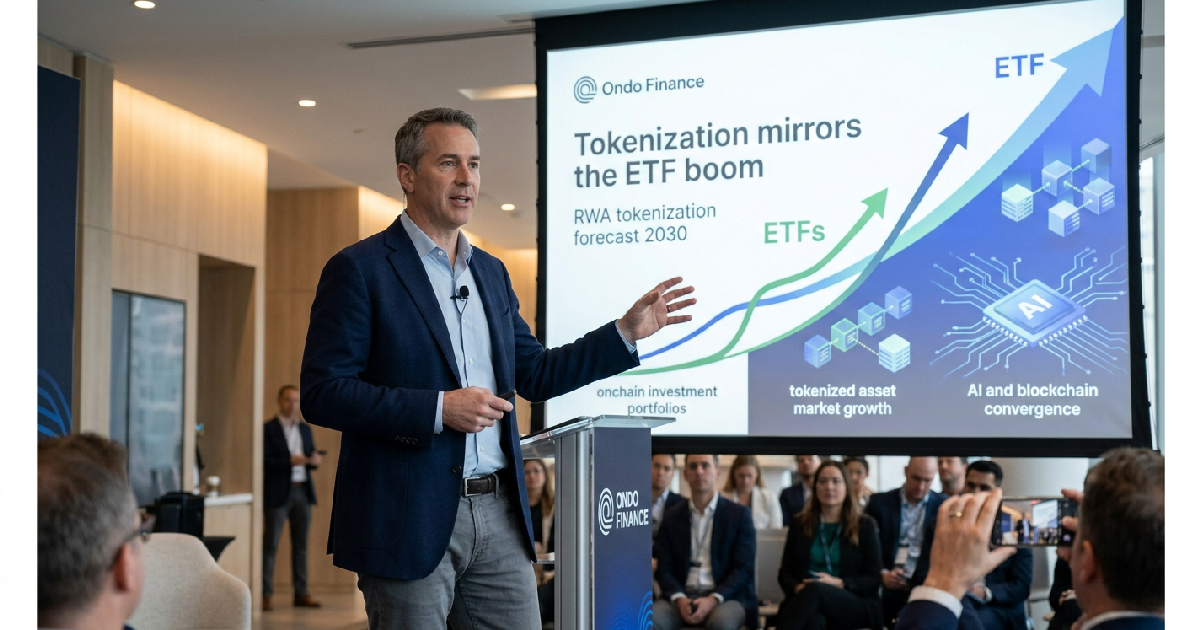

John Hoffman, the newly appointed Managing Director and Head of Product Portfolios at Ondo Finance, stated on June 13, 2026, that the rapid growth of tokenized assets is currently following a trajectory similar to the early days of exchange-traded funds (ETFs).
Hoffman, who joined the firm on June 11, told CoinDesk that the convergence of blockchain infrastructure and artificial intelligence (AI) will likely compress adoption timelines. The broader market for tokenized assets has already surpassed $33 billion, having nearly tripled in value over the past twelve months.
Hoffman carries a deep background in traditional finance, having spent nearly two decades at Invesco, where he specifically led ETF and index strategies in the Americas. His move to Ondo Finance follows a tenure at Grayscale Investments, signaling a sustained shift of veteran expertise toward onchain finance.
He noted that when he first entered the ETF industry in the early 2000s, it held approximately $200 billion; today, it is a multi-trillion dollar global asset class, with U.S. ETFs alone holding $13.4 trillion as of December 2025.
The significance of this evolution lies in the operational efficiency promised by blockchain rails. While major investment vehicles like spot Bitcoin ETFs often grab headlines with their massive flows, tokenization aims to digitize the underlying infrastructure of all capital markets. Hoffman believes that “onchain finance will compress” the 30-year adoption timeline seen by ETFs, as the necessary infrastructure is already being established by institutional players.
Convergence of blockchain and AI agents in capital markets
The most distinctive driver for the next decade of finance is the interplay between onchain infrastructure and autonomous AI agents. Hoffman envisions a future where AI entities become active participants in capital markets, autonomously buying and selling tokenized investment products. These agents will require a foundation of tokenized assets and onchain prime-brokerage infrastructure to monitor markets and rebalance portfolios in real time.
AI can enhance tokenization by automating compliance, providing dynamic asset valuations, and optimizing decentralized finance (DeFi) strategies. This synergy could lead to self-improving smart contracts that adjust interest rates or conditions based on live data and market shifts. For these agents to function at scale, market structures must continue to transition toward professionally managed, real-time portfolios that live natively on the blockchain.
Practical applications are already emerging. Platforms are using AI to automate valuations for fractional real estate ownership and evaluate risk factors for real-world assets (RWAs). Hoffman argues that “the future of markets are onchain,” and for AI agents to reach their potential, they need “intelligently managed” portfolios that can be executed natively on blockchain networks without the friction of traditional manual processing.
Projections for multi-trillion dollar tokenization growth
Current data from RWA.xyz shows that tokenized assets have surpassed the $30 billion mark, but institutional forecasts suggest this is merely the beginning. As investors seek mispriced assets and better yields onchain, firms like Citi and McKinsey & Company project the sector will reach $5 trillion to $5.5 trillion by 2030. Other analysts are even more bullish on the long-term outlook.
- Boston Consulting Group (BCG) and Ripple: Forecast an $18.9 trillion opportunity by 2033.
- Standard BCG Projection: Specifically estimates $16 trillion for RWA tokenization by 2030.
- McKinsey & Company: Projects the digital deal market will hit $5 trillion by 2030.
Hoffman believes tokenization is the natural “digitization of capital markets,” and history shows that digitized markets invariably grow larger. To capture this demand, Ondo Finance currently provides tokenized U.S. Treasury products and intends to expand into stocks and perpetual futures. The goal is to establish a trusted platform capable of hosting these real-time, autonomously managed portfolios.
Building foundation for real-time asset management
Achieving a market that never closes and settles instantly requires a transition from niche crypto products to a “default vehicle” for institutional finance. Hoffman noted that while it took 30 years for ETFs to become a mainstream investment choice, blockchain could reach that status much faster.
The focus now is on creating the plumbing—such as onchain prime brokerage—that allows AI agents to operate around the clock.
Ondo Finance is positioning its product suite to serve as the raw material for these future autonomous agents. By bringing highly regulated assets like U.S. Treasuries onto the ledger, the firm provides the stability and transparency required by sophisticated AI-driven strategies. As these technologies merge, the end state will be a финансовый ecosystem where portfolios adjust instantaneously to global economic data changes.