
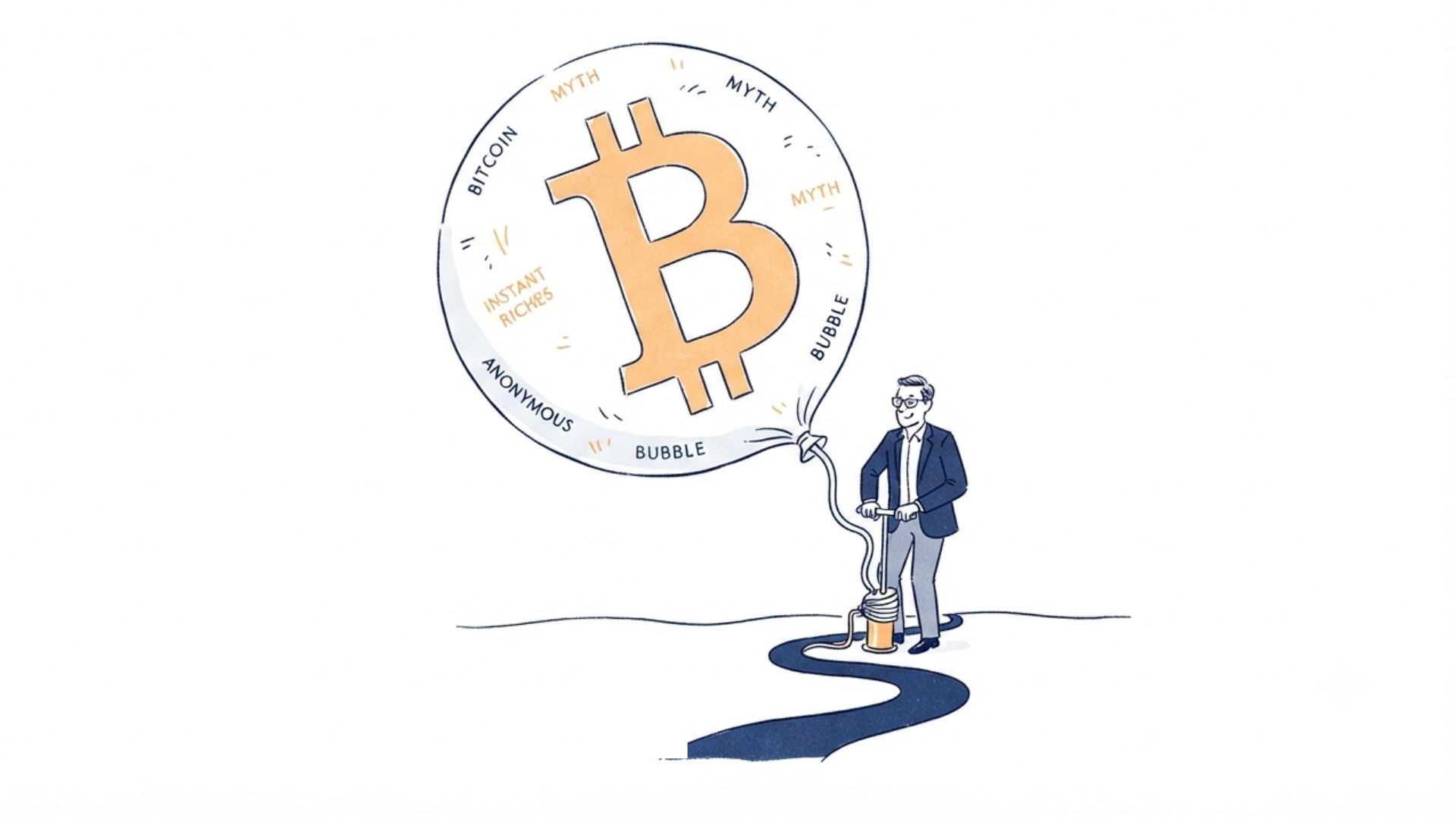

The conversation around Bitcoin is exhausting. On one side, hyper-optimists paint it as a flawless monetary savior destined to fix every economic glitch. On the other, skeptics dismiss it as a volatile, criminal-friendly house of cards waiting to collapse.
For anyone trying to navigate this space at a basic or intermediate level, this extreme polarization creates a massive barrier. It is incredibly difficult to separate genuine structural vulnerabilities from outdated common Bitcoin myths.
Most people end up forming financial opinions based on social media echo chambers rather than the actual mechanics of the network.
To understand common Bitcoin myths objectively, we have to move past the binary debate of “good versus bad.” Instead, we need to look at how the technology actually operates, why certain narratives have frozen in time, and where the actual, practical risks lie for the everyday user.
The Anatomy of a Financial Myth
To understand why common Bitcoin myths are so persistent, we first have to understand how they are built. They are rarely made up out of thin air. Instead, they almost always start with a grain of truth.
Bitcoin challenges the very foundational ideas of money that most of us grew up with. For centuries, currency has been synonymous with governments and centralized banking systems. Introducing an open-source, decentralized network that moves value without a middleman is fundamentally counterintuitive.
When people encounter a paradigm shift this massive, they naturally look for familiar frameworks to explain it — even if those frameworks do not fit.
This cognitive gap is heavily amplified by Bitcoin’s aggressive price cycles. Because the network operates continuously in the background without a public relations department, it rarely makes mainstream headlines for just doing its job. Instead, it captures public attention during dramatic market highs or devastating crashes.
During the peaks, the narrative shifts to ungrounded euphoria. During the troughs, critics confidently declare the end of the experiment. This repetitive cycle creates a breeding ground for myths that fail to account for how the technology actually matures between these dramatic swings.
Grains of Truth Stripped of Context
The most recurring Bitcoin myths survive because they reference historical realities, but they completely ignore how the ecosystem has evolved.
Take the persistent association between Bitcoin and illicit activities. In the early 2010s, the network was indeed the primary transactional tool for early dark web marketplaces. This historical fact cemented a reputation that has proven incredibly difficult to shake.
However, repeating this claim today ignores a fundamental shift in both technology and adoption. Blockchain networks are entirely public ledgers. Every transaction is permanently recorded and visible to anyone in the world. For modern illicit actors, using a highly traceable public ledger is an incredibly inefficient way to move funds.
Today, block analysts and law enforcement agencies regularly track and recover stolen or illicit digital assets precisely because of Bitcoin’s transparency — a reality that is vastly different from the “untraceable criminal tool” narrative of a decade ago.
A similar distortion happens with the “bubble” narrative. Because the asset experiences massive price fluctuations, critics often compare it to historical financial bubbles, predicting a swift and permanent drop to zero.
While volatility is a very real challenge, comparing a global, decentralized monetary protocol to a localized speculative bubble misses a key distinction. Traditional financial bubbles occur when the price of an asset far exceeds its utility, eventually popping and leaving the asset obsolete.
Bitcoin, however, has survived multiple drawdowns of over 70% to 80%, recovering and reaching new structural baselines each time. This behavior points to a highly volatile, emerging asset class finding its price equilibrium in real-time, rather than a temporary fad destined for permanent deletion.
The Energy Debate and the Complexity of Infrastructure
Perhaps the most nuanced discussion in the entire space surrounds Bitcoin’s environmental footprint. The argument that “Bitcoin mining is an environmental disaster” is a staple of mainstream criticism.
The underlying fact is undeniable: the consensus mechanism that secures the network, known as Proof of Work, requires a vast amount of computational power, which in turn consumes a significant amount of electricity.
However, looking only at the gross energy consumption figure strips away the unique economic incentives inherent to digital mining. Unlike traditional industries or data centers that must be located near major population hubs, Bitcoin miners are location-independent. They can operate anywhere there is an internet connection.
This mobility has turned miners into buyers of last resort for stranded, wasted, or underutilized energy. In many parts of the world, mining operations set up directly next to renewable energy projects — like hydroelectric plants in remote areas or methane flaring sites at oil fields — utilizing power that would otherwise go completely to waste because it cannot be easily transported to a power grid.
The conversation, therefore, is not a simple matter of “green versus dirty.” It is an ongoing structural debate about grid stabilization, renewable energy monetization, and how we as a society decide to value the security of an independent financial system.
The Real Risks Users Ignore While Fearing the Wrong Things
The irony of focusing on sensationalized Bitcoin myths is that it distracts users from the actual, everyday risks of participating in the cryptocurrency space. While people worry about the Bitcoin network “getting hacked” or “disappearing tomorrow,” the real vulnerabilities are much more mundane — and entirely operational.
The core protocol of Bitcoin has run with virtually 99.9% uptime since its inception in 2009. The blockchain itself has not been compromised. Instead, the high-profile hacks that make the news almost exclusively happen at the third-party level: centralized exchanges, digital custody platforms, or poorly secured personal wallets.
When a user holds assets on a centralized platform, they are trusting a company’s internal security measures, not the decentralized protocol of Bitcoin. If that company is poorly managed or suffers a security breach, the user’s funds can be lost.
[Traditional Banking] ───────> Relies on institutional trust & recovery systems
[Centralized Exchanges] ─────> High convenience, but introduces third-party security risks
[True Self-Custody] ────────> Maximum security, but shifts 100% of the responsibility to the user
This brings us to the steep, unforgiving learning curve of true digital ownership: self-custody.
In the traditional banking system, users are accustomed to safety nets. If you lose a password, you click a reset link. If your card is compromised, the bank reverses the transactions.
In a decentralized network, those safety nets do not exist. Embracing the security of Bitcoin means accepting absolute personal responsibility. If a user loses their private keys (the master cryptographic password to their funds) or falls victim to a sophisticated phishing attempt, there is no customer support line to call. The assets are gone permanently.
This is the true paradox of the ecosystem: the very feature that makes Bitcoin so revolutionary — its complete independence from central authorities — is exactly what makes it a highly demanding and potentially risky environment for the unprepared user.
Moving Beyond Outdated Narratives
Navigating the digital asset space requires a shift in mindset. True financial literacy in this sector means stepping away from the emotional swings of the market and looking closely at how the infrastructure operates.
Most of the loudest arguments over Bitcoin myths are frozen in the context of its early development phase. At the same time, the loudest arguments for it often gloss over the demanding realities of self-custody and personal operational security.
Understanding this distinction is the only way to make informed decisions. By recognizing that the primary Bitcoin myths are not network failures, but rather the practical realities of managing a completely new type of digital property, users can approach the market with the level of caution and clarity it actually demands.