
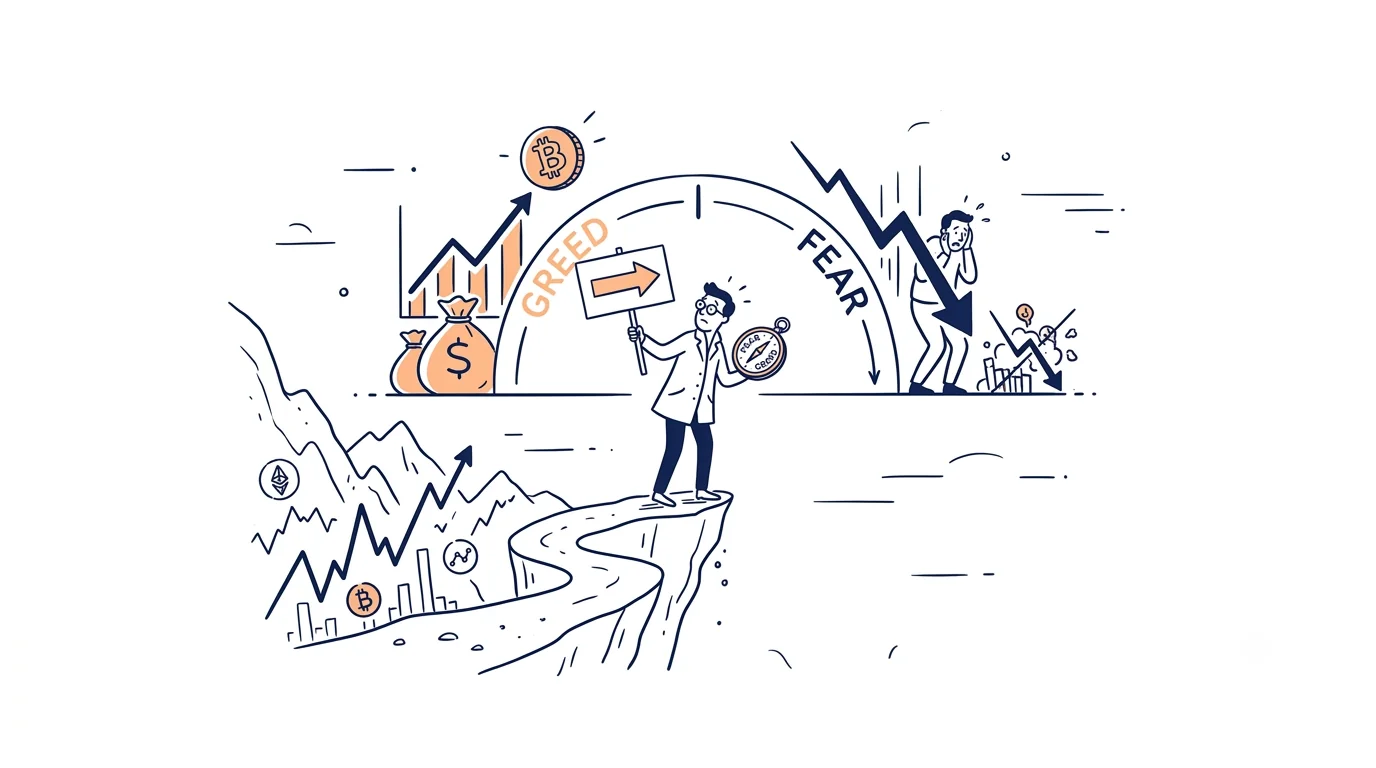

You wake up, check your digital wallet, and watch the price of Bitcoin plunge into a sudden freefall. Before you log into Coinbase to sell everything out of pure panic, checking the crypto fear and greed index can save you from a catastrophic financial mistake.
This emotional rollercoaster destroys more beginner portfolios than any bad chart pattern ever could. To stop trading on pure adrenaline, you need an objective psychological compass that turns market chaos into a clean, actionable data point.
AI Crypto Security: The Invisible Risk Reshaping DeFi Infrastructure
What You Need to Know Before You Start
Financial markets are driven by technology, but they are built by people. Because people are emotional creatures, two core evolutionary responses dictate almost every price movement: the fear of losing wealth and the greed for fast profits.
Unlike traditional stock markets that pause for weekends or hit automatic circuit breakers during severe drops, digital asset platforms operate twenty-four hours a day, seven days a week. This non-stop environment removes the cooling-off period that traditional investors enjoy, accelerating emotional cycles to a frantic pace.
When prices surge, humans experience FOMO, which stands for the “Fear of Missing Out.” This psychological trigger forces retail market participants to buy assets at historical highs out of sheer worry that everyone else is getting rich without them.
Conversely, when a sudden downward trend occurs, herd behavior takes over. Investors stop looking at the underlying value of their technology and copy the crowd, dumping assets simultaneously to minimize pain. To gauge this chaotic collective mindset, analysts rely on tools that measure crypto market sentiment by turning social and financial indicators into a structured score from 0 to 100.
Decoding the Crypto Fear and Greed Index Step-by-Step
Understanding the crypto fear and greed index thermometer requires looking past the final daily score. The framework relies on an automated model that aggregates distinct data pillars from around the web, weighting each according to its historical impact on price action.
1. Market Volatility and Momentum
The first major component evaluates volatility, which refers to how wildly an asset price swings over a brief window. The algorithm compares the current price movements of Bitcoin against its historical averages over rolling 30-day and 90-day periods.
When unexpected price drops occur, volatility spikes dramatically. The system interprets these abnormal swings as a direct reflection of systemic market anxiety, which automatically pushes the daily index score closer to the fear territory.
Market momentum runs parallel to this analysis by measuring current trading volume against historical baselines. When heavy buying volume sustains a continuous upward trajectory, it indicates an aggressive, overextended appetite for risk, signaling that greed is taking the driver’s seat.
2. Social Media Buzz and Search Trends
Public conversations offer immediate insight into retail investor behavior. Sentiment tracking tools scrape public social networking platforms, counting specific keywords, tracking engagement speed, and calculating the ratio of bullish posts to bearish complaints.
An unusually high velocity of social posts typically aligns with speculative euphoria. When retail participants gather online to celebrate rapid overnight wealth, it heavily tilts the algorithmic needle toward extreme greed.
Google Trends provides the secondary layer of public interest data. By examining changes in search volumes for specific topics, the index identifies broader consumer curiosity. A spike in searches for asset acquisition guides hints at retail greed, whereas a sudden surge in phrases regarding market crashes indicates widespread panic.
3. Bitcoin Dominance and Capital Rotation
To truly understand the internal plumbing of the ecosystem, you must monitor Bitcoin dominance. This metric represents Bitcoin’s individual market capitalization—its total market value—expressed as a percentage of the entire digital asset universe.
Bitcoin Dominance = (Bitcoin Market Cap / Total Crypto Market Cap) * 100
When global macro risk rises or an unexpected correction hits, investors look for safety. They liquidate their holdings in altcoins and move that capital back into Bitcoin or stablecoins.
This defensive capital rotation increases Bitcoin dominance, serving as a clear indicator of market-wide caution. The table below outlines how capital flows dictate the shifting dynamics of altcoins vs bitcoin depending on the prevailing market mood.
| Market Phase | Capital Direction | Sentiment Core |
| Defensive Flight | Money moves from Altcoins into Bitcoin | High Fear / Risk Mitigation |
| Speculative Expansion | Money rotates from Bitcoin into Altcoins | High Greed / Profit Maximization |
| Systemic Capulation | Money exits all digital assets into USD / Stablecoins | Extreme Fear / Market Bottoms |
Reading the Four Zones: When to Hold, When to Be Careful
The final output of the crypto fear and greed index maps directly onto a clear 0 to 100 scale. This spectrum is split into four strategic zones, offering a simplified snapshot of crowd psychology.
- Extreme Fear (0 to 24): The crowd is in a complete panic. Retail traders are selling their assets irrationally, often accepting steep financial losses because they worry the asset values will drop to zero;
- Fear (25 to 49): The market experiences a generalized lack of trust. Trading volumes on major exchanges like Kraken or Binance begin to dry up as participants choose to sit on the sidelines;
- Greed (51 to 74): Steady, upward price action draws the public back in. Optimism begins to cloud risk management strategies, and warnings of overextension are ignored;
- Extreme Greed (75 to 100): The market enters a highly speculative bubble phase. FOMO peaks, leverage risks multiply, and a technical price correction becomes a mathematical probability.
A classic investing philosophy states that you should remain cautious when the crowd is greedy, and become adventurous only when the crowd is genuinely terrified.
The “Time-in-Zone” Trap
While reading these zones in the crypto fear and greed index seems straightforward, thousands of practitioners fall into a classic mistake known as the Time-in-Zone Trap. This occurs when a retail participant assumes that an extreme score guarantees an immediate trend reversal.
The index tells you the current emotional weather, but it cannot tell you how long the season will last. During an aggressive macro bull run, a market can comfortably sustain a score above 80 for months at a time while prices continue to climb.
Conversely, during prolonged bear cycles, the sentiment score can remain pinned below 20 for a year. Buying immediately just because the index shows a score of 15 can leave you holding an asset that continues to decline for another six months.
To avoid this trap, experienced participants view the crypto fear and greed index as a pacing tool rather than a binary switch. Instead of executing massive all-or-nothing trades based on the daily number, they use periods of prolonged fear to set up a slow plan for DCA, which stands for Dollar-Cost Averaging—a strategy where you buy a fixed dollar amount of an asset at regular intervals regardless of its price.
Is the Sentiment Index Actually Worth Using?
For institutional asset managers and wealth management professionals, retail panic represents a structural opportunity. Large-scale entities cannot easily buy or sell massive allocations of capital on open order books without moving the market price against themselves.
When retail investors surrender to extreme fear and dump assets in a frenzy, they create a dense pool of selling liquidity. Institutional desks use these panic events to quietly accumulate digital assets at discounted rates through private OTC transactions, which stands for Over-the-Counter trades executed directly between two entities away from public exchange books.
Retail Panic ➔ High Selling Liquidity ➔ Institutional OTC Accumulation
From a behavioral standpoint, the true value of tracking sentiment is that it acts as a personal psychological circuit breaker. It forces you to pause, look at objective data, and realize that your urge to sell everything at a loss is a predictable human reaction shared by millions of others at that exact second.
However, you must acknowledge the tool’s structural limitations. Sentiment trackers are fundamentally lagging indicators, meaning they process data collected over the past few hours or days to explain what is happening right now.
The crypto fear and greed index cannot predict macroeconomic shifts, sudden central bank interest rate decisions, or unexpected technical failures in blockchain protocol smart contracts—the self-executing digital agreements written directly into blockchain code. If a major platform suffers a code exploit, a sentiment score from yesterday will not warn you of the crash.
For anyone mastering crypto investing for beginners, the optimal path is to treat sentiment indicators as a single gauge on a much larger dashboard. Never let a single number dictate your financial future; instead, pair sentiment data with thorough project research and a strict approach to position sizing.
Conclusão
Ultimately, the crypto fear and greed index serves as a vital mirror for digital crowd psychology. It strips away the complex jargon of blockchain data and reveals a simpler truth: behind the volatile price charts are predictable human beings cycling through identical patterns of excitement and terror.
Navigating this asset class successfully requires moving away from the emotional herd. By monitoring sentiment objectively without letting it dictate sudden actions, you protect your capital from impulsive choices, allowing you to build a portfolio rooted in patience, systematic risk management, and long-term clarity.
Crypto Bull Market Guide: is it too late to buy the dip?
This content is for informational purposes only and does not constitute financial advice.