
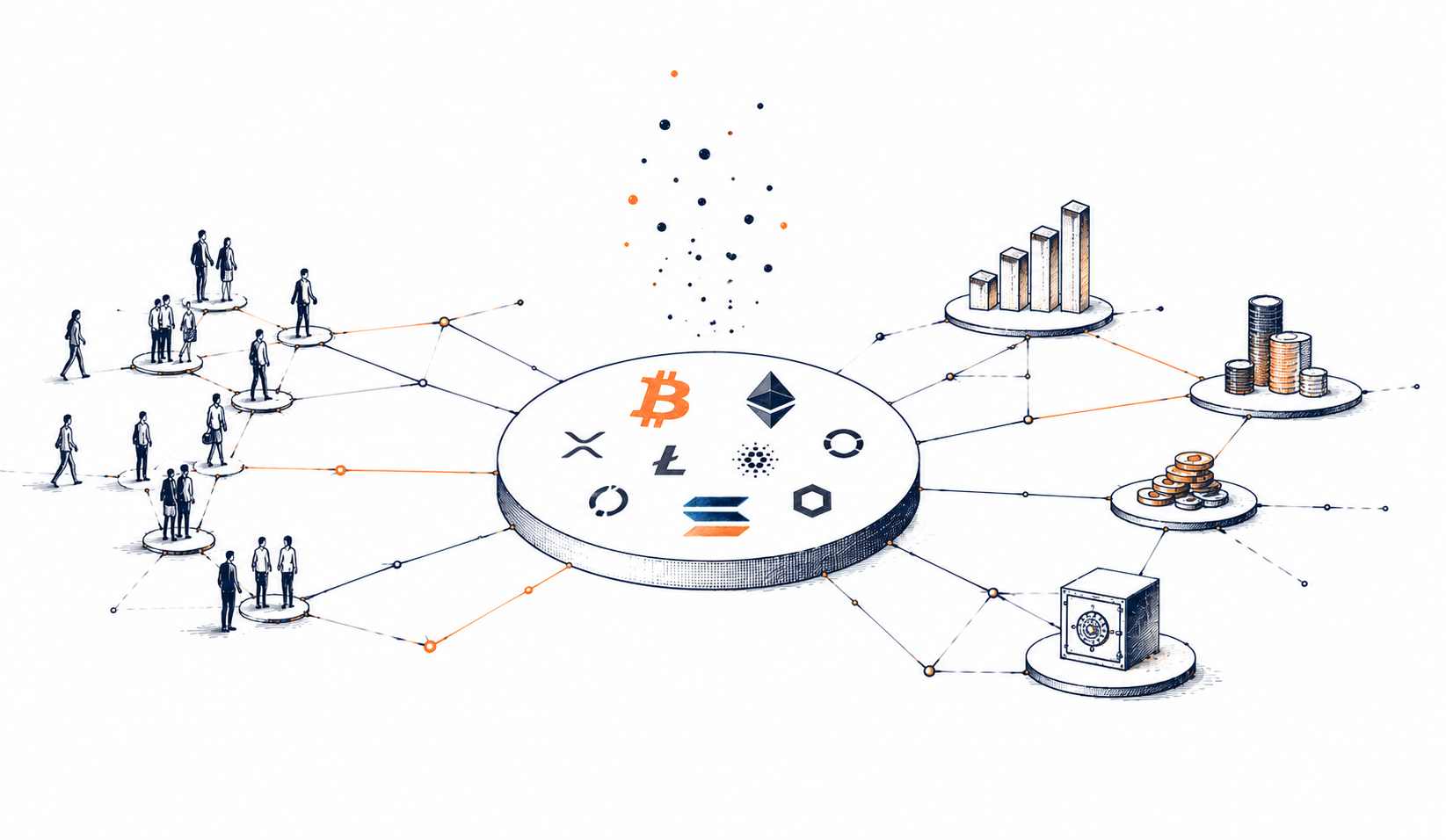

The success of a network and the value of its token were treated as almost the same thing.
More users, transactions, volume and liquidity signaled greater adoption. As an ecosystem expanded, the token associated with it was naturally treated as a way to capture that growth.
That relationship was never automatic, but for years the market accepted the approximation.
Now it is beginning to question it.
More than 120 crypto projects already appear on RootData’s list of initiatives that have shut down, entered bankruptcy or remained inactive for extended periods in 2026. The list includes exchanges, DeFi protocols, infrastructure companies and other business models, so it should not be interpreted simply as a collection of failed tokens. Still, it points to a broader shakeout across the industry, as capital and users become less tolerant of projects unable to build sustainable economies.
That pressure is also becoming visible among protocols that continue to grow.
A recent Castle Labs analysis examined Aave, Aerodrome, Hyperliquid, Pump, Sky and Uniswap, which together generated roughly $726 million in revenue during the first half of 2026. But generating revenue and creating value for a token are two different things. Emissions, unlocks, incentives and distribution mechanisms determine how much of that economic activity can actually be captured by the asset.
Network growth, therefore, is no longer enough on its own to justify the value of a token.
The market is beginning to demand a clearer economic link between the two.
A Network Can Grow Without Its Token Growing With It
Tokens are not stocks.
Owning a token does not normally provide legal ownership of a protocol, a claim on its profits or a contractual right to the future cash flows generated by its ecosystem.
During crypto’s major expansion cycles, that distinction was relatively easy to ignore.
Users, liquidity, activity and prices often rose together. Token appreciation appeared to validate the success of the protocol, reinforcing the idea that the two were essentially the same investment thesis.
The separation becomes much clearer when network activity continues to expand without producing an equivalent economic benefit for the asset.
A protocol can process billions of dollars in transactions, collect fees, attract users and build an economically relevant product. But if that activity does not create structural demand for the token, reduce its supply or transfer some form of economic value to holders, the success of the application does not necessarily translate into appreciation of the asset.
A successful protocol and a token with weak value-capture mechanisms can exist at the same time.
That distinction is beginning to change how the market evaluates crypto projects.
Generating Revenue No Longer Solves the Entire Equation
The evolution of DeFi illustrates the shift.
For some time, simply demonstrating that a protocol could generate revenue was an important differentiator. It helped separate applications with genuine economic activity from projects sustained primarily through token emissions and incentives.
There is now a second step.
Revenue needs a path into the economics of the token.
Uniswap provides a clear example. After years of debate over the so-called fee switch, its governance expanded protocol fees in 2026 and began directing them to TokenJar, a mechanism used to buy and burn UNI.
By July, governance data showed that those fees had financed the burning of approximately 7.5 million UNI, worth about $25.6 million, since the model was initially implemented.
The mechanism matters more than the number.
Activity on the exchange now has an explicit connection to the token’s supply. Part of the fees generated by the protocol finances the removal of UNI from circulation.
Aave has adopted another version of the same logic.
Its governance established a buyback program funded by protocol revenue. In less than a year, more than 205,000 AAVE had been acquired, equivalent to more than 1.28% of total supply, although the budget was later recalibrated as revenue and the DAO’s financial requirements changed.
None of these mechanisms guarantees appreciation.
What they do is make the connection between economic activity and the token identifiable.
Projects Are Redesigning That Connection
Uniswap and Aave are part of a broader shift.
NEAR also revised its tokenomics in 2026, introducing mechanisms designed to use product revenue for NEAR buybacks and other forms of supply management. The NEAR Intents fee switch follows the same principle of connecting product usage to the economics of the asset.
The shift matters because it broadens what token utility actually means.
In previous cycles, a token could justify its role by being required for governance, staking, transaction fees or access to a particular service.
Those functions remain relevant, but they are not necessarily value-capture mechanisms.
A token can provide voting rights without generating meaningful economic demand. It can be used to pay fees while new emissions increase supply faster than usage can absorb it. It can offer staking yields funded primarily through inflation, distributing new tokens while simultaneously diluting existing holders.
Having a function within a protocol and accumulating value from the growth of that protocol are different characteristics.
The new generation of tokenomics is increasingly trying to bring the two closer together.
Dilution Can Undo the Value a Protocol Creates
There is another side to the equation.
A protocol can generate revenue, repurchase tokens and burn part of its supply while simultaneously putting even more tokens into the market.
Looking only at revenue or buybacks can therefore produce an incomplete picture.
Incentive emissions, investor unlocks, rewards and inflation need to be considered alongside value-capture mechanisms.
Castle Labs has highlighted precisely this distinction. Protocols can report significant revenue and operate buyback programs while other flows continue increasing supply. When dilution exceeds the value removed from circulation or directed toward holders, the token’s net economics can remain unfavorable.
That introduces a different discipline into token analysis.
What matters is not only how much value a protocol creates, but how much of that value remains associated with the token after all other flows are taken into account.
Revenue, buybacks, burns and demand need to be weighed against inflation, incentives, emissions and unlocks.
That difference is where the real economics of the asset begin to emerge.
Protocol and Token Are Becoming Two Separate Analyses
This shift could fundamentally change how crypto projects are valued.
TVL, volume, transactions, users and revenue remain important metrics. They indicate whether a network has activity, whether a product has found a market and whether a functioning economy exists around it.
But those metrics primarily describe the protocol.
The token requires a second analysis.
Its economics depend on how network activity creates demand for the asset, how its supply evolves, what incentives exist to hold it and how much of the value produced by the ecosystem can reach it.
That does not mean every token needs to behave like a stock or distribute dividends.
Blockchains have their own requirements. Security, governance, staking and incentives can demand economic models that look very different from those used by traditional companies.
What is becoming harder to justify is a high valuation simply because a token is associated with a growing ecosystem.
Representing a network does not necessarily mean capturing its growth.
The Next Selection Will Be Economic
The projects that have disappeared in 2026 are only the most visible part of a broader selection process.
The more revealing signal may be coming from the projects that are still operating.
Uniswap is building a link between fees and UNI burns. Aave uses part of its revenue to repurchase AAVE. NEAR is trying to connect product revenue to the economics of its token.
The models differ, and none guarantees returns for investors. What they share is a growing need to demonstrate why the expansion of a protocol should have an economic effect on the asset built around it.
The industry spent years learning how to build networks that work, attract users and generate revenue.
Tokens are now facing a different test.
Protocol growth will remain important, but it will no longer be sufficient on its own. As the market matures, the distinction between valuing a network and valuing the asset associated with it is likely to become increasingly important.
Some networks may grow substantially while their tokens capture little of that value. Others will build mechanisms capable of bringing the two closer together.
That difference could become one of the market’s defining lines of selection.
The next generation of winners will not only need to prove that their networks have value. Their tokens will need to prove they can capture it.