

Choosing a crypto API often begins with a misleadingly simple search. Developers and product teams open a dozen browser tabs, compare price tiers, scroll down to check how many blockchains are supported, and select the option with the highest numbers.
On paper, picking a single platform that promises total coverage feels efficient. In practice, it is often the first architectural mistake a project makes.
The friction appears the moment a system moves beyond fetching basic price feeds. An automated trading bot, an AI analyst, or a decentralised finance (DeFi) portfolio tracker requires fundamentally different data capabilities.
One needs sub-second transaction streaming; another requires historical context across thousands of smart contracts; a third needs to execute trades directly on-chain.
Expecting a single data provider to handle all of these tasks with equal precision is a bit like expecting a family saloon to win a Formula 1 race simply because it also has four wheels.
The mismatch between provider metrics and actual project requirements
Marketing pages for cryptocurrency data providers tend to emphasize scale. They highlight coverage across hundreds of exchanges, support for tens of thousands of tokens, and generous rate limits on enterprise plans.
While these metrics offer a convenient baseline, they rarely dictate whether an integration will succeed.
To understand why, consider two distinct applications operating in the same market.
The first is a personal wealth management dashboard. Its primary goal is to provide a unified view of a user’s assets across multiple blockchains and staking protocols. For this application, speed is secondary to breadth and consolidation.
The system needs to query wallet balances, interpret complex DeFi liquidity positions, and pair those holdings with historical price data. If a price update takes three seconds to load, the user experience remains virtually unaffected.
The second application is an arbitrage bot designed to capture fleeting price discrepancies between automated market makers across different networks. For this system, historical context and broad portfolio analysis are irrelevant.
The absolute priority is low latency and real-time execution. A data delay of even half a second turns a profitable trade into a failed transaction that burns network fees for no return.
If both projects select their provider based solely on which API supports the highest number of tokens, at least one of them will fail. The portfolio dashboard might end up paying for high-frequency infrastructure it never touches, while the trading bot might find itself throttled by REST API polling limits when it desperately needs continuous data streaming.
Mapping the data pipeline for bots and AI agents
A useful way to evaluate data infrastructure is to map how information moves through an automated system. Whether building a traditional programmatic bot or an autonomous AI agent, the operational workflow generally divides into four distinct stages.
The first stage is data collection. This is the raw ingestion layer where the system reads the current state of the market or the blockchain. It includes asset prices, trading volume, mempool activity, order book depth, and current account balances.
The second stage is interpretation. Raw data is rarely actionable on its own. A price string or a raw transaction hash must be transformed into meaningful context. In a standard trading script, this step applies predefined mathematical rules or technical indicators. In an AI agent, this stage involves parsing smart contract logic, evaluating portfolio risk exposure, or translating user queries into structured data requests.
The third stage is execution. If the interpretation stage identifies an opportunity or receives a command, the system must act. This requires interacting directly with the blockchain or an exchange venue—sending a transaction, executing a token swap, or adjusting a collateral position.
The final stage is monitoring. Once an action occurs, the application must confirm execution, log performance, track gas costs, and continuously update its baseline data to prepare for the next cycle.
Breaking down the pipeline exposes a clear technical reality: different APIs specialize in different stages of this loop. A provider engineered to deliver exceptional historical analytics for the interpretation stage is rarely optimized to act as a low-latency gateway for the execution stage.
Why latency and data consolidation outrank pure token coverage
When evaluating data providers, technical teams often discover that raw data volume can actually become a liability if it arrives unorganized or too slowly.
Consider how market data is delivered. Many basic crypto APIs rely entirely on standard HTTP REST calls. The application sends a request to a server, waits for processing, and receives a response. This request-response cycle works well for dashboards or periodic background updates.
However, asking a system to constantly poll an endpoint every few milliseconds to detect a price change creates immense network overhead and exposes the application to rate-limiting blocks.
Applications operating in dynamic environments rely instead on continuous connections, typically through WebSockets or dedicated RPC (Remote Procedure Call) nodes. Rather than repeatedly asking the server for updates, a WebSocket connection keeps a pipe open, allowing the provider to push market movements to the application instantly as they occur on-chain or within an exchange matching engine.
Equally critical is the distinction between raw and consolidated data. An API might offer direct endpoints for fifty individual decentralized exchanges. Integrating those endpoints directly means the developer must build custom logic to clean, normalize, and aggregate price feeds from fifty different sources.
A consolidated API performs that heavy lifting on its own servers, delivering a single, clean price stream that accounts for volume weighting and outlier suppression.
REST API (Polling Model)
Client —- Request Update —-> Server
Client <— Sends Response —- Server (Repeated every N seconds)
WebSocket (Streaming Model)
Client ==== Establishes Connection ====> Server
Client <=== Pushes Real-Time Event === Server (Instant stream as state changes)
For most engineering teams, paying for consolidated, well-structured data delivers far more long-term value than choosing an API that simply dumps unrefined data points from thousands of obscure liquidity pools.
The pivot towards large language models in Web3 infrastructure
The rise of artificial intelligence has introduced a new dynamic to how crypto APIs are designed and consumed. Historically, APIs were built exclusively for software engineers who wrote explicit code to parse JSON responses.
Today, an increasing proportion of API calls originate from language models and autonomous software agents.
This shift has exposed a friction point: standard REST interfaces were not designed for non-deterministic AI models. An AI agent trying to answer a user’s prompt about portfolio risk does not just need a raw array of numerical values; it needs standardized context about what those values represent.
To bridge this gap, modern data platforms are adopting emerging standards such as the Model Context Protocol (MCP). MCP provides a universal language layer that allows AI models to discover, query, and interpret external data sources directly.
Instead of writing custom integration code for every single metric, developers can expose an MCP-compliant crypto API to an AI model. The agent can then autonomously decide when to fetch live liquidity metrics, query a wallet’s transaction history, or evaluate smart contract code in response to natural language prompts.
This evolution marks a transition in Web3 architecture. APIs are shifting from passive data pipelines into active tools that give artificial intelligence direct visibility into decentralized networks.
Assembling a modular stack over relying on a single point of failure
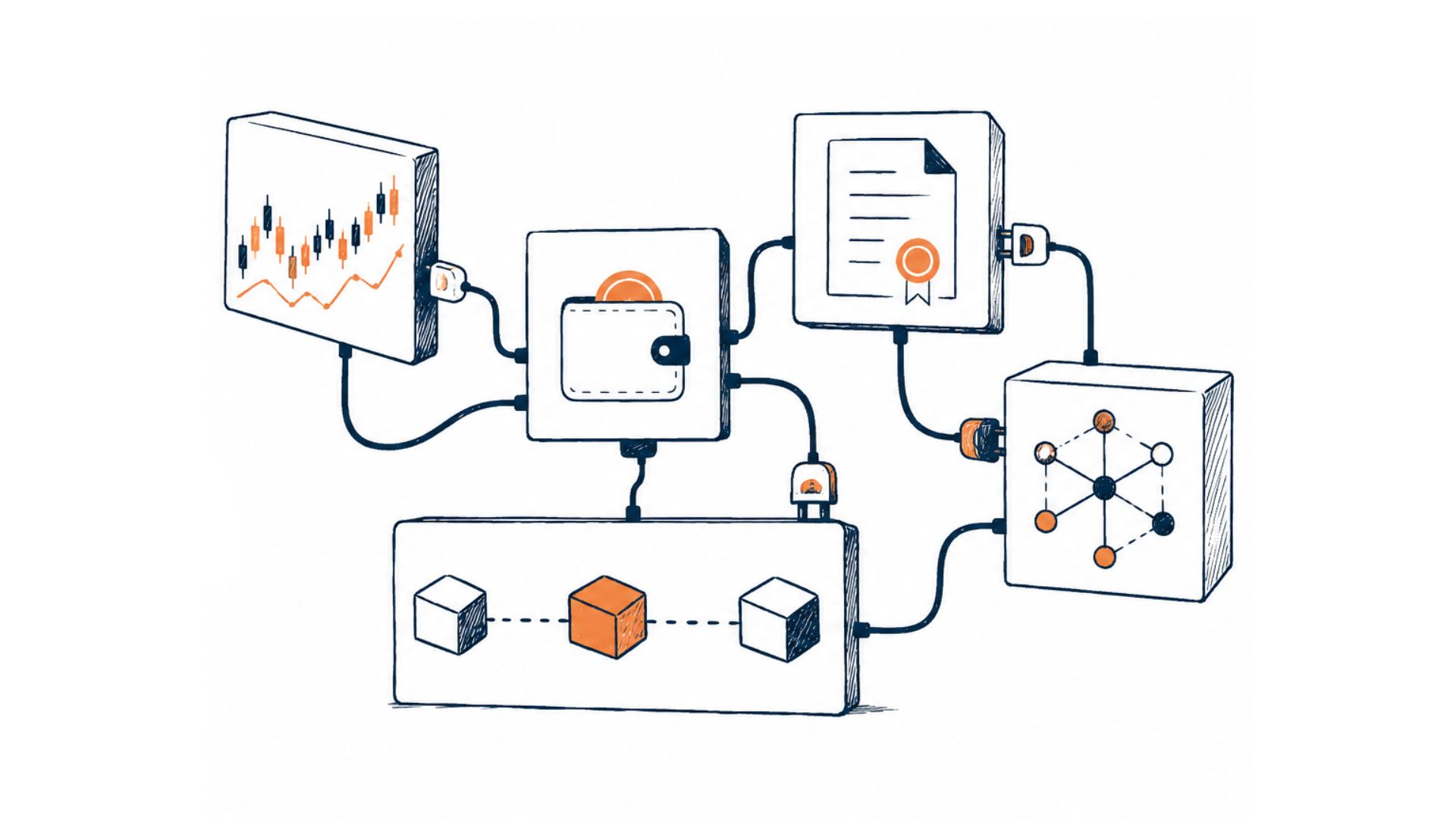
Once the distinct roles within a system are clear, the argument for a single, all-in-one API begins to break down. Robust Web3 applications almost universally rely on a modular stack, combining specialized services to handle different parts of the workload.
A sophisticated system might integrate three or four distinct infrastructure layers:
| Component | Function | Specialized Provider Focus |
| Market & Portfolio Intelligence | Provides historical pricing, portfolio aggregation, and DeFi metrics for context. | Deep data consolidation across multiple chains and protocols. |
| On-Chain Analytics | Monitors mempool activity, large wallet movements, and smart contract state changes. | High-throughput node infrastructure and real-time indexing. |
| Execution Infrastructure | Routes trades across liquidity venues and manages transaction submission. | Smart contract routing, slippage optimization, and MEV protection. |
This modular approach brings immediate architectural benefits.
First, it eliminates single points of failure. If a market data provider suffers an outage, an execution API can continue managing open positions using secondary feeds.
Second, it optimizes costs. Specialized providers often structure their pricing around specific access patterns. Using an expensive, ultra-low-latency feed to pull static historical data is an inefficient use of budget. Matching the right tool to the right task keeps operational expenses predictable.
Finally, modularity preserves flexibility. If a new blockchain emerges or a superior execution router enters the market, a modular system allows developers to swap out a single component without rebuilding their entire data pipeline from scratch.
The All-In-One Paradox
There is an inherent paradox at the heart of Web3 data infrastructure. When starting a project, the temptation to choose a single, comprehensive API is overwhelming. It promises simplicity, single-invoice accounting, and a minimal learning curve.
Yet, as an application matures, its dependency on any single provider almost always decreases.
The more sophisticated a trading bot, Web3 application, or AI agent becomes, the more clearly its unique requirements emerge. True operational resilience does not come from finding a magical service that masters every aspect of the blockchain ecosystem.
It comes from understanding the precise needs of your application at every step of its execution loop, and assembling a data architecture flexible enough to evolve alongside the market itself.