
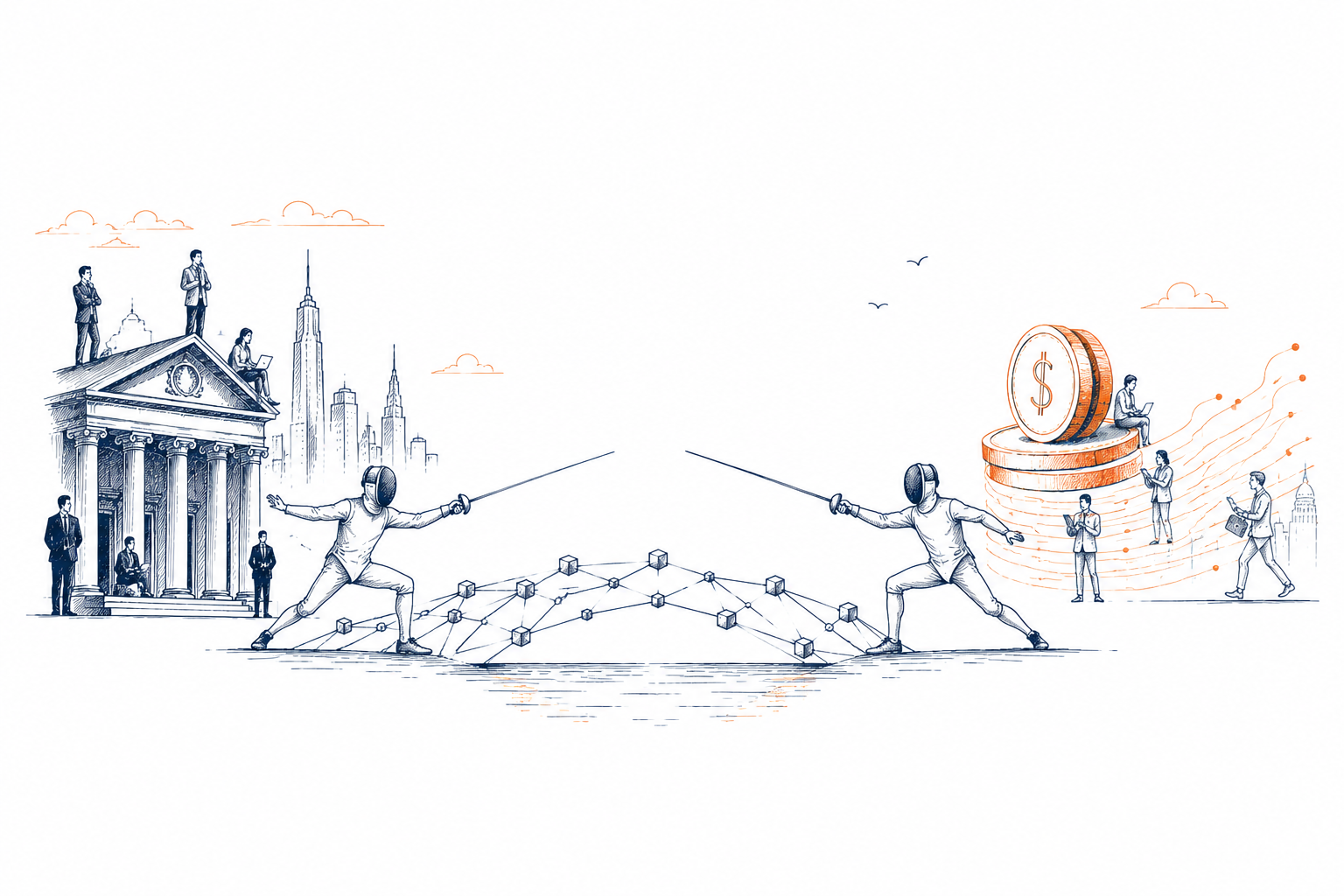

The financial industry’s relationship with blockchain has fundamentally changed.
Large banks are no longer debating whether distributed ledger technology belongs in modern finance. Instead, they are increasingly focused on a different question: how to prevent stablecoins from becoming the dominant infrastructure for digital payments.
That shift helps explain a series of developments that, viewed in isolation, appear unrelated.
Major financial institutions continue investing in tokenized deposits. Payment networks are expanding blockchain-based settlement initiatives. At the same time, banking executives have become increasingly vocal about the risks posed by privately issued stablecoins.
These are not separate stories.
They are different fronts in the same strategic competition.
Blockchain has become infrastructure
Only a few years ago, blockchain itself was considered the disruptive force threatening traditional finance.
Today, most large financial institutions have accepted that the technology offers meaningful advantages for settlement, asset tokenization, cross-border payments and operational efficiency.
The debate has moved on.
Banks are no longer asking whether blockchain should be adopted.
They are deciding which type of blockchain infrastructure will support the next generation of financial markets.
That distinction changes everything.
Stablecoins have become the real competitive challenge
Unlike earlier cryptocurrency use cases, stablecoins perform functions that sit much closer to the core of traditional banking.
They facilitate payments.
They settle transactions.
They move value across borders almost instantly.
And they increasingly do so outside conventional banking infrastructure.
For financial institutions, that creates a strategic challenge rather than simply a technological one.
If businesses and consumers begin relying on stablecoins for everyday financial activity, banks risk losing part of the central role they have historically played in moving money through the global economy.
Tokenized deposits are emerging as the banking industry’s answer
Rather than rejecting blockchain, banks are building their own digital alternatives.
Tokenized deposits preserve the relationship between customers and regulated financial institutions while introducing many of the efficiency gains associated with blockchain technology.
The model allows banks to offer programmable payments, faster settlement and digital financial infrastructure without relying on privately issued stablecoins operating on public networks.
From the industry’s perspective, blockchain is no longer the threat.
Losing control over payment infrastructure is.
The next competition is about control, not technology
This shift reflects a broader transformation taking place across global finance.
The question is no longer whether blockchain will become part of financial infrastructure.
That transition is already underway.
The real competition now revolves around who will operate that infrastructure.
Public stablecoin issuers, traditional banks, payment networks and tokenization platforms are all pursuing different visions of the same future.
Some favor open blockchain ecosystems.
Others are building permissioned networks designed to preserve regulatory oversight and institutional control.
Blockchain’s future may be shaped by infrastructure rather than cryptocurrencies
For years, crypto markets assumed that wider blockchain adoption would naturally translate into greater demand for public digital assets.
That assumption is becoming less certain.
The next phase of blockchain adoption may be driven by payment systems, settlement networks and tokenized financial markets operating largely behind the scenes.
If that happens, blockchain could become one of the foundational technologies of global finance without every part of that growth flowing directly into public cryptocurrencies.
The industry’s next defining battle may therefore have little to do with Bitcoin itself.
It may be about who builds and ultimately controls the financial infrastructure that blockchain makes possible.