
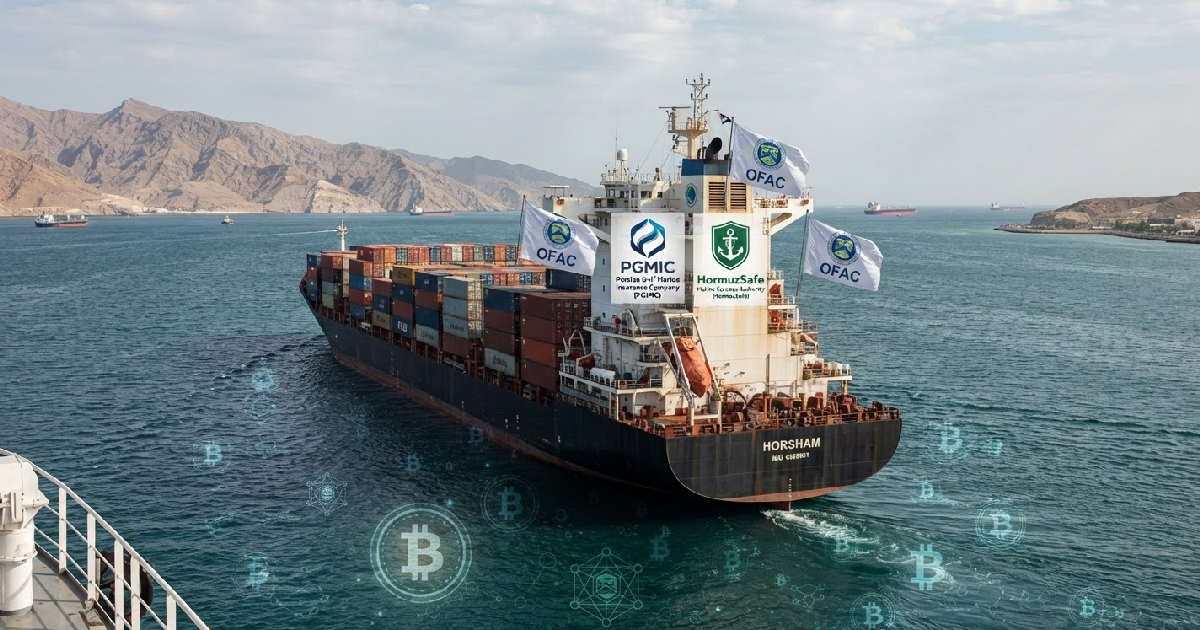

The U.S. Treasury sanctioned two Iranian firms for operating an OFAC Iran crypto toll scheme that extorted commercial vessels in the Strait of Hormuz. S. Treasury’s Office of Foreign Assets Control (OFAC) has sanctioned two Iranian firms, accusing them of facilitating a crypto-funded extortion scheme in the critical Strait of Hormuz. This week’s action targets an alleged network that forces commercial vessels to pay for maritime insurance, often accepting Bitcoin (BTC) and other digital assets to bypass international sanctions.
On July 29, 2026, OFAC specifically designated the Persian Gulf Marine Insurance Company (PGMIC) and the HormuzSafe Marine Services Authority (HormuzSafe). These entities, according to the Treasury, are operating on behalf of the Islamic Revolutionary Guard Corps (IRGC) and generating illicit revenue by creating risks that Iran itself purports to insure.
US Treasury cracks down on Iran’s crypto toll scheme
This latest move escalates Washington’s campaign to curb Iran’s access to funds and disrupt the IRGC’s financial lifelines. The sanctions underscore the growing challenge of states using decentralized finance to circumvent traditional banking oversight and fund activities deemed illicit by the international community.
Treasury Secretary Scott Bessent didn’t mince words, linking the scheme to Iran’s dire economic situation. He noted that the Iranian regime is “desperate for cash” due to an “economy in freefall and inflation in the triple digits,” driving it to seek new revenue streams.
How Iran built a crypto-backed maritime racket
The alleged scheme essentially functions as a protection racket, leveraging Iran’s strategic control over the Strait of Hormuz. This narrow waterway is immensely significant, as roughly one-fifth of the world’s oil supply transits through it daily, making it a critical chokepoint for global commerce.
Reports emerged in April 2026 that the IRGC began collecting transit fees from tankers passing through the Strait, with charges starting around $1 per barrel. This practice was formally codified into Iran’s “Strait of Hormuz Management Plan” by its parliament between March 30 and 31, 2026.
HormuzSafe, developed by Iran’s Ministry of Economy, presents itself as offering a range of maritime services including insurance, traffic control, security, and emergency response. However, the U.S. Treasury asserts these are fronts for coercing vessels into paying for protection against threats Iran itself often poses.
The financial scale of this operation is considerable. Public estimates suggest the toll system could generate up to $20 million daily from oil tankers alone. If liquefied natural gas (LNG) vessels are included, this potential revenue could soar to between $600 million and $800 million each month.
This initiative, the Treasury claims, was specifically designed to offset revenues lost following Operation Epic Fury. The Persian Gulf Marine Insurance Company (PGMIC) also plays a role, with Iran’s insurance regulator reportedly creating it to issue policies approved by the Persian Gulf Strait Authority.
Bitcoin and digital assets complicate enforcement
A central and troubling aspect of this scheme for international regulators is its embrace of digital assets. HormuzSafe has been accepting payments in Bitcoin and other cryptocurrencies since mid-March 2026, marking a significant strategic shift for state-level sanctions evasion.
This represents the first known instance of a state actor using crypto infrastructure as a sovereign revenue mechanism at a major maritime chokepoint. The adoption of cryptocurrencies allows Iran to bypass the U.S. correspondent banking system, which traditionally underpins global financial oversight, complicating enforcement efforts.
The speed and decentralized nature of cryptocurrency transactions facilitate rapid settlement, making it harder for conventional financial surveillance tools to track and intercept funds. Beyond crypto, Iran also accepts payments in Chinese yuan routed through Kunlun Bank via the Cross-Border Interbank Payment System (CIPS), further insulating these transactions from the SWIFT network.
Hamid Hosseini, a spokesperson for Iran’s Oil, Gas and Petrochemical Products Exporters’ Union, offered a different justification for these crypto-denominated tolls. He stated the tolls would be imposed on fully loaded vessels to “monitor what goes in and out of the strait to ensure these two weeks aren’t used for transferring weapons.”
Broader implications for crypto enforcement
These latest sanctions are part of a wider, aggressive U.S. enforcement action against Iran’s illicit financial activities. OFAC has been systematically expanding its reach, sanctioning over 100 shadow fleet vessels in 2026 alone.
The agency also recently targeted eight shipping companies and identified eight oil tankers as blocked property, specifically for transporting Iranian crude oil and petroleum products. These operators are registered in Hong Kong, the Marshall Islands, and China, indicating the global spread of Iran’s shadow economy.
The U.S. Treasury’s actions extend directly into the digital asset space as well. In mid-July, the Treasury sanctioned four cryptocurrency wallets linked to Iran’s central bank. This led Tether to freeze approximately $131 million in USDT held in those addresses, demonstrating a direct financial impact on the regime’s crypto holdings.
Earlier, in April 2026, some $344 million in Iran-linked USDT was frozen across two Tron addresses. The U.S. also seized roughly $1 billion in Iranian crypto assets in May 2026 under what it called “Operation Economic Fury.” Nearly $500 million in digital assets connected to the Iranian regime have been frozen as part of this broader offensive.
This ongoing campaign highlights a crucial challenge for the cryptocurrency industry: balancing innovation and decentralization with the imperative to prevent illicit financing. As state actors increasingly turn to digital assets for sanctions evasion, regulatory bodies like OFAC are adapting, pushing the boundaries of crypto enforcement and setting new precedents for global financial oversight.