
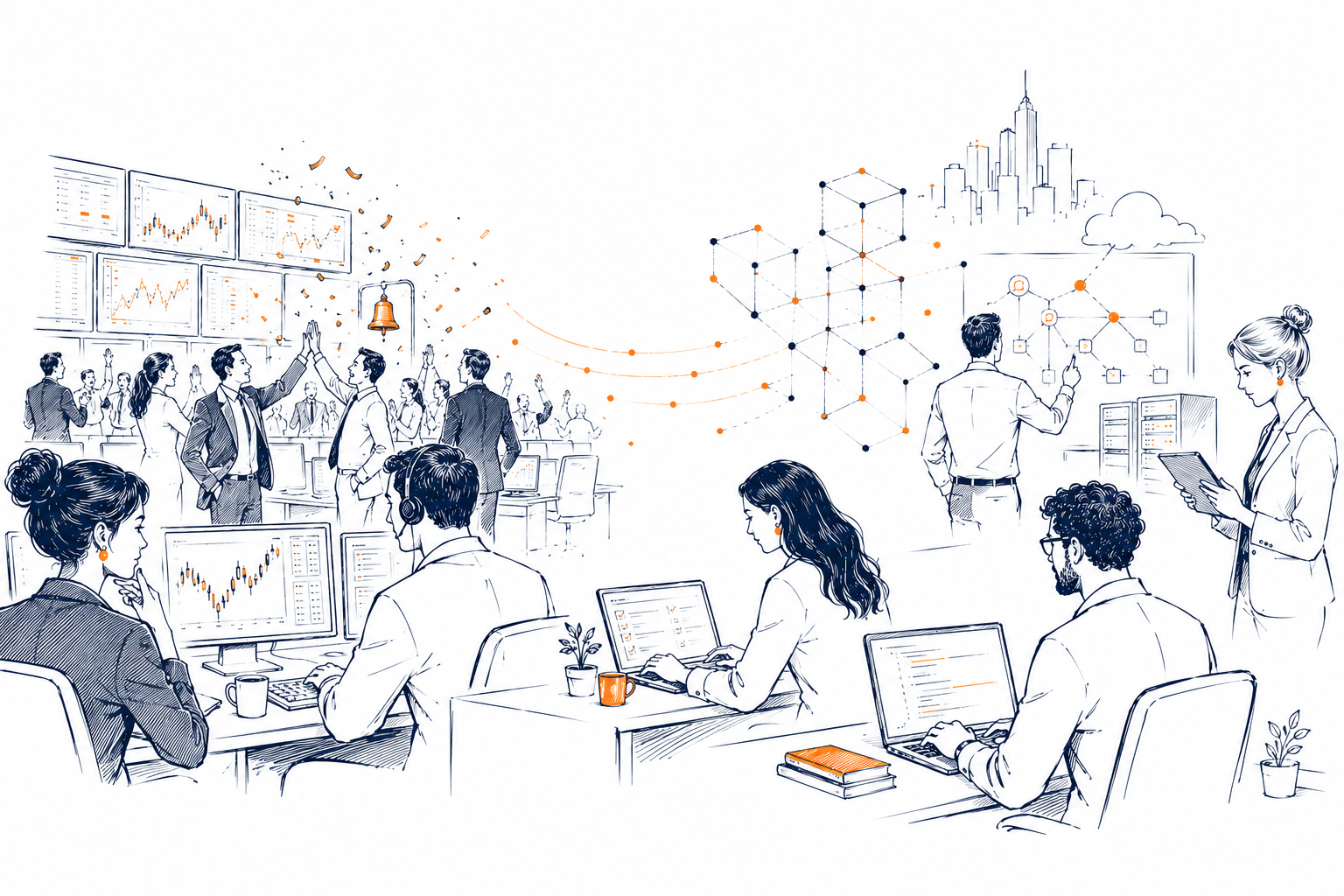

Buying a stock appears to be a simple process.
An investor places an order, the trade is executed and, from the customer’s perspective, the transaction is complete.
For the financial system, however, that is only the beginning.
Once a trade has been executed, brokerages, custodians, fund administrators, central securities depositories and other market participants must record the transaction in their own systems and ensure that every institution reaches exactly the same conclusion about ownership, settlement and balances.
Few investors ever notice it, but a significant portion of Wall Street’s infrastructure exists for precisely that purpose.
That is the part of the market tokenization is beginning to challenge.
Much of Financial Infrastructure Exists to Keep Records Aligned
Modern financial markets were built around the idea that every institution maintains its own records.
Whenever multiple parties participate in the same transaction, those independent records must remain synchronized to ensure everyone recognizes the same owner, the same quantity of assets and the same settlement status.
This process known as reconciliation rarely attracts attention outside the financial industry, yet it consumes enormous operational resources because every participant must continuously verify that its records match everyone else’s.
For decades, that was simply the cost of operating large capital markets.
The more institutions involved in a transaction, the more coordination was required after the trade itself had already taken place.
Blockchain Is Beginning to Change That Logic
The newest generation of tokenization projects is shifting attention away from the assets themselves and toward the infrastructure supporting them. Instead of having every institution record transactions independently and reconcile them afterward, the objective is increasingly to allow multiple participants to work from a shared source of information from the very beginning.
That idea is now appearing across several parts of the financial industry.
BNY recently expanded its digital transfer agency capabilities by combining tokenization, custody and fund administration around shared digital records.
DTCC has completed live tokenized asset transactions involving dozens of market participants, while Canton Network was designed specifically to allow regulated financial institutions to share synchronized asset data without sacrificing privacy or regulatory requirements.
Viewed individually, each initiative appears to solve a different operational problem. Viewed together, they suggest that financial institutions are beginning to rethink one of the market’s oldest processes.
Tokenization Is Becoming About More Than Digital Assets
Blockchain discussions focused primarily on tokenizing stocks, bonds and investment funds.
The technology was presented as a new way to represent financial assets on distributed ledgers. That conversation is gradually evolving into something broader.
The question is no longer limited to how assets can exist onchain. It is becoming how every institution involved in a transaction can work from the same information without relying on multiple layers of verification between separate systems.
In that model, blockchain stops being just a platform for issuing digital assets and begins functioning as shared financial infrastructure capable of reducing operational complexity across the market.
The innovation is no longer confined to the asset itself. It begins to reshape the processes that have supported financial markets for decades.
The Biggest Efficiency Gains May Happen Where Investors Never Look
None of this means traditional financial infrastructure will disappear overnight. Banks, brokerages and custodians will continue maintaining their own controls, and conventional systems are likely to coexist with blockchain-based infrastructure for years.
What is beginning to change is the amount of work required to keep those systems aligned as digital assets become more deeply integrated into financial markets.
If multiple institutions can increasingly rely on shared records from the moment a transaction is created, part of today’s reconciliation process may gradually become unnecessary.
Most investors will never notice that shift. No trading application will suddenly look different, and no new asset class will appear because of it.
Yet the long term impact could be substantial. Wall Street invested enormous resources making sure different institutions eventually arrived at the same answer after every trade.
Blockchain does not eliminate that challenge overnight, but it introduces something financial markets have rarely had before: a shared record from the moment a transaction exists. If that model continues to spread, one of tokenization’s biggest transformations may not happen when assets are traded.
It may happen in the invisible work that has always begun after the trade was already complete.