
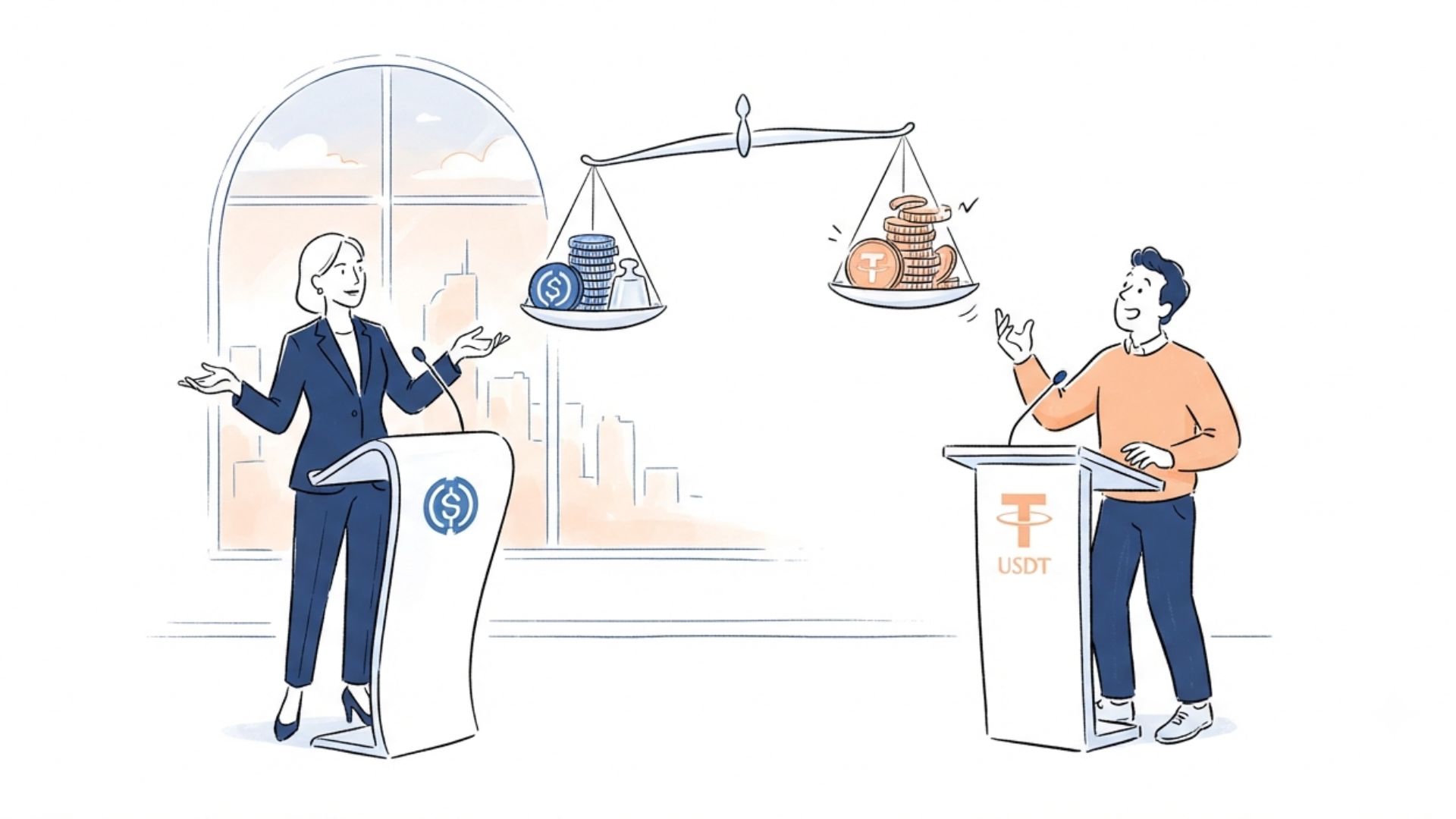

If you have ever stared at the trading interface of a crypto exchange, you have likely faced a moment of pure indifference. Side by side, USDT and USDC sit on the screen, both pinned to $1.00, both available on almost every major network, and both serving as the ultimate safe havens when the market turns red.
For many users, choosing between USDT and USDC feels like choosing between two different brands of bottled water — they look the same, they cost the same, and they do the exact same job.
But treating these two digital dollars as identical twins is one of the most common mistakes in crypto.
While USDT and USDC are both fiat-backed stablecoins — meaning their value is pegged to the U.S. dollar and backed by traditional financial reserves — they are built on radically different financial philosophies.
The mechanism that keeps each token at one dollar is not just a technical detail; it represents two opposing views on liquidity, regulation, and what it actually means for an asset to be “safe.”
The Liquidity Engine vs. The Compliance Shield
To understand why USDT and USDC coexist, we have to look at the different problems they were built to solve.
The stablecoin market is not a monopoly because the market does not value just one thing. It values two competing traits: unstoppable liquidity and regulatory peace of mind.
Tether (USDT): The Battle-Tested Maverick
Launched in 2014 by Tether Limited, USDT is the pioneer. Because it arrived first, it captured the massive network effects of the early crypto trading boom.
Tether’s primary strength is its sheer scale. It is the lifeblood of global crypto trading pairs. If you are trading an obscure altcoin on an international exchange, the odds are high that its primary trading pair is priced in USDT, not USDC.
Tether was built to operate globally, often outside the immediate reach of U.S. regulatory authorities. This offshore stance made it the preferred tool for traders who require speed, massive volume, and a dollar-pegged asset that is not easily frozen by Western banking jurisdictions.
USD Coin (USDC): The Institutional Answer
Launched in 2018 by Circle, USDC was designed as a direct, compliant alternative to Tether’s early opacity. Circle’s strategy was simple: win over corporations, institutional investors, and strict regulators by being the “good student” of the crypto class.
Instead of chasing offshore trading volume, USDC focused on integrating with the traditional banking system. It is structurally aligned with U.S. financial regulations, making it the preferred choice for venture capital funds, corporate treasuries, and decentralized finance (DeFi) protocols that prioritize compliance over sheer trading volume.
The Core Trade-off:
If you want to trade any asset, anywhere in the world, instantly and with minimal slippage, USDT is virtually unmatched. If you are representing a business, interacting with regulated entities, or holding capital inside a jurisdiction with strict financial reporting, USDC is the default lane.
What Actually Anchors the Peg?
A stablecoin is only as strong as the market’s belief that its issuer can redeem every single digital token for a real physical dollar. This is where the paths of Tether and Circle diverge most sharply.
Historically, Tether’s reserve composition was a black box. In its early years, the company faced heavy criticism, fines, and skepticism regarding whether its reserves were fully backed. Over time, Tether has significantly cleaned up its balance sheet, pivoting heavily toward highly liquid U.S.
Treasury bills and publishing frequent, detailed attestation reports. However, critics still point out that Tether has never undergone a full, traditional financial audit by a “Big Four” accounting firm, relying instead on independent attestations.
Circle, on the other hand, built its entire reputation on transparency. From day one, it provided monthly, third-party audited attestations of its reserves, which are held almost entirely in cash and short-duration U.S. Treasury securities managed by financial giants like BlackRock.
For years, the consensus was clear: USDC was the lower-risk asset because its reserves were parked safely inside the highly regulated U.S. banking system.
And then, the system broke.
The Transparency Paradox
The dividing line between USDT and USDC was put to an extreme test in March 2023, exposing a paradox that caught many investors completely off guard.
For years, the market assumed that being deeply integrated with U.S. banks made USDC safer. But when Silicon Valley Bank (SVB) collapsed, it was revealed that Circle held $3.3 billion of its cash backing reserves inside that single bank.
As SVB went under, fear rippled through the market. If those billions were lost, USDC was no longer fully backed. Within hours, the supposedly “ultra-safe” USDC lost its peg, dropping to nearly $0.88 on secondary markets.
[USDC Reserves parked in U.S. Banks] ──> [Silicon Valley Bank Collapses] ──> [USDC De-pegs to $0.88]
Meanwhile, USDT — the asset frequently criticized for its offshore, non-U.S. banking relationships — beamed with stability. Because Tether had very little exposure to the regional banking crisis unfolding inside the United States, it traded at a premium during the panic.
This crisis revealed a fascinating reality: systemic risk works both ways.
- Tether’s risk is primarily regulatory and counterparty-focused: What happens if global regulators aggressively target its offshore banking partners or freeze its accounts?
- Circle’s risk is systemic to the traditional banking system: By tying itself so closely to the U.S. financial plumbing, USDC is inherently exposed to the structural failures of that very system.
While the Federal Reserve eventually stepped in to guarantee SVB’s depositors, allowing USDC to quickly regain its $1.00 peg, the event permanently shattered the assumption that compliance is a shield against all volatility.
The Practical Verdict: When to Use Which
Because neither, USDT and USDC, are risk-free, the decision of which to use depends entirely on your immediate goals rather than finding a “perfect” asset.
| Scenario | Preferred Asset | The Strategic Reason |
| Active Trading & Arbitrage | USDT | Deepest liquidity, highest trading volume, and presence across almost every international trading pair. |
| Institutional & Business Use | USDC | Transparent, monthly third-party audits and direct compliance with U.S. financial frameworks. |
| DeFi Yield Farming | Co-dependent | Many protocols favor USDC for its lower regulatory risk, but USDT often offers higher-yield pools due to demand. |
| Offshore/Non-US Remittances | USDT | Widely adopted in emerging markets where local access to U.S. banking rails is limited. |
The evolution of USDT and USDC shows that stability in the crypto market is not a solved technical problem; it is an ongoing negotiation between trust, liquidity, and systemic risk.
Whichever token you choose to hold, your decision is ultimately a bet on which system you trust more to weather the next financial storm: the traditional banking corridors of Wall Street, or the battle-hardened, offshore networks of global crypto trading.