
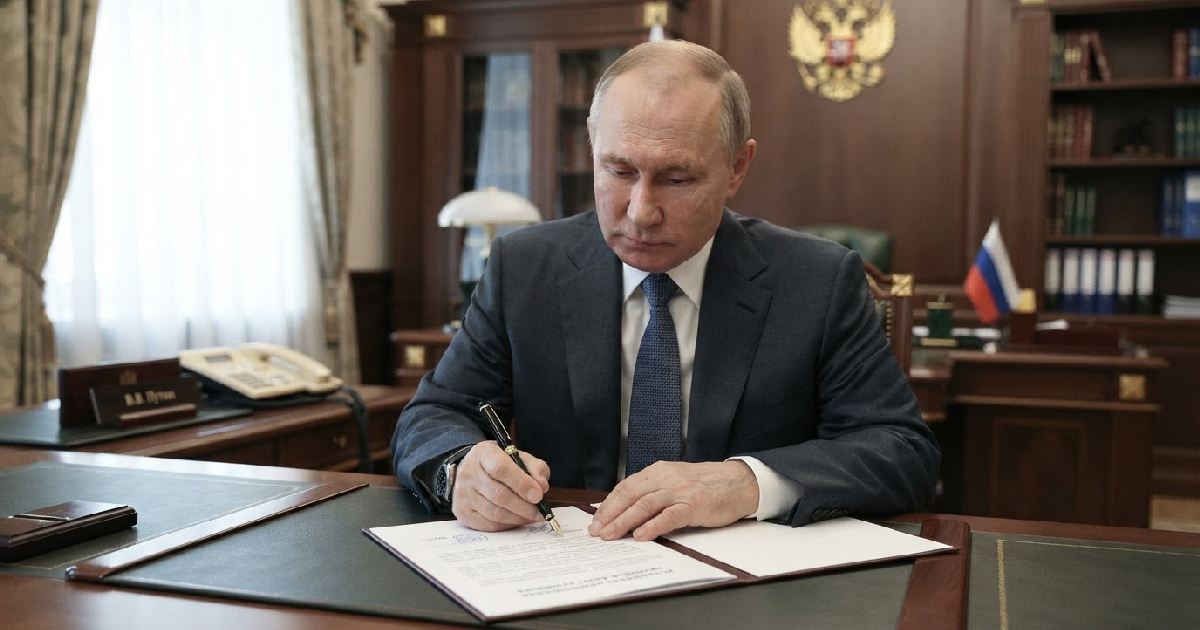

Russian President Vladimir Putin officially signed a comprehensive new law regulating cryptocurrencies on August 4, 2026. This landmark legislation, set to take effect for most core provisions on September 1, 2026, establishes Russia’s first formal licensed framework for digital asset trading, permitting cross-border transactions involving Bitcoin (BTC) and other digital assets.
The move signals a decisive shift from previous legal ambiguity, placing Russia significantly ahead of the United States, where the CLARITY Act still awaits a full Senate floor vote.
Establishing Russia’s Digital Asset Framework
This swift regulatory action provides a clear contrast to the protracted debates seen in Western economies. It underscores a strategic effort by Moscow to bring the nascent crypto industry under state control, offering a structured environment for market participants while simultaneously navigating the pressures of international sanctions.
The new law, formally titled “On Digital Currency and Digital Rights,” mandates stringent requirements for all cryptocurrency service providers operating within Russia. This includes exchanges, brokers, and custodians, which must now register directly with the Central Bank of Russia, known as the Bank of Russia.
Only entities listed in a special state register will be permitted to run cryptocurrency exchanges. Registered platforms must maintain a minimum capital of at least 15 million rubles, roughly $187,000 USD, and join a self-regulatory organization within the financial market. Digital depositories face even higher capital requirements, ranging from 50 million to 250 million rubles based on their specific financial services.
Defining Market Activity and Eligible Assets
The regulation also clearly delineates what constitutes “active trading” or “systemic trading activity.” Regulators have set this threshold at two or more transactions within a month, totaling 3.5 million rubles (approximately $43,700 USD) or more. This distinction aims to separate licensed market makers from casual, one-off traders.
Moreover, the law restricts public trading to a select list of cryptocurrencies. To qualify, assets must have an average market capitalization exceeding 5 trillion rubles and demonstrate a daily trading volume of over 1 trillion rubles for two consecutive years. Currently, only Bitcoin (BTC), Ethereum (ETH), and the stablecoin USDT meet these rigorous criteria.
Anatoly Aksakov, chairman of the State Duma’s Financial Markets Committee, emphasized the rationale behind these strict measures. He stated that the “mass use of anonymous wallets and the gray circulation of cryptocurrencies contradict the idea of a legal market.” This reflects a broader government objective to ensure transparency and prevent illicit financial activities within the digital asset space.
Retail Investor Safeguards and Domestic Payment Restrictions
While the new framework opens doors for institutional trading, retail access comes with notable limitations. Non-qualified investors, defined as those who haven’t passed a mandatory knowledge test, face an annual purchase cap of 300,000 rubles (about $3,700 USD) per licensed intermediary. They can only buy crypto-assets specifically approved by regulators as “most liquid.”
Qualified investors, however, are exempt from these annual investment limits, provided they also complete a suitability test. Their past cryptocurrency trading history may play a role in determining their eligibility. These measures aim to protect less experienced investors from the inherent risks of the volatile crypto market.
Continued Ban on Domestic Crypto Payments
Despite the broader legalization, the law explicitly maintains Russia’s prohibition on using cryptocurrencies as a form of payment for goods, services, information, or intellectual property within the country. Officials cite the need to protect the stability of the ruble, arguing that widespread domestic crypto use could undermine demand for the national currency.
The law also extends to advertising, banning any promotion or dissemination of information that encourages domestic cryptocurrency payments. However, it does carve out exceptions for cross-border settlements in foreign trade contracts, transactions involving mined cryptocurrencies, payment of fees within digital asset platforms, and settlements with other digital assets or securities.
Crypto Mining Gains Legitimate Status
A significant shift in the new regulation is the official recognition of cryptocurrency mining as a legitimate economic activity. This classification provides a clear legal basis for miners, who were previously operating in a regulatory grey area. Industrial miners are now required to register with authorities, report their produced cryptocurrency, and pay applicable taxes.
Individual miners operating at home can avoid registration, provided their electricity consumption remains below government-stipulated limits. However, the law does introduce some restrictions, with mining being limited or seasonally restricted in certain regions until at least 2031, a measure designed to prevent potential power shortages.
Global Regulatory Race: Russia Versus the US
The speed and comprehensiveness of Russia’s new crypto regulation stand in stark contrast to the slower legislative pace in the United States. While Russia’s law is already signed and scheduled for implementation on September 1, the US CLARITY Act remains in legislative limbo.
The CLARITY Act, a market structure bill intended for US crypto exchanges, advanced through the Senate Banking Committee with a 15-9 vote in May. However, it still requires a full Senate floor passage, reconciliation with a competing House version, and a presidential signature before it can take effect. This complex and multi-stage process highlights the divergent approaches to digital asset oversight between the two nations.
Russia’s proactive regulatory stance also reflects its broader geopolitical context. The nation has faced successive rounds of European Union sanctions, which have progressively limited its access to global financial systems.
By establishing state-licensed crypto rails, Russia aims to create a controlled avenue for trade and financial activity, mitigating some of the effects of these Western restrictions.
This new framework transforms what might have been a temporary workaround for foreign trade payments into a foundational licensing regime, providing a clear, albeit tightly controlled, path forward for digital assets.
The full registration requirements for existing platforms, effective July 1, 2027, give the industry a transition period. This phased implementation suggests a strategic intent to integrate crypto operations into the existing financial infrastructure rather than completely stifling innovation. It also provides the Bank of Russia with ample time to refine its oversight mechanisms and adapt to the evolving digital asset landscape.
This divergence in regulatory trajectories could have significant implications for the global cryptocurrency market. As Russia moves to formalize its crypto sector, it offers a different model for state control and integration, one driven by both economic strategy and geopolitical necessity.
It’s a model that prioritizes oversight and stability, even if it comes at the cost of some of the decentralization principles often championed by the crypto community.
Ultimately, Russia’s swift move to implement a comprehensive crypto regulation suggests a clear recognition of digital assets’ growing importance. It positions the country as a jurisdiction with defined rules, regardless of the motivations behind them.
This contrasts sharply with the ongoing uncertainty that continues to characterize the regulatory environment in the US, making the market impact of these distinct approaches a key area to watch in the coming months and years.