
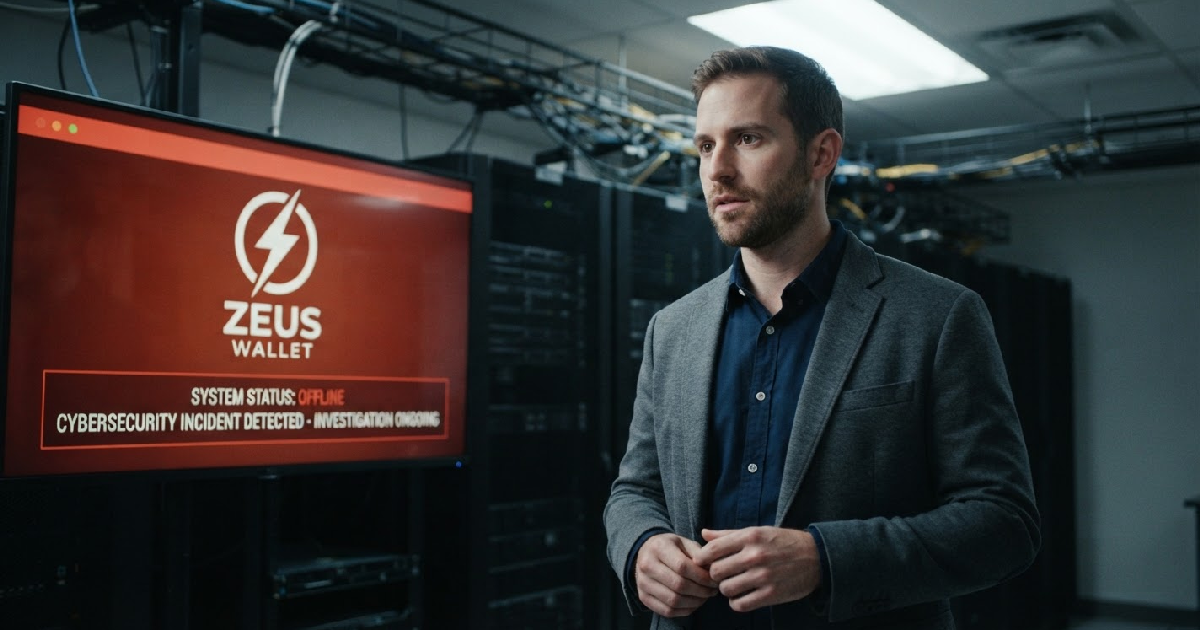

Zeus Wallet, a prominent self-custodial Lightning Network wallet, has temporarily taken its infrastructure offline after a cybersecurity incident. The event occurred within the last few hours of August 5, 2026, or early August 6, 2026 (UTC+8). Founder Evan Kaloudis confirmed no customer funds were lost or put at risk following the Zeus Wallet cyberattack.
The company announced it has already mitigated the attack. However, services will remain offline out of an abundance of caution while a comprehensive security audit is completed. This measure ensures all systems are thoroughly checked before any restoration.
Incident scope and customer funds secure
The cybersecurity incident was limited to ZEUS Wallet’s own infrastructure. Initial investigations show no evidence that the attack stemmed from a vulnerability in the broader Lightning node software. This indicates a targeted breach of ZEUS’s systems.
Evan Kaloudis, the founder of ZEUS, explicitly reassured users on X. He stated that “customer funds were neither lost nor at risk.” This highlights the security model of self-custodial wallets, where users maintain direct control over their private keys, safeguarding their assets even during platform disruptions.
This incident offers a crucial distinction within the crypto space. It shows that an attack on a service provider’s infrastructure doesn’t automatically compromise user funds in a truly self-custodial setup. Unlike centralized custodians, a wallet security vulnerability on the provider’s side doesn’t expose user private keys.
Impact on users and support channels
Customers whose Lightning Service Provider (LSP) channels were closed during the incident will receive replacement channels. The ZEUS team plans to process these requests once their service is fully restored and operational.
Affected users needing assistance should contact support via the email listed under the Help menu in the mobile app. The company has warned that response times for support may be slower than usual due to an anticipated backlog of inquiries.
Broader Lightning Network incidents
The ZEUS Wallet cyberattack comes shortly after service interruptions affected other Lightning Network providers. Earlier in the week, Boltz stopped processing swaps on August 3 after detecting an AI-assisted attack on its infrastructure.
Similarly, AQUA Wallet reported issues with its Lightning and Liquid swaps, prompting them to seek alternative providers. ZEUS has not indicated any connection between its incident and these disturbances, and no proof links them.
Despite these isolated provider-level issues, the Lightning Network’s public capacity actually increased. It grew by 28 BTC (0.61%) during the week covering August 6. This suggests that the incidents were specific to individual platforms rather than reflecting a widespread systemic vulnerability.
The number of public payment channels also rose by 256 (0.59%), while publicly accessible nodes saw a minor drop of 108 (0.73%). These metrics underscore the network’s resilience, reinforcing the importance of diversifying crypto holdings across multiple platforms or methods.
Strengthening future security measures
The incident has reinforced ZEUS’s commitment to ongoing security enhancements. The company is actively working to harden its infrastructure by integrating trusted execution environments. This technology aims to protect sensitive operations.
ZEUS is also leveraging the Validating Lightning Signer project in its upcoming architecture. This design is intended to help mitigate similar future breaches by isolating critical signing functions. The goal is to add a robust layer of protection against infrastructure-level compromises.
Why self-custody remains critical for users
The ZEUS Wallet cyberattack serves as a timely case study on the importance of self-custody in the cryptocurrency ecosystem. While any service provider can face infrastructure challenges, the self-custodial model fundamentally ensures user assets aren’t directly exposed.
When users hold their own private keys, their funds remain secure on the blockchain, even if a service provider’s servers are compromised. This core design principle allowed ZEUS to confidently state that no customer funds were lost, despite a significant attack on its operational infrastructure.
For users, this incident emphasizes the distinction between a wallet interface and actual custody of funds. A temporary service disruption can be inconvenient, but the critical aspect of self-custody is that private keys, and thus the funds, always remain under the user’s control, not the platform’s.