
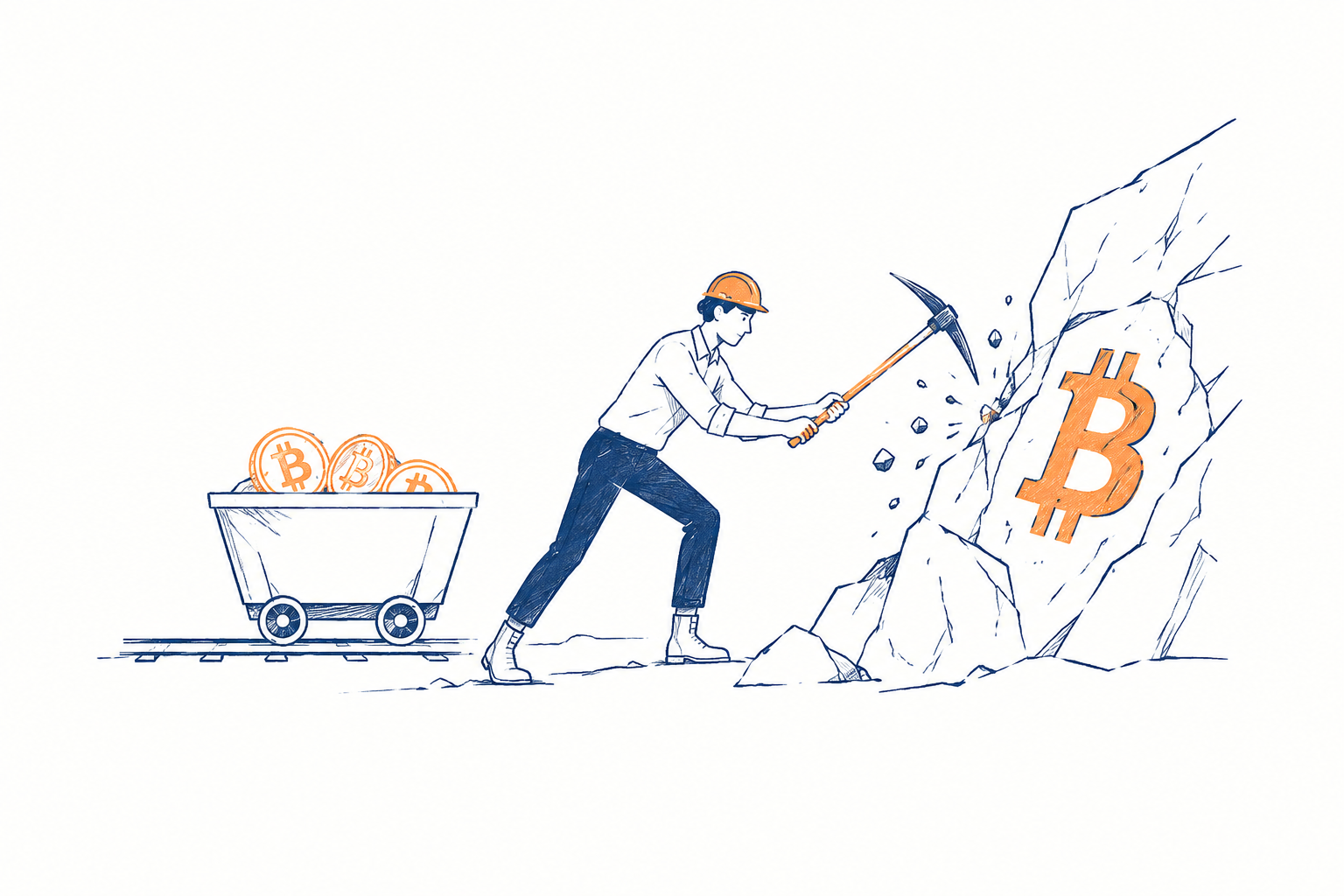

Learning how to mine cryptocurrency sounds like a technical question. In practice, the harder question is economic: what does it actually take to compete for block rewards once the machine is running?
A miner does not simply plug in a computer and wait for coins to appear. On a Proof-of-Work (PoW) blockchain, specialised hardware competes to produce a valid block, while electricity, network difficulty, hardware efficiency and pool fees determine what that activity looks like in practice.
That distinction is relevant because mining is both a piece of blockchain infrastructure and a real operating business. The software may be downloadable in minutes. The economics are considerably less forgiving.
A miner is competing for the right to add the next block
Proof-of-Work gives a blockchain a way to select who gets to propose the next block without relying on a central authority.
Miners assemble transactions into a candidate block and repeatedly hash its block header, changing values such as the nonce until they find a result below the network’s target. A hash is the fixed-length output of a cryptographic function; the process is effectively trial and error at enormous scale.
The winning miner broadcasts the block, which the network’s nodes can then check against the protocol’s rules. If it is accepted, the miner can receive the block subsidy and transaction fees included in the block.
That is why more computing power helps, but does not guarantee a reward. A miner with twice the hash rate has a larger share of the network’s attempts, not a reserved place in the next block. Bitcoin’s design automatically adjusts mining difficulty so blocks continue to arrive at roughly the intended rate.
The blockchain decides which machine makes sense
There is no universal piece of mining hardware.
The algorithm used by a Proof-of-Work network determines what kind of computation miners need to perform. Bitcoin, for example, uses SHA-256 and has become closely associated with application-specific integrated circuits, or ASICs. These are machines built for a narrow computational task rather than general-purpose computing.
Other PoW networks can have different hardware requirements. Some are designed to remain more accessible to GPUs or CPUs. Monero, for instance, uses RandomX, an algorithm designed around general-purpose processors.
The important point is not to memorise a list of machines. It is to start with the network. If the hardware is not well matched to its algorithm, the headline hash rate means very little.
The same logic explains why not every major cryptocurrency can be mined. Ethereum, for example, switched from Proof-of-Work to Proof-of-Stake, so ETH is no longer produced through mining. Its network now uses validators rather than miners.
A mining setup has a few more moving parts than the machine
Once a suitable PoW network has been chosen, the practical setup is relatively straightforward.
You need compatible mining hardware, software that connects it to the network or a mining pool, and a wallet that can receive the rewards. The physical side matters too. A high-performance miner generates heat and noise, consumes continuous power and may need additional ventilation or cooling.
This is one reason mining is easy to misunderstand: the equipment is visible, while the infrastructure and running costs are not.
A machine can operate perfectly well while producing an unattractive result once electricity and other costs are included.
Mining pools change the rhythm of rewards
A solo miner competes against the entire network alone. If that miner finds a valid block, the block reward belongs to them, subject to the protocol and any relevant transaction fees.
The difficulty is that a single machine may account for only a tiny fraction of the network’s total hash rate. That can turn rewards into a highly irregular event.
A mining pool combines many miners’ hash rate and distributes rewards according to its payment rules and each participant’s contribution. The result is typically smaller but more frequent payouts.
Pools smooth reward timing, but they do not remove costs or make inefficient hardware competitive.
Electricity is where the mining equation becomes real
For a mining operation, revenue is only half of the story.
The basic calculation is:
Mining revenue − electricity − hardware costs − cooling − maintenance − pool fees = operating result
The electricity line deserves particular attention because it continues while the machine is running. A miner that looks efficient on paper can become uneconomic when its power bill is high.
Hardware efficiency matters for the same reason. Hash rate tells you how much computation a machine can perform, but the better comparison is how much computing power it delivers for the energy consumed.
This is also why buying the newest or most powerful machine is not automatically the right decision. Two devices can have different upfront prices, power requirements and useful lives, and the cheaper machine can still be the more expensive one to operate.
Before buying hardware, the question is therefore not “How much can this miner make?” but “What assumptions make this machine viable?”
Mining profitability can change after the purchase
The awkward part of mining economics is that several variables are outside the miner’s control.
Network difficulty can change as the amount of computing power participating changes. The market value of the mined asset can also move sharply. Hardware can lose its competitive edge as newer machines arrive, while electricity prices and other operating costs can change at the same time.
So a profitability estimate is not a permanent characteristic of a mining machine. It is a calculation under a particular set of assumptions.
That makes mining different from buying a piece of equipment for a conventional business where the output and selling price may be easier to estimate. Here, the miner is entering an open competition in which other participants are constantly changing the conditions.
An open protocol can still produce an unequal business
This is the tension at the heart of mining.
Proof-of-Work is permissionless at the protocol level. Anyone with compatible hardware can attempt to participate. But the ability to compete economically is another matter.
As efficiency becomes more important, miners with better hardware, lower electricity costs, stronger infrastructure and greater scale can gain an advantage. Smaller operators can still participate, but they may find that technical access and economic competitiveness are two very different things.
That does not make mining “closed”. It reveals a more interesting trade-off: the network can remain open while the business of mining becomes increasingly demanding.
For an individual considering home mining, this distinction is crucial. A machine running successfully in a spare room is evidence that the system works. It is not, by itself, evidence that the operation makes economic sense.
What to work out before you mine cryptocurrency
The practical steps are simple enough: choose a Proof-of-Work network, match the hardware to its algorithm, install the necessary software, configure a wallet, decide whether to mine solo or through a pool, and monitor the machine.
The difficult part comes before all of that.
You need to understand the hardware’s efficiency, your electricity cost, the network’s difficulty, expected pool fees, cooling and maintenance requirements, and how quickly the equipment may lose its advantage. Those variables can matter more than the reward advertised on a mining calculator.
That is the real lesson behind how to mine cryptocurrency. The technical barrier to switching on a miner may be manageable. The economic barrier is dynamic, because every miner is competing not only with the network’s algorithm, but with everyone else trying to make the same calculation work.
Mining starts with a machine. Whether it makes sense starts with the spreadsheet.