
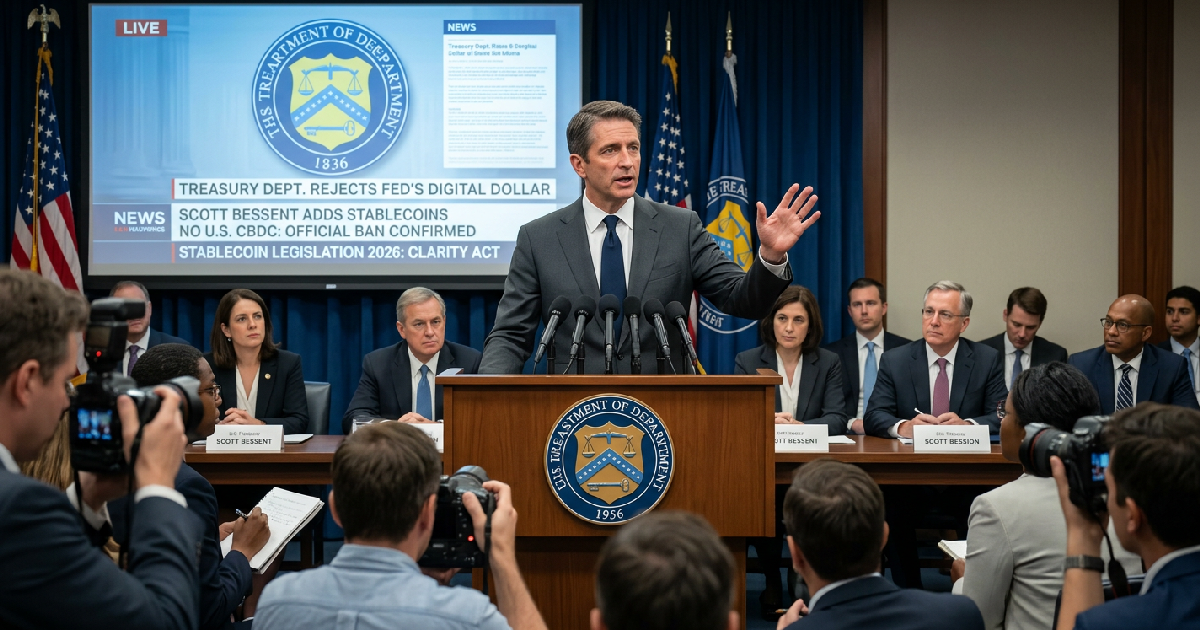

U.S. Treasury Secretary Scott Bessent has officially ruled out the creation of a central bank digital currency (CBDC), stating today that the President Donald Trump administration will instead prioritize stablecoin legislation and the CLARITY Act to bolster domestic crypto investments. The announcement confirms a definitive shift in American monetary policy, as the executive branch aligns with recent Senate legislation that institutes a moratorium on a “digital dollar” until at least 2030.
During a press conference on May 29, 2026, Secretary Scott Bessent grounded the administration’s decision in concerns over government overreach and personal privacy. He argued that a state-issued digital currency would provide a gateway for the federal government to track individual financial transactions, a prospect the current Treasury finds unacceptable. “There will be no Central Bank Digital Currency,” Bessent told reporters, emphasizing that the project has been “taken off the table” to prevent state surveillance.
This policy pivot effectively ends years of exploration by the Federal Reserve into a retail CBDC, which proponents had argued would streamline payments and maintain the dollar’s status as a global reserve currency. However, the U.S. Treasury now views the private sector as the primary engine for digital asset innovation. By backing the CLARITY Act’s legislative progress, the administration aims to provide the regulatory certainty needed to keep capital within the United States.
Treasury shifts focus toward stablecoin regulation and private innovation
The decision to reject a CBDC does not mean the U.S. is withdrawing from the digital finance race. Instead, the Treasury Department is doubling down on private stablecoins like those issued by Circle and Tether. Secretary Scott Bessent highlighted that establishing a clear legal framework for these assets is the “important thing” for the current economic agenda, suggesting that privately issued tokens can fulfill the role of a digital dollar without the risks of state monitoring.
This stance coincides with a period where macro outlook warnings have made investors more cautious about government-controlled financial pipes. By opting for stablecoins, the Treasury believes it can allow the market to handle retail transactions while the government focuses on high-level oversight. This approach also seeks to mitigate fears of “backdoor freezing” of funds, a feature often discussed in CBDC whitepapers that has drawn heavy criticism from civil liberties advocates.
Industry leaders have largely welcomed the focus on the CLARITY Act, which seeks to distinguish between different types of digital assets. We have already seen how regulatory shifts impact specific ecosystems, such as when David Schwartz joined the XRPL Foundation amid broader discussions of legislative clarity. The Treasury’s rejection of a CBDC is seen by many in the industry as a victory for the “decentralized” ethos of the crypto market.
Global landscape sees high-profile cancellations of digital currency projects
The United States is not alone in its retreat from state-issued digital tokens. As of May 2026, several other nations including Canada, Denmark, Norway, Finland, Kenya, and the Philippines have also canceled or indefinitely paused their CBDC plans. This wave of cancellations suggests a growing skepticism toward the necessity of retail CBDCs in an era where private payment technology is rapidly evolving.
Despite this trend, the global landscape remains divided. According to data from the CBDC Tracker, four nations have fully launched their digital currencies: Nigeria, Kazakhstan, Jamaica, and the Bahamas. Major economies like China and India continue to move forward with pilot programs for the e-CNY and e-rupee, respectively. The Atlantic Council reports that roughly 91% of central banks were still exploring some form of CBDC as recently as late 2025.
The debate is now shifting from retail applications to “wholesale” CBDCs. These instruments are designed for high-value settlements between major banks and governments rather than for everyday consumer use. Project Agora, supported by the Bank for International Settlements (BIS), remains a primary vehicle for testing these tokenized wholesale payments, though it remains unclear if the U.S. will participate in future live trials under the current administration.
Future of the digital dollar after the 2030 ban
While the Trump administration has closed the door on a digital dollar for the immediate future, the Senate’s ban only extends until 2030. This six-year window provides a buffer for the private stablecoin market to mature and for the CLARITY Act to be fully implemented. It also leaves room for future administrations to revisit the concept should the global competitive landscape change significantly.
For now, the Treasury Department’s priority remains the repatriation of crypto investment. By removing the threat of a state-competitor in the form of a CBDC, officials hope to encourage domestic fintech firms to expand their stablecoin offerings. This strategy bets on the idea that the U.S. dollar’s digital future is better served by the private sector than by the halls of the Federal Reserve.