
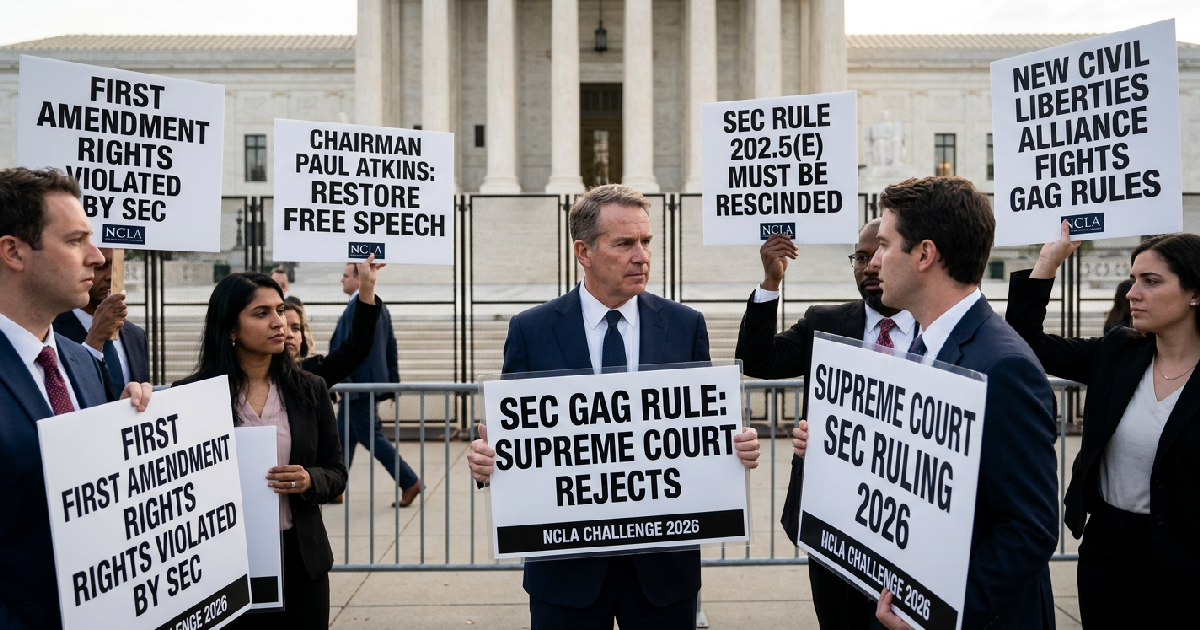

The U.S. Supreme Court on Monday, June 29, 2026, declined to hear a significant First Amendment challenge to the Securities and Exchange Commission (SEC) “gag rule,” bringing an end to a high-profile legal battle over the agency’s power to silence defendants. The court’s decision to turn away the case, Powell v.
Securities and Exchange Commission, comes just weeks after the agency voluntarily rescinded the 54-year-old policy under the leadership of Chairman Paul Atkins. By refusing to hear the appeal, the justices left the underlying constitutional questions unanswered, much to the frustration of free-speech advocates who had hoped for a definitive ruling against the practice.
Supreme Court rejects SEC gag rule appeal
The litigation was spearheaded by the New Civil Liberties Alliance (NCLA) on behalf of Thomas Powell, an individual who settled SEC charges in 2021 involving unregistered oil and gas securities. As a condition of that $75,000 settlement, Thomas Powell was forced to sign a “no-deny” clause, a staple of SEC enforcement for decades.
These clauses legally prohibited defendants from ever publicly disputing the SEC’s allegations, even as they were technically allowed to “neither admit nor deny” the charges in court. Critics have long characterized this as a form of government-mandated censorship that prevented the public from hearing the full story of regulatory overreach.
The refusal by the U.S. Supreme Court to grant certiorari effectively means the justices found the case moot, or no longer a live controversy requiring their intervention. Because the SEC rescinded Rule 202.5(e) in May 2026, the government argued that Thomas Powell’s challenge no longer carried legal weight.
However, legal experts and the NCLA argued that without a formal precedent, the SEC could simply reinstate the policy the moment a more aggressive administration takes office. The lack of a ruling leaves a door open for future regulators to once again trade settlement agreements for a defendant’s right to speak.
The Gag Rule, which was adopted in 1972 without a formal notice-and-comment period, has been a thorn in the side of high-profile figures for years.
Prominent critics like Elon Musk and Mark Cuban filed amicus briefs earlier in the case, arguing that the rule created a “de facto” gagging of the most successful critics of federal agencies.
They contended that the SEC used its leverage to force individuals into silence, knowing that the cost of fighting a federal investigation at trial is often prohibitive for all but the wealthiest defendants.
And while the SEC has promised not to enforce old no-deny clauses, the legal framework for those past agreements remains in a gray area. The NCLA wrote in its final briefs that the government’s sudden reversal was a tactical move to avoid a stinging defeat at the nation’s highest court. Former U.S.
Key details
Solicitor General Greg Garre had urged the court to take the case regardless, asserting that Americans should not have to bargain away their First Amendment rights to resolve civil litigation with the state.
Impact on current and future crypto enforcement actions
For the digital asset industry, the Supreme Court’s inaction is a double-edged sword. While the rule is currently dead, the lack of a constitutional burial means it remains a potential zombie policy. Many crypto firms that settled under the old regime may now feel emboldened to speak out about their experiences with the agency.
Over the last year, the Ethereum support analysis and general market reactions have shown that regulatory clarity is the most sought-after commodity in the space.
The SEC recently admitted to “flaws” in its previous aggressive approach to the sector, dropping seven cases against major players like Coinbase, Binance, and Kraken.
For these companies, the end of the gag rule means they can finally address the technical and procedural specifics of their settlements without the fear of the SEC reopening their cases.
This newfound freedom of speech could lead to a wave of “post-settlement” disclosures that illuminate the inner workings of the SEC’s crypto-enforcement unit during the previous administration.
The Commodity Futures Trading Commission (CFTC) also followed the SEC’s lead, repealing its own 1998 gag rule this month. The shift toward transparency suggests a broader change in the federal regulatory tone toward a “show your work” philosophy.
As XRP Clarity Act legislative progress continues to move through Congressional committees, the dismantling of administrative hush-money tactics aligns with a legislative push to rein in executive agency overreach.
The New Civil Liberties Alliance warns of future policy reversals
The New Civil Liberties Alliance has remained vocal in its disappointment, calling the court’s silence a missed opportunity to protect the First Amendment.
Representatives from the group pointed out that if a change in the White House brings back a new SEC Chairman with a different philosophy, Rule 202.5(e) could be resurrected with the stroke of a pen. “Rules that can be rescinded overnight can also be reinstated overnight,” the group stated in a recent reply brief.
The government, they argue, has failed to provide a permanent guarantee that the gag rule is gone for good.
Under Chairman Paul Atkins, the SEC has pivoted toward a less adversarial relationship with the markets it oversees. However, Paul Atkins’ term is not permanent, and the administrative state has a long history of cyclical policy returns.
Key details
By allowing the SEC to “self-correct” just before a Supreme Court showdown, the justices have essentially allowed the agency to dictate the timing of its own accountability. This tactic, often referred to as “voluntary cessation,” is frequently used by agencies to dodge judicial review when a case looks like it might go against them.
But the pressure is not just coming from the courts. Lawmakers are increasingly skeptical of how agencies like the SEC and CFTC handle their settlement processes. The narrative of “regulation by enforcement” has taken a hit as more details of these deals become public.
If defendants like Thomas Powell start sharing their stories of the pressure tactics used to secure settlements, it may add fuel to the fire for those demanding comprehensive reform of the Securities Exchange Act.
The Bitcoin price analysis and other market indicators often reflect this regulatory uncertainty, showing that the market values a stable and predictable legal environment above all else.
Future implications for market transparency and retail investors
The ultimate beneficiaries of the gag rule’s demise—even without a Supreme Court mandate—are the retail investors. For decades, the public was only given the SEC’s version of the facts in settled cases. By preventing defendants from offering their side of the story, the agency created a lopsided historical record of its enforcement successes.
Now that the silence has been lifted, researchers and investors can better evaluate whether certain settlements were based on genuine fraud or were the result of a defendant simply lacking the resources to fight back.
This shift is particularly relevant as the U.S. prepares for a new era of digital finance. With more sophisticated products entering the market, the ability of firms to defend their business models publicly is crucial.
Key details
If a firm is accused of violating a technical rule but believes the rule itself is poorly defined, they can now settle the matter and then go to the press or Congress to explain why the regulation needs to change.
This creates a feedback loop that was previously blocked by the gag rule’s permanent injunction against denial.
What happens next likely depends on the individual courage of those who signed these agreements in the past. While the SEC has stated it will not seek to reopen cases if people speak out, the legal finality of those statements has not been tested in a courtroom.
For now, the “gag” is off, but the legal community remains wary of a future where federal agencies try to reclaim the power to control the narrative of their own investigations. The Supreme Court may have passed on the case today, but the debate over the limits of agency power is far from over.