
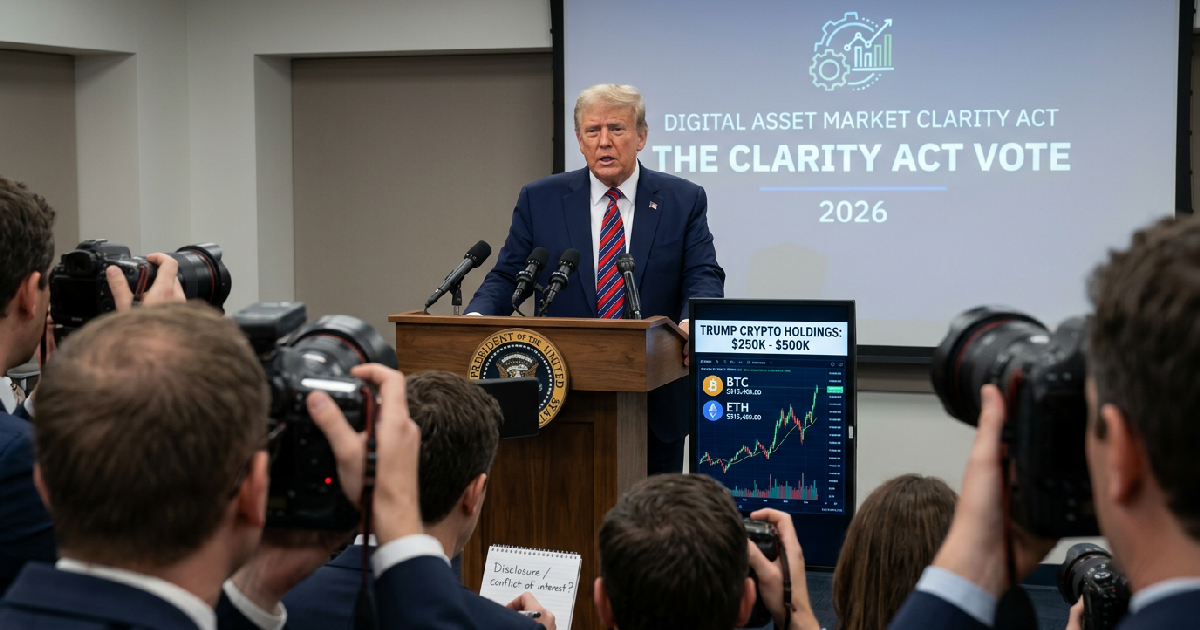

Donald J. Trump has released a new financial disclosure that reveals the former president holds significantly larger cryptocurrency assets than previously estimated, a development that now sits at the center of the upcoming vote on the CLARITY Act.
The 2026-07-01 filing indicates that his digital asset portfolio, which includes a mix of Ethereum and Bitcoin, has grown to a valuation that positions his personal wealth as a major stakeholder in the very industry he would regulate if re-elected.
Quantifying the Trump cryptocurrency portfolio
The timing of this disclosure is critical as the United States Congress prepares to vote on the Digital Asset Market Clarity Act of 2025 (CLARITY Act). This legislation aims to provide the first comprehensive regulatory framework for stablecoins and digital asset market structures.
Critics and supporters alike are now grappling with the reality that the bill’s passage could directly impact the personal net worth of a leading presidential candidate, shifting the legislative debate from abstract policy to a question of potential conflicts of interest.
The CLARITY Act has long been the subject of intense lobbying from the digital finance sector, but these new financial figures have altered the political calculus. For months, market sentiment shifts as CLARITY Act advances have been tied to the hope of institutional adoption.
Now, the focus has pivoted to the specific holdings of Donald J. Trump, which include not only direct cryptocurrency but also significant positions in Non-Fungible Tokens (NFTs) and licensing agreements with crypto-native firms.
Key details
The specific documents filed with the Office of Government Ethics (OGE) show a diverse array of digital holdings that exceed earlier reports. While past filings suggested a modest interest in the space, the 2026 data shows Donald J.
Trump owns between $250,000 and $500,000 in a “cryptocurrency wallet” holding Ethereum, alongside substantial income from his “Trump Digital Trading Cards” NFT collection. The income from these digital assets alone is estimated to have generated millions in royalties over the last fiscal year.
Beyond the direct holdings, the disclosure highlights a complex web of licensing deals that pay out in digital assets. These arrangements mean that the value of his estate is increasingly correlated with the health of the broader crypto market.
If the CLARITY Act passes, it would likely stabilize market volatility and invite more traditional finance players into the fray, which analysts suggest would provide a significant tailwind for the value of the former president’s specific assets.
This financial entanglement represents a unique moment in American political history. Never before has a major party’s presumptive nominee held such a large, liquid, and technologically specialized portfolio that depends so heavily on domestic legislative outcomes. The connection remains particularly sensitive given the former president’s public cooling toward central bank digital currencies (CBDCs) and his vocal support for domestic Bitcoin mining operations.
How the CLARITY Act impacts stablecoins and market structure
To understand why these disclosures are so flammable, one must look at the specific provisions of the CLARITY Act. The bill, officially known as H.R. 3633, focuses on creating a “regulatory perimeter” for digital assets. It explicitly defines which tokens are securities and which are commodities, a distinction that has plagued the industry for years.
For an investor with the scale of Donald J. Trump, this legal certainty is almost as valuable as the assets themselves.
The act provides a clear pathway for stablecoin issuers to operate under federal oversight, which many believe will lead to a surge in Ethereum network usage. As Ethereum remains a cornerstone of the former president’s reported holdings, the legislation could act as a catalyst for his portfolio’s growth.
Key details
Currently, Ethereum network outlook strengthens whenever legislative clarity appears on the horizon, creating a feedback loop between Washington D.C. and the digital markets.
Legislative hurdles and committee progress
Despite the controversy surrounding the disclosure, the bill continues to move through the House Committee on Financial Services. Proponents of the act argue that the personal holdings of any single politician should not derail a framework that the entire American economy needs to stay competitive. They note that other members of Congress also hold digital assets, though rarely on the scale of the former president.
However, the opposition is seizing on the $1 billion “payday” narrative. They argue that the bill’s favorable tax treatment for certain digital transactions and its lenient stance on self-custody wallets are tailored to benefit large-scale holders like Donald J. Trump.
The debate is no longer just about preventing financial crime; it has become a referendum on the ethics of legislating a market in which the executive branch might have a billion-dollar stake.
Conflict of interest and the 2026 political landscape
Legal experts are divided on whether Donald J. Trump would be required to divest his holdings if he wins the presidency. Under current law, the president is exempt from many conflict-of-interest statutes that apply to other executive branch officials. However, the sheer size of the crypto market and its vulnerability to regulatory tweets make this a different scenario than traditional real estate or stock holdings.
The presence of significant Bitcoin and Ethereum positions in his portfolio aligns him with a growing voter bloc often referred to as “single-issue crypto voters.” These individuals view the CLARITY Act as a “bill of rights” for digital finance. By holding these assets, Donald J.
Trump is not just an investor; he is symbolically part of the community he is promising to protect. This branding has been effective, even as it draws fire from ethics watchdogs.
Furthermore, the volatility of these assets adds a layer of risk to his campaign. If there were a major market crash—similar to previous cycles—it could wipe out a portion of the candidate’s reported wealth overnight. Conversely, a bull run triggered by legislative progress could be framed by opponents as “insider legislating.”
As the Bitcoin price analysis repeatedly shows, the market is highly sensitive to political narrative, and there is no louder narrative than the personal wealth of the former president.
Forward-looking implications for the digital asset industry
Whatever the outcome of the CLARITY Act vote, the link between high-level politics and digital asset wealth is now permanent. The disclosure has forced other candidates to be more transparent about their own “on-chain” activities. Before this filing, most voters assumed political wealth was tied to BlackRock funds or real estate trusts.
Now, the public is learning that the future of political financing may be written in code.
The crypto industry’s reaction to the disclosure has been cautiously optimistic. While the optics are difficult, the fact that a major political figure is so heavily invested suggests that a total ban or extremely hostile regulation is increasingly unlikely.
Key details
For the industry, the former president’s $1 billion stake serves as a form of insurance against the “anti-crypto army” led by figures such as Senator Elizabeth Warren.
In the coming weeks, the House is expected to bring the CLARITY Act to a full floor vote. All eyes will be on whether the Republican caucus remains united behind the bill or if the “conflict of interest” label causes enough moderate members to defect. For Donald J.
Trump, the vote represents a dual-track victory: a win for his policy platform and a potential massive increase in his personal net worth.