
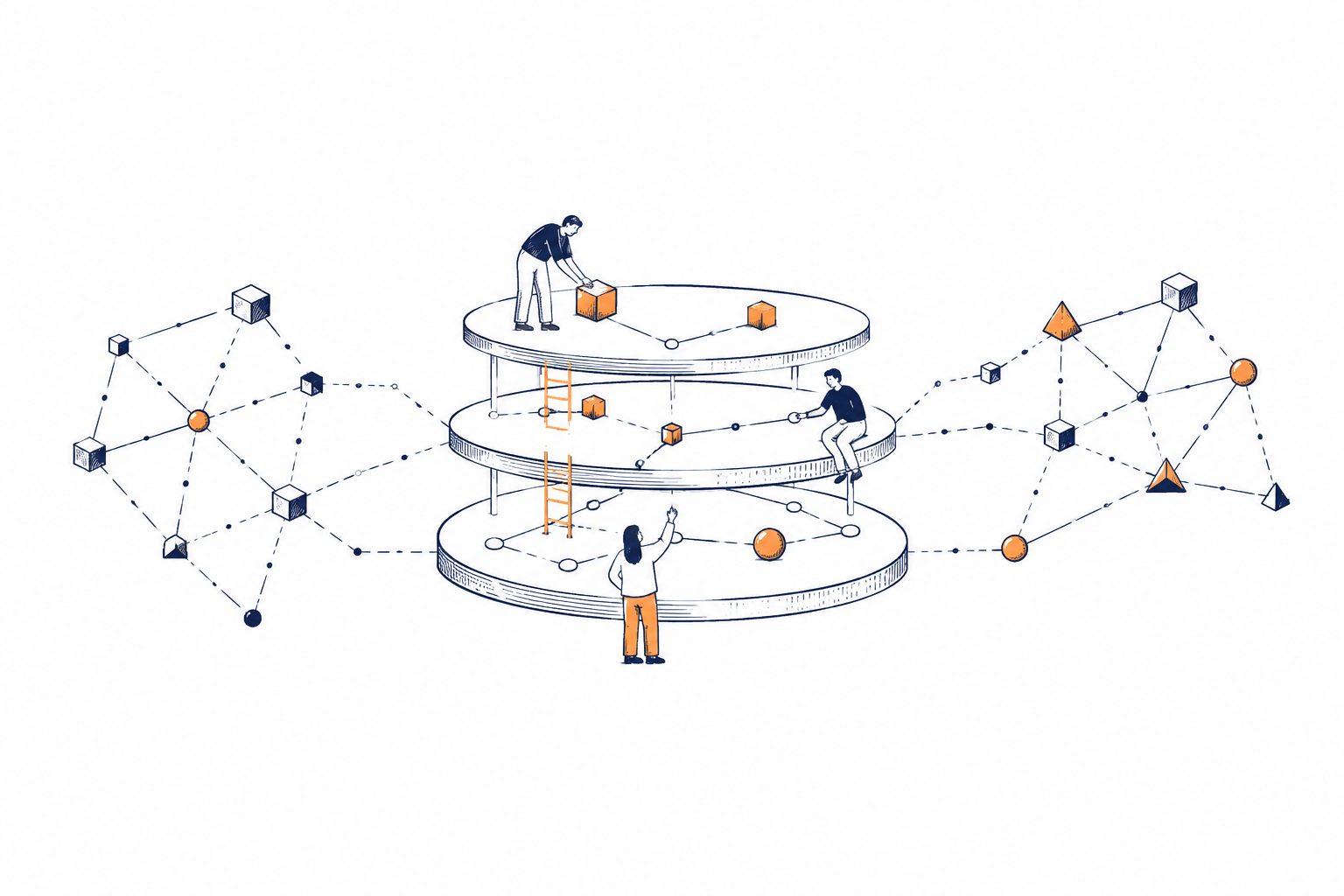

At first glance, it seems unnecessary. After all, Layer 2 solutions were introduced to tackle some of blockchain’s biggest limitations, including high transaction fees and network congestion. If those problems are being addressed, adding yet another layer can look like technology searching for a problem.
The reality is more nuanced.
A Layer 3 blockchain isn’t simply another attempt to process more transactions per second. Instead, it reflects a broader shift in how blockchain infrastructure is evolving. Rather than focusing solely on scaling entire networks, developers are increasingly trying to build environments tailored to specific applications, users and industries.
As decentralised applications become more sophisticated, they often require different trade-offs than a general-purpose network can provide. A gaming platform, for example, has very different technical priorities from a decentralised exchange or an on-chain social network.
Layer 3 networks aim to provide that flexibility without sacrificing the security foundations established by the layers beneath them.
Understanding why they exist means looking beyond the idea of “more scalability” and asking a more important question: what happens when blockchain infrastructure stops optimising networks and starts optimising the applications built on top of them?
Blockchain architecture is becoming more specialised, not simply more powerful
The evolution of blockchain infrastructure has followed a fairly consistent pattern. Each new layer has emerged because the previous one couldn’t optimise every aspect of the network simultaneously.
Layer 1 blockchains, such as Bitcoin and Ethereum, prioritise security and decentralisation. Their job is to maintain consensus, validate transactions and preserve the integrity of the ledger. These responsibilities make them exceptionally secure, but they also impose practical limits on transaction throughput and cost.
Layer 2 networks were introduced to ease those constraints.
Instead of processing every transaction directly on the main blockchain, Layer 2 solutions handle much of the activity elsewhere before settling the final result back on Layer 1. This reduces congestion, lowers fees and allows significantly more users to interact with the ecosystem at the same time.
For many applications, that’s already enough.
However, not every decentralised application faces the same challenges.
As blockchain ecosystems matured, developers realised that some projects weren’t limited by transaction speed alone. They needed greater control over how their applications behaved, how users interacted with them and even how network fees were managed.
That’s where the idea behind a Layer 3 blockchain begins.
Rather than asking, “How can we scale Ethereum further?”, the question becomes, “How can we build the best possible environment for this particular application?”
It’s a subtle but important change in perspective.
Infrastructure is no longer evolving only to increase capacity. It’s evolving to support increasingly diverse types of software.
The next challenge isn’t handling more transactions but building better applications
One misconception surrounding Layer 3 blockchains is that they exist to outperform Layer 2 on raw performance metrics.
In reality, speed is often only part of the equation.
Imagine a busy motorway. Building additional lanes helps reduce traffic, which is essentially what Layer 2 networks accomplish for many blockchains. But some destinations eventually require dedicated roads rather than wider motorways.
An airport, a shipping port or a sports stadium doesn’t simply benefit from more motorway lanes. Each needs infrastructure designed around its own patterns of movement.
Blockchain applications are beginning to reach a similar stage.
A decentralised finance protocol may prioritise liquidity and security above everything else. A blockchain-based game might instead require rapid interactions, predictable costs and minimal interruption to gameplay. Meanwhile, a consumer-facing social application may place the greatest emphasis on simplicity, where users barely notice they’re interacting with blockchain technology at all.
Trying to serve every one of these use cases with exactly the same infrastructure can become increasingly inefficient.
Layer 3 networks provide developers with greater flexibility to tailor their environment around the specific needs of an application rather than forcing every project into identical technical constraints.
This doesn’t replace Layer 1 or Layer 2.
Instead, it builds upon them.
The relationship is cumulative rather than competitive. Each layer performs a different role, allowing the overall architecture to become more adaptable without compromising the security inherited from the underlying blockchain.
That layered approach also explains why discussions around Layer 3 blockchain often focus less on blockchain itself and more on the applications users actually interact with.
The technology is becoming increasingly invisible.
The biggest bottleneck isn’t blockchain speed anymore
Many newcomers assume that blockchain adoption depends primarily on making networks faster.
While performance remains important, developers are increasingly focused on something much less visible: reducing friction.
For many users, the most difficult part of using a decentralised application isn’t waiting for a transaction confirmation. It’s understanding wallets, managing private keys, signing multiple requests and navigating interfaces filled with unfamiliar terminology.
Even experienced crypto users sometimes underestimate how intimidating these steps appear to someone interacting with blockchain for the first time.
This is one reason concepts such as account abstraction have attracted growing attention.
In simple terms, account abstraction allows developers to redesign how blockchain accounts function so that interacting with decentralised applications feels more like using conventional software. Instead of exposing every technical process to the user, applications can automate or simplify many of those interactions behind the scenes.
The blockchain still performs the same underlying operations.
The difference is that users don’t necessarily need to understand every one of them.
For applications hoping to reach mainstream audiences, that distinction is significant.
Few people expect to understand how internet routing works before opening a website. Likewise, many blockchain developers believe future users shouldn’t need an advanced understanding of wallets, gas fees or cryptographic signatures simply to access an application.
From that perspective, a Layer 3 blockchain isn’t just another infrastructure upgrade.
It’s part of a broader effort to make blockchain technology fade into the background, allowing the product itself to take centre stage.
Why gaming and social platforms are leading the Layer 3 experiment
The clearest examples of a Layer 3 blockchain adoption have emerged in sectors where user experience matters just as much as blockchain performance.
Blockchain gaming is one of them.
The most interesting Layer 3 projects aren’t trying to compete with Ethereum or other Layer 1 blockchains. They’re trying to create environments where a specific category of application can perform better than it could on a more generic network.
Unlike many financial applications, games generate thousands of small interactions that players expect to happen instantly. Delays, unpredictable fees or repeated wallet confirmations can quickly disrupt the experience, making blockchain feel like an obstacle rather than an advantage.
That distinction often gets lost when discussions focus exclusively on transaction speed.
It’s also worth noting that the broader concept isn’t exclusive to Ethereum’s ecosystem. Other blockchain networks have explored different approaches to modular infrastructure and interoperability, demonstrating that the underlying idea — building specialised environments on top of secure foundations, extends beyond a single blockchain.
More layers don’t automatically create a better blockchain
As with many blockchain innovations, it’s easy to mistake additional infrastructure for automatic progress.
Layer 3 networks introduce genuine possibilities, but they also introduce new trade-offs.
The first is complexity.
Every additional layer adds technical decisions for developers, from deployment and maintenance to integration with the underlying infrastructure. For large projects, these trade-offs may be worthwhile. For smaller teams, they can create unnecessary overhead without delivering meaningful benefits.
There’s also the question of fragmentation.
One of blockchain’s strengths has always been the shared environment where applications can interact with the same ecosystem of users, liquidity and assets. As more specialised Layer 3 networks emerge, there’s a risk that activity becomes distributed across increasingly isolated environments.
Paradoxically, the same customisation that improves an individual application’s experience could make the broader ecosystem more fragmented.
Interoperability solutions continue to improve, but maintaining seamless communication across multiple specialised layers remains an ongoing challenge.
Perhaps the biggest misconception, however, is the belief that every decentralised application should eventually migrate to Layer 3.
In reality, many never will.
For countless projects, Layer 2 already offers an excellent balance between scalability, cost and security. Building another layer only makes sense if there’s a clear reason to customise the application’s infrastructure beyond what existing networks already provide.
That’s an important point because blockchain architecture isn’t a race to accumulate layers.
Each additional layer should solve a real problem.
Otherwise, it simply becomes another piece of infrastructure that developers — and eventually users, must navigate.
Why Layer 3 reflects a broader change in blockchain’s future
Looking at a Layer 3 blockchain purely as a technical upgrade misses the bigger story.
The emergence of specialised blockchain layers suggests that the industry’s priorities are changing.
The first generation of blockchain focused on proving that decentralised networks could operate securely without central authorities.
The second generation concentrated on making those networks practical at larger scales.
Layer 3 points towards a different challenge altogether: creating blockchain applications that feel intuitive enough for everyday users.
That shift explains why discussions increasingly revolve around user experience, application design and developer flexibility rather than headline figures such as transactions per second.
The infrastructure itself is becoming less visible.
In many ways, that’s a sign of technological maturity.
The internet became mainstream not because people suddenly understood routing protocols or server architecture, but because those technical details gradually disappeared behind intuitive products. Most users don’t think about the systems delivering a streaming video or processing an online payment — they simply expect those services to work.
Blockchain may be following a similar path.
If that happens, the most successful crypto applications of the future may not be those running on the fastest or most technically sophisticated networks. They may be the ones where users barely notice the blockchain at all.
That’s ultimately what makes the idea of a Layer 3 blockchain significant.
Its purpose isn’t to prove that another layer can exist.
It’s to recognise that blockchain infrastructure has entered a new phase — one where success depends less on making networks universally faster and more on making individual applications feel effortless to use.
Seen through that lens, Layer 3 blockchain isn’t simply another step in the blockchain scaling roadmap. It’s evidence that the conversation is shifting from infrastructure for its own sake to infrastructure that quietly adapts to the needs of the people using it.
For the future of decentralised applications, it could prove far more important than adding another layer alone.