
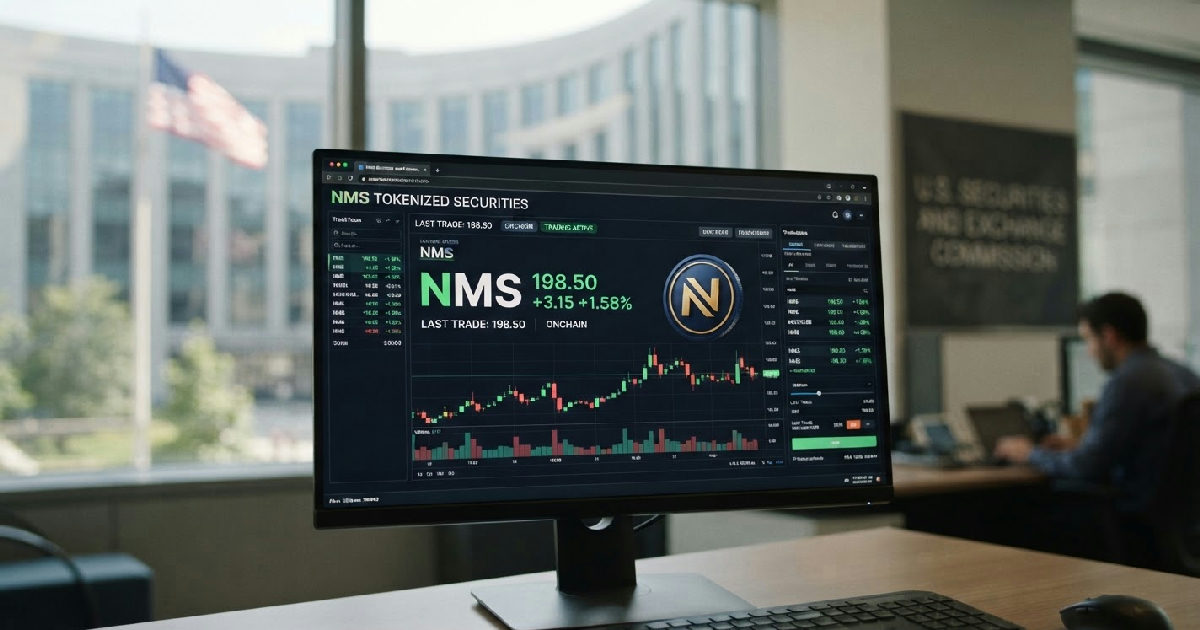

The SEC issued a conditional five-year exemption on September 17, 2026, permitting tokenized NMS stock trading on permissioned AMMs. S. Securities and Exchange Commission (SEC) on Thursday, September 17, 2026, issued a conditional five-year exemption permitting tokenized National Market System (NMS) stocks to trade on permissioned automated market makers (AMMs).
This move significantly advances the landscape for tokenized NMS stock trading. Simultaneously, the Commodity Futures Trading Commission (CFTC) staff broadened broker-registration relief for passive software providers across the industry.
These coordinated actions follow the Senate’s recent blockage of the CLARITY Act, underscoring a pivot towards administrative rulemaking in the absence of clear legislative direction.
SEC exemption paves way for tokenized NMS stock trading
This regulatory movement signals a significant step for integrating traditional financial assets with blockchain technology. Such policy changes often precede broader shifts in regulatory approach, including recent discussions around SEC custody changes.
The SEC’s new “Innovation Exemption” allows for the onchain trading of tokenized NMS stock, a move long anticipated by the digital asset sector. This exemption, valid until September 17, 2031, applies specifically to NMS stocks tokenized by the issuer or an unaffiliated third party.
It provides crucial relief under the Securities Exchange Act of 1934. Certain Tokenized Securities Venues (TSVs) are exempt from the “exchange” definition, while “Covered Firms” acting as liquidity providers in AMM Liquidity Pools gain exemption from the “dealer” classification.
However, the exemption comes with stringent conditions. TSVs must ensure that tokenized NMS stock grants holders identical rights and privileges as their traditional counterparts, including dividend and voting rights. They also need to provide written notice to an underlying issuer before trading third-party-tokenized NMS stock, offering an opportunity for objection.
Crucially, smart contracts utilized by TSVs must be auditable, publicly accessible, and deployed on a public, permissionless distributed ledger. SEC Chairman Paul S. Atkins described this exemption as an “interim, targeted measure” designed to facilitate onchain trading as the Commission develops future rulemaking. He emphasized that existing federal securities laws on fraud and market manipulation remain fully applicable.
This nuanced approach by the SEC suggests a willingness to cautiously engage with blockchain innovation within existing regulatory frameworks. The agency is attempting to foster growth while maintaining investor protections in a rapidly evolving financial landscape.
CFTC widens software relief for brokers
In a parallel development, the CFTC’s Market Participants Division issued a no-action position, expanding conditional broker-registration relief to passive software providers throughout the industry. This means qualifying providers won’t face enforcement for failing to register as an introducing broker or an associated person.
The relief is contingent on providers meeting ten specific conditions. These include not taking custody of customer assets, exercising zero trade discretion, and collaborating with an already regulated platform. The software must also facilitate trading with registered futures commission merchants, introducing brokers, and designated contract markets.
This move significantly broadens the scope of an earlier no-action letter issued to Phantom Technologies in March 2026. That initial letter addressed self-custodial crypto asset wallet software. Now, Staff Letter No. 26-25 makes equivalent relief universally available to all “Passive Software Providers,” fostering a more inclusive regulatory environment for innovation.
While the relief primarily benefits passive software providers enabling users to trade CFTC-registered derivatives, its application isn’t confined to crypto assets. It extends to broader markets, including perpetual futures and prediction markets, signaling a forward-thinking approach to technological advancements in finance.
Regulatory pivot post-CLARITY Act
These dual regulatory actions arrived swiftly after the U.S. Senate failed to advance the CLARITY Act earlier this month. The bill, which aimed to establish clear jurisdictional lines between the SEC and CFTC for crypto assets, garnered only 49 votes, falling short of the 60 needed to proceed to debate.
The CLARITY Act had passed the House of Representatives in July 2025 and the Senate Banking Committee in May 2026. Its ultimate failure has prompted both SEC Chairman Atkins and CFTC Chairman Michael S. Selig to affirm their intent to establish crypto rules through administrative means rather than awaiting new legislation.
This shift underscores the ongoing “turf war” between the two agencies over crypto regulation, with the SEC traditionally focusing on securities and the CFTC on commodities. The lack of legislative consensus now forces these agencies to navigate the complex digital asset landscape using their existing authority and issuing targeted guidance and exemptions.
Such regulatory maneuvers highlight a proactive stance from U.S. financial watchdogs to define the operational parameters for digital assets, even as lawmakers struggle to deliver comprehensive legislation. This pragmatic approach aims to provide some level of certainty for market participants, preventing a complete regulatory vacuum.
Implications for the evolving crypto market
The SEC’s Innovation Exemption for tokenized NMS stocks represents a crucial step toward bridging traditional finance with decentralized blockchain technology. It allows for increased liquidity and accessibility for a broader range of investors, potentially transforming how securities are traded. This could significantly impact the market for tokenized deposits, offering a precedent for future developments.
By enabling NMS stocks to trade onchain, the SEC is cautiously opening doors to enhanced efficiency and transparency inherent in blockchain systems. This move could also stimulate further institutional adoption of digital asset infrastructure, provided the conditions for compliance are met. The emphasis on auditable, public smart contracts ensures a level of oversight that aligns with existing regulatory expectations.
The CFTC’s expanded software relief, on the other hand, lowers the barrier to entry for innovators in the derivatives space. By clarifying that passive software providers do not need extensive broker registration under certain conditions, the CFTC is encouraging the development of more user-friendly and accessible trading tools.
This could fuel further innovation in areas like perpetual futures and prediction markets, which rely heavily on such software solutions.
These regulatory developments, while administrative in nature, are collectively shaping the future of digital asset markets. They suggest a future where onchain trading of traditional assets becomes more commonplace, and where software developers can innovate with clearer guidelines. The broader altcoin market cap may also see continued effects from these types of regulatory clarifications, leading to sustained growth in specific sectors of the digital economy.