
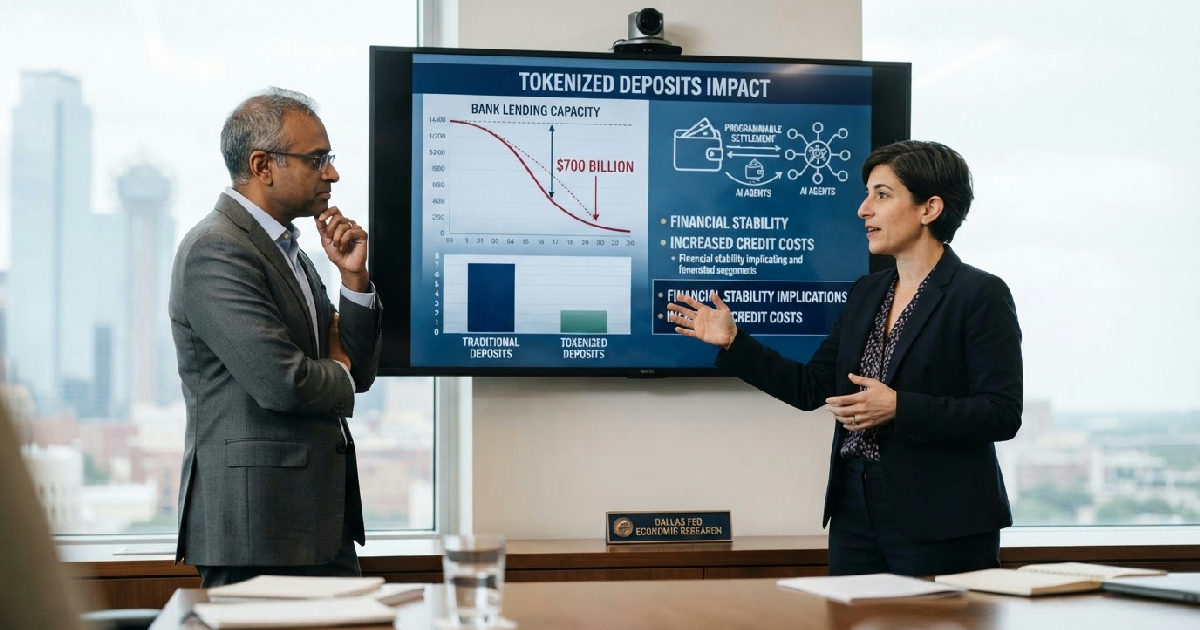

The Federal Reserve Bank of Dallas (Dallas Fed) has issued a stark warning that the widespread adoption of tokenized deposits could slash U.S. banks’ lending capacity by hundreds of billions of dollars. According to research from Dallas Fed economists Rosie Levy and Srini Ramaswamy, this emerging financial technology threatens the stability of bank funding.
The economists’ analysis, published on August 25, 2026, models a scenario where tokenized deposits make savers just 10% more sensitive to interest rates. This shift alone could reduce banks’ ability to absorb long-term interest rate risk by an estimated $700 billion, directly constraining their capacity for making loans.
How tokenized deposits could destabilize bank funding
The core of the issue lies in a concept known as deposit stickiness. Traditionally, banks rely on a stable base of deposits that aren’t immediately moved when a competitor offers a slightly better interest rate. These sticky deposits provide the low-cost, reliable funding banks use to issue long-term loans like mortgages and business credit.
Tokenized deposits, which are bank-issued liabilities on a blockchain, threaten to erase this friction. Their key features—programmable payments and instantaneous, 24/7 settlement—allow customers to move funds between institutions with unprecedented speed. This is a departure from the world of stablecoins for everyday use, bringing programmability inside the regulated perimeter.
Levy and Ramaswamy wrote that “instant settlement would allow deposit holders who prioritize yield to switch banks almost instantaneously.” The economists further suggest that smart contracts or even AI agents could automate this process, constantly searching for the highest yield and moving funds without requiring any human intervention. This would create a hyper-competitive environment for deposits.
In a separate calculation, the economists estimated that if tokenization causes deposits to leave banks 10% sooner than they do now, the capacity to hold long-term interest-rate risk could fall by about $580 billion. These figures are based on the assumption that deposits currently remain at a bank for an average of four years.
Higher credit costs for consumers and businesses
Faced with less reliable funding, banks would be forced to adapt their business models. To retain deposits in a more fluid environment, they would likely have to offer higher interest rates, compressing their net interest margins. This would directly increase their funding costs and reduce profitability from lending operations.
Alternatively, banks could be forced to hold larger portfolios of high-quality liquid assets, such as central bank reserves and Treasury securities, to buffer against potential rapid outflows. While this would enhance their liquidity profile, it would come at the cost of reducing capital available for lending to the real economy.
Another option would be to rely more heavily on more expensive and stable forms of funding, like long-term debt. According to the economists, if banks pursued this path to maintain their current lending levels, it would almost certainly “adversely impact the cost of credit for consumers and businesses.” Ultimately, the price of innovation in deposit technology could be paid through more expensive loans for everyone.
A real-world parallel from Brazil’s Pix network
The Dallas Fed’s warning isn’t purely theoretical. The economists pointed to evidence from Brazil’s instant payment network, Pix, as an early case study. A 2025 study of the system found that its widespread use had a tangible impact on bank behavior, echoing the concerns raised about tokenized deposits.
The research on Pix revealed that banks with heavier usage of the instant payment network tended to increase their holdings of liquid assets, particularly government bonds. This came alongside a corresponding reduction in credit intermediation, meaning less money was being lent out to the economy for every dollar held.
Furthermore, to compensate for the tighter margins and reduced lending volume, these banks appeared to take on more risk in their remaining loan portfolios. The study noted an increase in the share of subprime loans as banks sought higher returns, suggesting that increased funding volatility can lead to a deterioration in credit quality.
Banks develop the very tech the Fed is warning about
Ironically, the technology at the center of the Fed’s warning is being actively developed by some of the largest U.S. financial institutions. Tokenized deposits are widely seen as the banking industry’s regulated answer to stablecoins, which have grown outside the traditional banking perimeter since the Guiding and Establishing National Innovation for U.S. Stablecoins Act (GENIUS Act) was authorized in 2025.
By placing commercial bank money on a blockchain, these instruments offer the programmability and real-time settlement of crypto assets. Unlike many stablecoins, they remain a direct claim on a regulated bank’s balance sheet, embedded within the existing banking system.
The Clearing House, a payments company owned by major banks including Bank of America, Citi, and Wells Fargo, is building an interoperable network specifically for this purpose. The project aims to support cross-bank clearing, automated workflows, and 24/7 settlement for these digital liabilities. Building this kind of security and capacity is essential for institutional adoption.
While the technology remains in its early stages and cross-issuer transfers are still complex, the industry’s direction is clear. The Dallas Fed’s report highlights a critical tension: the banking sector’s push for modernization may inadvertently introduce systemic risks that challenge the very foundation of its lending-based business model.