
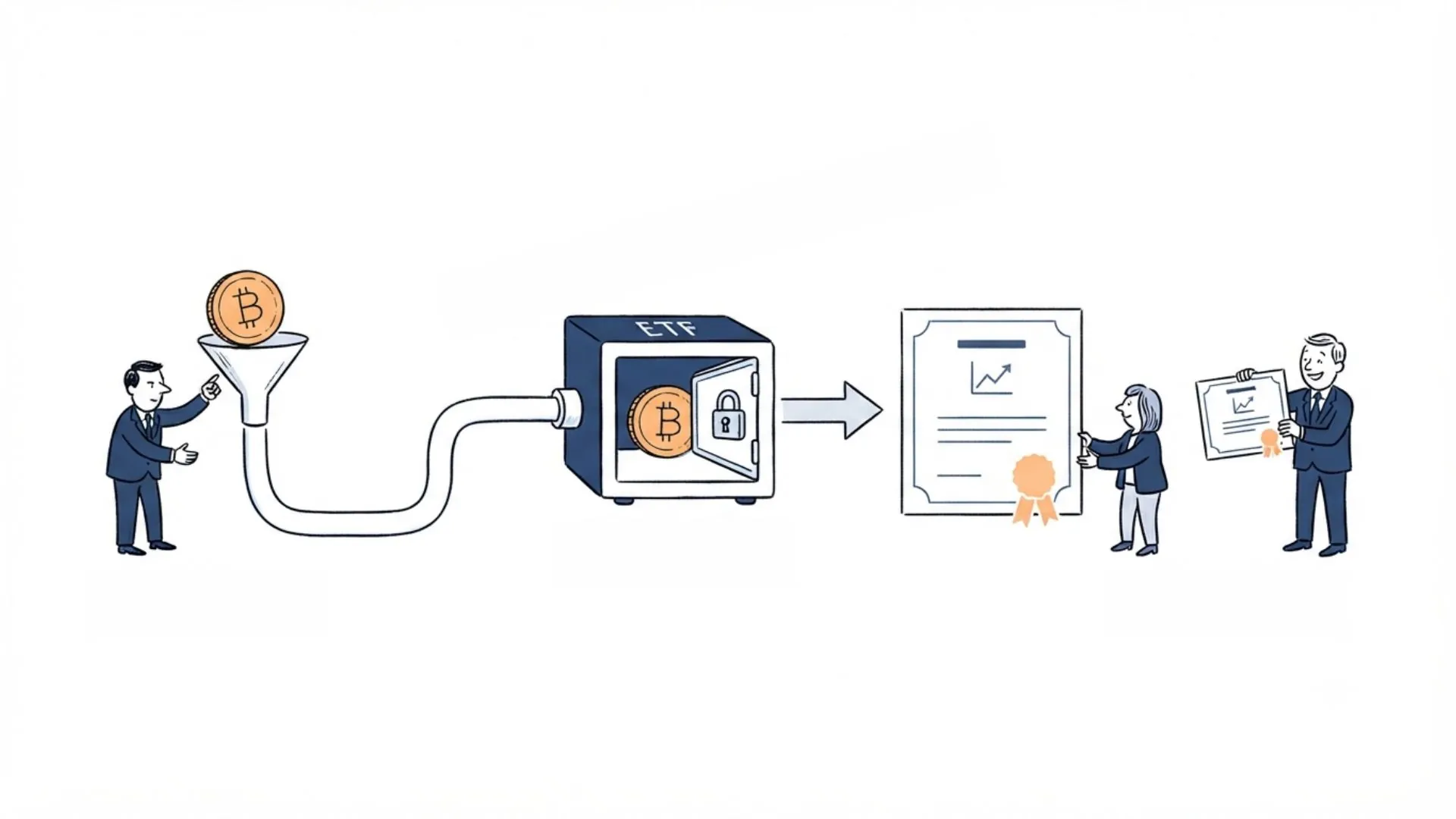

Every time headlines announce that billions of dollars have flowed into spot crypto ETFs, the same assumption tends to follow: investors bought ETF shares, so the fund must have purchased billions of dollars’ worth of Bitcoin.
The reality is more nuanced.
Most ETF trades never trigger a Bitcoin purchase at all. They simply transfer existing shares from one investor to another, much like buying shares of any publicly traded company. The transactions that do lead to real buying or selling of cryptocurrency happen behind the scenes through a process most investors never see.
Understanding that hidden infrastructure explain why ETF flow data has become one of the crypto market’s most closely watched indicators. It also reveals why inflows, outflows, and trading volume are not interchangeable — and why interpreting them correctly can provide a clearer picture of institutional demand.
Most ETF trades never touch the Bitcoin market
Buying a share of a spot crypto ETF feels straightforward. An investor places an order through a brokerage account, the trade executes on a stock exchange, and the position appears in the portfolio alongside stocks or other ETFs.
From the investor’s perspective, that’s the entire experience. Behind the scenes, however, the transaction often ends there.
Most ETF trading occurs in what’s known as the secondary market, where investors buy and sell existing shares among themselves. If one investor decides to sell shares of a spot Bitcoin ETF while another wants to buy them, ownership simply changes hands. The fund itself doesn’t participate in the transaction, and no Bitcoin moves into or out of its reserves.
This distinction is easy to overlook because financial news often highlights the total dollar value traded by an ETF. High trading volume can make a product appear to be attracting significant new investment, even though many of those transactions represent existing shareholders exchanging positions rather than fresh capital entering the fund.
The Bitcoin backing the ETF only changes when demand cannot be satisfied by the existing supply of shares.
Imagine a popular concert where fans are buying tickets from each other outside the venue. As long as someone is willing to sell, tickets simply change owners. The event organizer doesn’t need to print more tickets. Only when demand significantly exceeds the available supply does it become necessary to issue additional ones.
Spot crypto ETFs operate in much the same way.
New shares are created only when the market needs them. Likewise, shares are removed only when there is enough net selling pressure to justify shrinking the fund.
This mechanism allows ETFs to expand and contract without disrupting everyday trading while keeping the number of outstanding shares closely aligned with investor demand.
The institutions most investors never notice
If ordinary investors can’t create new ETF shares, who can? The answer lies with a small group of financial institutions known as Authorized Participants, often shortened to APs.
Although they rarely appear in headlines, Authorized Participants are central to how spot crypto ETFs function. They serve as the bridge between the ETF issuer and the broader financial markets, ensuring that supply adjusts whenever demand changes meaningfully.
Most Authorized Participants are large banks or institutional trading firms with the operational capabilities to transact directly with ETF providers. Unlike retail investors, they have the exclusive ability to create new ETF shares or redeem existing ones.
Consider what happens after positive news sends demand for a spot Bitcoin ETF sharply higher. Buyers begin competing for a limited number of existing ETF shares, causing the market price of those shares to rise slightly above the value of the Bitcoin already held by the fund.
That price difference creates an opportunity.
An Authorized Participant can purchase Bitcoin in the spot market, deliver those assets to the ETF issuer, and receive a newly created block of ETF shares in return. Those shares are then sold on the stock exchange, increasing supply and helping bring the ETF’s market price back toward the value of its underlying holdings.
The process works because everyone involved has an economic incentive.
The ETF issuer receives the Bitcoin needed to back the new shares. Investors gain access to additional liquidity. The Authorized Participant earns a profit by capturing the temporary pricing difference between the ETF and its underlying assets.
Importantly, the Bitcoin purchase occurs before the new shares appear on the exchange. This is one of the reasons ETF inflows receive so much attention from market analysts. They often represent moments when new capital has entered the system rather than simply circulating among existing investors.
The same mechanism also works in reverse.
When investors collectively redeem more shares than the market can absorb, Authorized Participants can return ETF shares to the issuer in exchange for the underlying assets. As shares leave circulation, the size of the fund contracts accordingly.
This continuous adjustment may sound complex, but it solves a fundamental challenge faced by any exchange-traded fund: how to let millions of investors trade freely throughout the day while ensuring the fund accurately reflects the assets it owns.
Why spot crypto ETFs rarely trade far from Bitcoin’s price
Spot crypto ETFs trades on a stock exchange, while Bitcoin trades continuously across cryptocurrency exchanges. Given those different markets, you might expect their prices to drift apart.
Most of the time, they don’t.
The reason is arbitrage — a mechanism that encourages professional firms to quickly eliminate pricing gaps.
Every ETF has a Net Asset Value (NAV), which reflects the value of the Bitcoin or Ether it holds. If the ETF starts trading above its NAV, Authorized Participants (APs) can buy Bitcoin, exchange it for newly created ETF shares, and sell those shares at the higher market price. As more shares enter circulation, the premium typically disappears.
The opposite happens if the ETF trades below its NAV. APs can buy discounted ETF shares, redeem them for the underlying cryptocurrency, and sell those assets on the spot market. Removing shares from circulation helps bring the ETF price back in line.
This process doesn’t eliminate every price difference, especially during periods of high volatility. But it usually keeps spot crypto ETFs closely aligned with the value of their underlying assets, making them a more accurate way to track Bitcoin or Ether than older investment structures.
ETF inflows reveal more than trading activity
ETF trading volume often grabs headlines, but it’s not the same as ETF inflows.
Trading volume measures how many shares changed hands during the day. Most of those trades happen between investors and don’t require the fund to buy or sell cryptocurrency.
Inflows are different. They measure the net amount of new money entering the ETF after accounting for creations and redemptions. Positive inflows often mean the fund had to acquire additional Bitcoin or Ether to back newly issued shares.
It’s also important not to confuse inflows with assets under management (AUM). A fund’s assets can grow simply because Bitcoin’s price rises, even if no new money enters the ETF. Likewise, AUM can decline during a market sell-off despite continued investor inflows.
That’s why analysts often focus on flow trends over days or weeks rather than reacting to a single headline.
Understanding the mechanism makes ETF headlines more meaningful
Spot crypto ETFs, like IBIT from Blackrock, have made digital assets more accessible to traditional investors, but their biggest innovation isn’t the investment product itself—it’s the infrastructure behind it.
The creation and redemption process links stock exchanges with the underlying cryptocurrency market while helping spot crypto ETFs prices stay close to the value of the assets they hold.
Understanding that mechanism also makes daily spot crypto ETFs flow reports easier to interpret. Rather than treating every large inflow or outflow as a bullish or bearish signal, it’s more useful to see them as one indicator of institutional activity alongside broader market conditions.
Once you understand how spot crypto ETFs work, those daily numbers become more than headlines — they become context.