
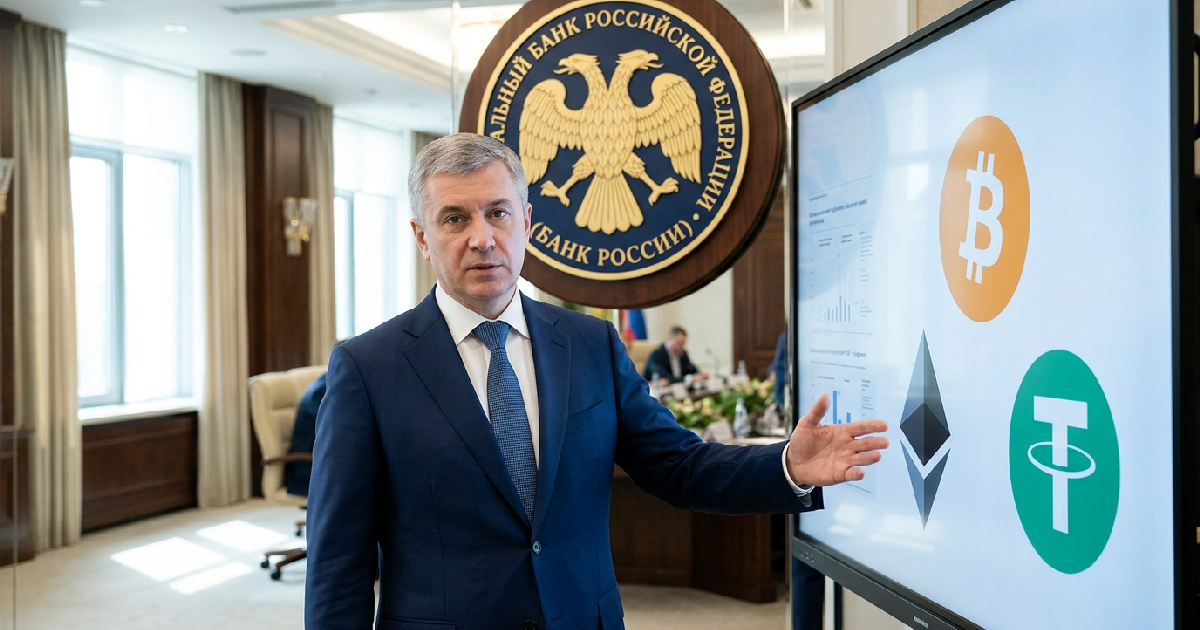

The Central Bank of Russia (CBR) will implement strict new regulations on July 1, 2026, that restrict non-qualified retail investors to trading only three specific digital assets: Bitcoin (BTC), Ethereum (ETH), and Tether (USDT).
First Deputy Governor Vladimir Chistyukhin confirmed the decision, stating that the regulator currently has no plans to expand this list to include other popular tokens like Solana (SOL) or Cardano (ADA).
The move follows the first reading of the “On Digital Currency and Digital Rights” bill in April 2026, which establishes a legal framework for a two-tier crypto market in Russia.
This policy shift represents a significant move for a central bank that, as recently as early 2025, was pushing for a comprehensive ban on all cryptocurrency activities. While the CBR has softened its stance in response to domestic demand and international sanctions, it remains deeply wary of the sector’s inherent volatility.
Chistyukhin emphasized that the bank continues to view digital assets as high-risk instruments, particularly citing the danger of funds being blocked by issuers, a risk he specifically associated with the stablecoin Tether.
Under the new rules, the Russian crypto market will be formally divided between professional and non-qualified participants. While professional “qualified” investors will maintain broader access to a variety of digital assets, the general public will face a curated environment designed to prioritize liquidity and market stability. This mirrors a broader trend where com/bitcoin-signals-market-structure-analysis-2026/”>Bitcoin signals indicate shifting market structure as major economies move toward formal recognition and containment of the asset class.
Stiff entry requirements for approved digital currencies
To qualify for the retail “whitelist,” a cryptocurrency must meet demanding historical and financial benchmarks. The Central Bank of Russia has mandated that any approved asset must maintain an average market capitalization exceeding 5 trillion rubles—roughly $60 billion—over the two years preceding its listing.
These assets must also demonstrate a daily trading volume of at least 1 trillion rubles and possess a verified trading history of five years.
Currently, only Bitcoin and Ethereum comfortably clear these hurdles, with Tether included primarily due to its role as a liquidity provider in international trade. Major altcoins that fail these criteria will be off-limits to the average Russian saver for the foreseeable future.
Chistyukhin noted that any potential additions to the approved list would be evaluated slowly and “gradually,” ensuring no immediate flood of speculative tokens enters the local retail market.
The restrictions extend beyond the type of currency to include a cap on total exposure. Non-qualified investors will be limited to an annual investment of 300,000 rubles ($4,100 USD).
This cap is calculated to cover the vast majority of the population, as Chistyukhin pointed out that this figure already exceeds the average balance on most Russian brokerage and trust management accounts. Before any purchase, every investor must also pass a mandatory knowledge test to prove they understand the risks involved.
Legislative outlook and the ban on unlicensed lending
The incoming legal framework, set to be fully adopted by the July 1 deadline, also targets the peripheral services surrounding the crypto industry. A major component of the 2026 legislation is a total ban on unlicensed crypto lending, which is scheduled to take effect in 2027.
This suggests the CBR is looking to centralize control over crypto-related credit and ensure that only regulated financial institutions can offer leveraged products to the public.
Interestingly, the Central Bank’s restrictive stance is not universally shared within the Russian government. Deputy Finance Minister Ivan Chebeskov has previously voiced support for broader access to stablecoins, particularly those issued in “friendly” jurisdictions or backed by the ruble outside of Russia’s borders.
This internal debate highlights the tension between the CBR’s desire for financial stability and the government’s need for alternative payment rails in a sanctioned economy.
Even as retail access narrows, institutional infrastructure continues to grow. For instance, the Moscow Exchange has already launched XRP futures and indices for professionals. This development comes as some analysts suggest an XRP market dominance path could become more prominent in institutional cross-border settlements, even if the token remains barred for ordinary Russian retail traders under the 5-trillion-ruble rule.
Broader implications for the Russian digital economy
The Central Bank of Russia is clearly attempting to steer the public away from volatile altcoins and toward a more “conservative” crypto portfolio. By bottlenecking retail flow into BTC, ETH, and USDT, the regulator hopes to minimize the systemic shock that a major altcoin collapse could cause.
This protective stance is typical of large central banks, similar to how Scott Bessent rejects central bank digital currency in other contexts to protect traditional financial autonomy.
For the average Russian trader, these rules change the fundamental nature of crypto participation. It transitions from a “Wild West” environment into a regulated brokerage-style experience. While this might improve safety, it effectively kills the burgeoning market for smaller decentralized finance projects and NFTs for the general population.
Those wishing to explore the wider ecosystem will likely have to prove they have the sophisticated capital necessary to gain “qualified” status.
As July 1 approaches, local exchanges and brokerage firms must scramble to update their compliance software and knowledge-testing protocols. The CBR has made it clear that while it is no longer seeking a total ban, it will not tolerate an unregulated free-for-all. The future of Russian crypto belongs to the “Big Three” assets, with the regulator firmly holding the keys to any further expansion.