
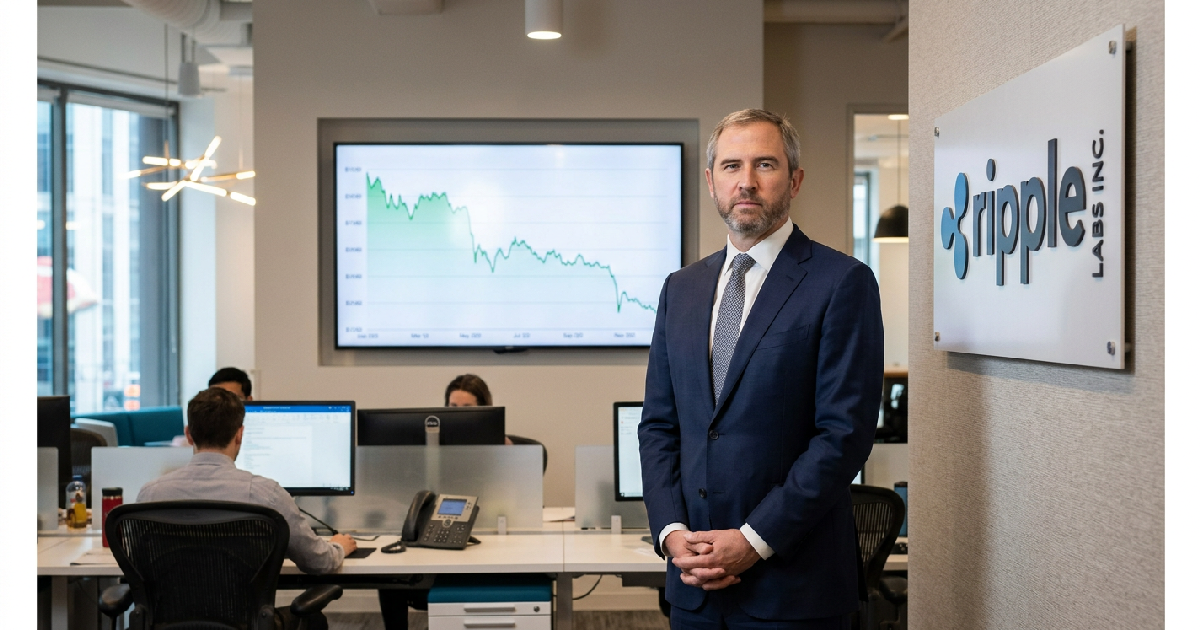

The Brad Garlinghouse SEC lawsuit, filed in 2020, led Ripple Labs Inc. to internally discuss a total shutdown. CEO Brad Garlinghouse revealed that the company internally discussed a total shutdown after the U.S. Securities and Exchange Commission (SEC) sued the firm in 2020. Speaking on the immense pressure of the multi-year litigation, Garlinghouse noted that the company considered liquidating its XRP supply and distributing it to shareholders, but ultimately decided against it to save the jobs of hundreds of employees.
The decision to fight the lawsuit proved costly, with Ripple Labs Inc. spending approximately $150 million on legal fees over a four-year period. Garlinghouse explained that the firm’s U.S. business effectively stalled for about five years as the legal battle unfolded.
Brad Garlinghouse details the decision to fight the SEC
While the regulator offered to drop personal charges against the CEO in exchange for a fine, he refused the deal because the agency intended to continue its case against the company itself.
The legal dispute centered on whether the XRP token should be classified as a security or a currency. The SEC maintained that Ripple Labs Inc. sold unregistered securities, while the company argued that XRP functions as an open-source bridge for fast, low-cost international payments.
Garlinghouse emphasized that XRP does not grant holders dividends, voting rights, or board powers, which are standard characteristics of actual corporate equity.
To support its defense, the company highlighted that it had already raised venture capital through traditional equity sales in 2012, 2015, and 2016. Holding these shares is comparable to owning Apple Inc. stock, whereas holding XRP is closer to owning Bitcoin. Unlike corporate shares, Ripple Labs Inc.
cannot unilaterally control the XRP Ledger because the underlying code is open source, even though the firm holds a substantial supply of the tokens.
The firm continues to focus on its cross-border payment software, which is marketed to financial institutions rather than individual users. According to Garlinghouse, an XRP transaction settles in roughly four seconds at a cost of less than a penny. By comparison, Bitcoin transactions can cost around $10 and take 10 minutes to verify.
The return of XRP speculative activity often reflects these fundamental technical differences compared to other digital assets.
Regulatory friction under Gary Gensler and Joe Biden
Garlinghouse expressed frustration with the SEC leadership under Chair Gary Gensler and the administration of President Joe Biden, describing the agency’s conduct as “distasteful.” He argued the core issue was the application of outdated financial laws to modern technology. He noted that in the 1990s, the U.S.
government provided clear legal boundaries for the internet industry, a level of clarity the crypto sector has requested but not received.
The CEO pointed out that he met with the SEC in 2017, 2018, and 2019 without legal representation to explain the Ripple system. During those meetings, staffers never indicated they considered XRP to be a security.
The sudden lawsuit in 2020 came without prior guidance, leading Garlinghouse to question whether the agency’s theory implied that every secondary market seller of XRP was also breaking the law.
Recent developments have shown a shift in the regulatory environment. Following a change in leadership during the final years of the fight, a new SEC chair appointed by Donald Trump adopted a different approach, engaging more directly with crypto companies. This transition marked a departure from the “regulation by enforcement” strategy that had dominated the early years of the case.
Future of the XRP Ledger and Ripple growth
With the primary court battle concluded, Ripple Labs Inc. is moving forward with its global expansion. The company remains a private entity and continues to integrate the XRP Ledger into its international fintech products. These efforts are often tracked alongside broader industry moves, such as those discussed by David Schwartz at the XRPL Foundation, as the ecosystem matures.
The four-year saga serves as a case study for the digital asset industry regarding survival under federal scrutiny. While the company survived the “existential threat” of a shutdown, the five-year stall in domestic growth remains a significant setback. Ripple now seeks to leverage its legal victory to secure the same clear legal limits that have existed for traditional tech companies since 1996.
The company maintains that its mission to revolutionize global financial transactions through RippleNet remains its priority. By enabling instant cross-border payments without the need for pre-funded accounts, the firm aims to prove the real-world utility of XRP. This focus on utility remains a core part of its strategy as it navigates the post-lawsuit market for digital financial infrastructure.