
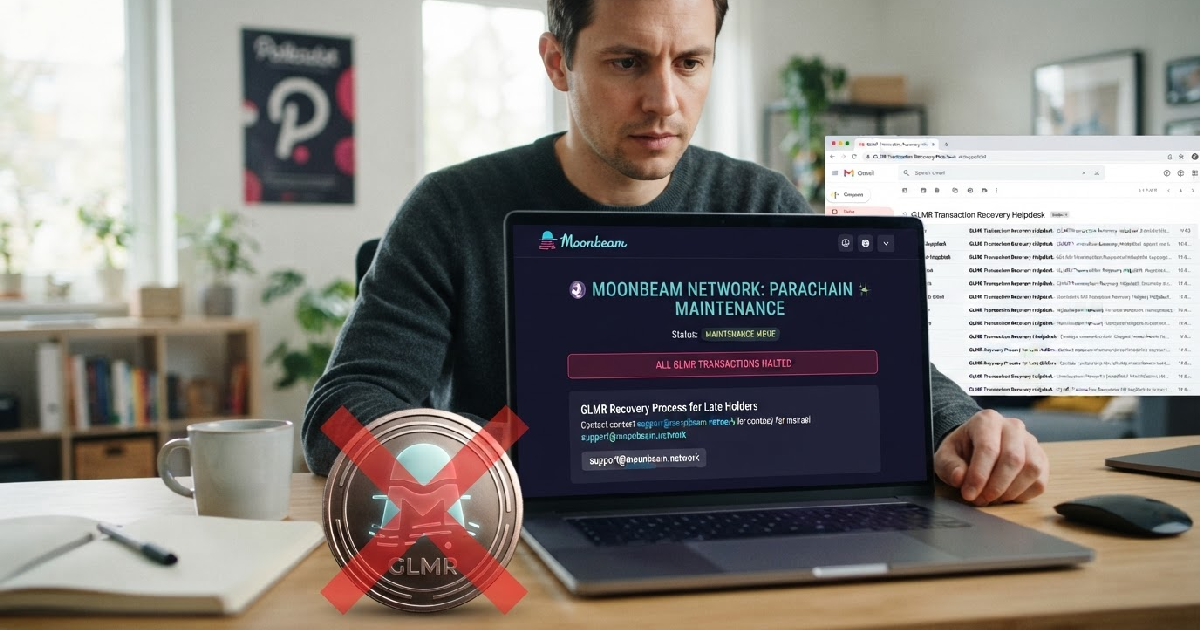

The Moonbeam network officially halted all user transactions on its Polkadot parachain, marking a definitive end to its presence on the Polkadot ecosystem. This critical move occurred as the project initiates a full migration of its GLMR token to Coinbase’s Base network.
As of 00:00 UTC on August 1, 2026, the Polkadot-based network entered a maintenance mode, actively rejecting further transactions. This abrupt cutoff has left some GLMR holders who missed the standard migration window reliant on an email helpdesk for potential fund recovery, with no public guarantees.
Moonbeam halts GLMR transactions for recovery
Moonbeam’s standard migration window for GLMR holders closed at 23:59 UTC on July 31, 2026. The shift signals a significant pivot for the project, which will relaunch as a “Moonbeam Protocol” with a new focus on decentralized AI agent communication and settlement on Coinbase’s Base network.
This means the existing Moonbeam parachain on Polkadot is now permanently shut down. Its July 3 announcement had warned users about potential inaccessibility of funds left deployed in on-chain protocols after the network’s winding down.
The official migration process involved locking GLMR tokens on the now-defunct Moonbeam network and releasing an equivalent amount from a pre-minted reserve on Base. These new tokens were then sent to the same user address at a 1:1 ratio, ensuring continuity for those who migrated on time.
However, many did not. At 20:20 UTC on July 31, just under four hours before the deadline, the migration contract held approximately 308.183 million GLMR. This represented only 24.83% of the total GLMR issuance, which stood at about 1.241 billion GLMR at that timestamp.
Late GLMR holders face uncertain recovery paths
The vast majority of GLMR — about 75.17% — was not processed through the direct migration contract by the cutoff. This includes a mix of free holdings, balances held on exchanges, staking positions, treasury funds, and other categories.
Moonbeam’s guidance had strongly advised users to withdraw funds from various DeFi protocols, including liquidity pools, lending markets, staking, crowdloans, and governance locks. The project explicitly stated that its bridging mechanism only supported free balances, leaving funds within active protocols at significant risk of becoming inaccessible post-shutdown.
For those who held staking and crowdloan balances, Moonbeam indicated it would honor these on Base, provided holders met specific account-signature and snapshot requirements. But the project’s public statements offered no such explicit commitment for other DeFi positions, arbitrary governance locks, or unclaimed rewards.
Late individual holders who failed to complete the standard migration are now directed to contact an email helpdesk for review. The absence of a universal late bridge or a public post-cutoff claim portal means these individual reviews are discretionary, offering no public guarantee that all balances can be recovered.
Exchange platforms offered automated migration for users
Fortunately for many, major cryptocurrency exchanges provided a smoother transition. Several platforms automated the GLMR migration process for tokens held within their custody, offering a stark contrast to the individual email helpdesk route.
KuCoin, for instance, confirmed it would automatically convert GLMR balances held on its platform at a 1:1 ratio, streamlining the process for its users. Bybit also outlined its own separate GLMR network migration and cutover schedule, ensuring its customers’ assets were handled through its established procedures.
Kraken also facilitated the migration, pausing GLMR funding (deposits and withdrawals) on July 30, 2026, at 14:00 UTC, ahead of a migration window that ran through August 7, 2026. The exchange automatically migrated client balances at a 1:1 rate, allowing trading to continue uninterrupted.
Similarly, Binance discontinued mainnet support for both Moonriver (MOVR) and Moonbeam (GLMR), enabling deposits and withdrawals directly via the Base Network. It suspended deposits and withdrawals via the old Moonriver and Moonbeam mainnets at 11:00 UTC on July 21, 2026.
This varied exchange handling highlights a key divergence in user experience during major protocol migrations. While self-custody offers autonomy, it also places a greater burden of responsibility on individual holders to meet strict deadlines and complex technical requirements.
Moonbeam’s strategic pivot to decentralized AI
The comprehensive migration to Base isn’t just a technical upgrade; it’s a strategic reorientation for Moonbeam. The project’s decision to relaunch as a “Moonbeam Protocol” focused on decentralized AI agent communication and settlement represents a significant shift in its core mission.
This move places Moonbeam squarely in the emerging intersection of blockchain and artificial intelligence, a burgeoning sector within the broader crypto industry. By focusing on AI agent communication, the protocol aims to provide foundational infrastructure for a new generation of decentralized applications.
The winding down of its Polkadot parachain and the hard reset on Base underscores the high stakes involved in blockchain innovation. Such transitions, while aiming for future growth, inevitably present challenges for a segment of the user base.
Moonwell, a decentralized lending protocol that operated on Moonbeam, also took steps to wind down its operations ahead of the chain’s shutdown. Its governance migrated to the Ethereum mainnet on May 21, 2026, after proposing to halt new supply and borrowing activity and advising users to close positions.
Moonbeam’s team has reported “exceptional uptake” for the migration across both users and exchange partners, indicating that a substantial portion of the community successfully transitioned. They anticipate opening a 60-day claim window after July 31 for any remaining late claimants, though without guaranteeing universal recovery.
This situation serves as a critical reminder for crypto participants about the importance of staying informed about protocol changes and migration deadlines. While some exchanges offer a safety net, ultimate responsibility for assets often lies with the individual, especially in the rapidly evolving landscape of decentralized finance and blockchain interoperability.