
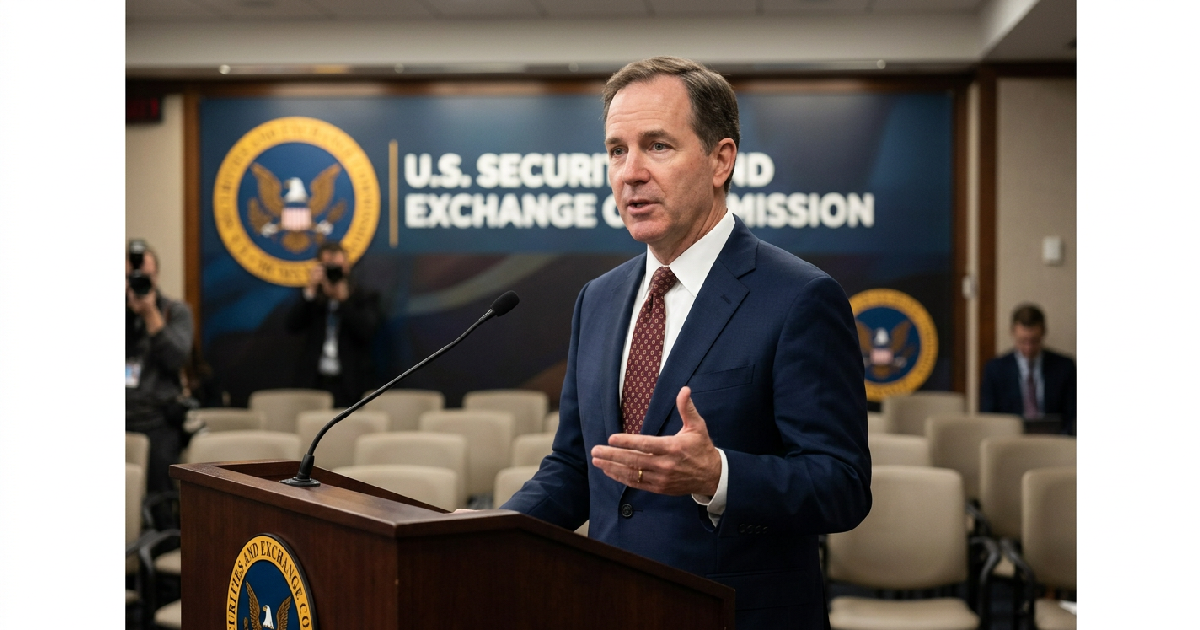

Paul Atkins announces the U.S. Securities and Exchange Commission (SEC) launched a formal request for public comment on Tuesday, June 30, 2026, to re-evaluate how the agency regulates “novel” exchange-traded funds (ETFs). This initiative targets funds that invest in innovative asset classes, such as crypto-linked products and prediction-linked funds, seeking to modernize the current automated approval system.
SEC Chairman Paul Atkins announced the move as a way to gather input on how the market can grow and innovate while protecting investors.
SEC Chairman Paul Atkins addresses regulatory transparency
The scope of this review is massive, reflecting an industry that has exploded from $4 trillion in assets in 2019 to more than $12 trillion at the end of 2025. This growth has created a dilemma for regulators who must decide if a standardized framework for listing should apply to funds tracking non-traditional assets.
The commission is specifically questioning whether ETF providers that do not focus on traditional assets can meet the legal definition of an “investment company” under the Investment Company Act.
The current request for comment follows a statement made by SEC Chairman Paul Atkins on May 20, 2026, where he instructed staff to seek public input on market changes.
Key details
Atkins, who was sworn in as the 34th Chairman of the SEC on April 21, 2025, has emphasized that innovation relies on a consistent and transparent regulatory framework.
By opening this 60-day window, the agency provides a formal channel for market participants to weigh in on how to best respond to recent shifts in the fund industry.
One of the primary technical questions involves the “express lane” for new products. Currently, many registration statements for ETFs can go into effect after a 75-day period, but the SEC is asking if this path is appropriate for novel strategies.
While the agency has approved spot Bitcoin ETFs and several others in the broader digital asset space, it has delayed approval for others, such as prediction market ETFs. Analysts suggest the move is intended to build a record that could eventually justify policy changes for a broader universe of assets.
Questions over crypto-linked funds and investment company status
Central to the SEC’s inquiry is how “novel” ETFs—those focusing on assets that are not traditional securities—should be categorized. Market participants have raised concerns about whether these funds truly fit the definition of an investment company.
If the SEC determines that certain crypto-linked or event-based funds do not meet this standard, it could fundamentally change the regulatory hurdles these sponsors must clear before reaching the market. This is particularly relevant as the SEC weighs rules for tokenized securities and other emerging digital instruments.
The commission is also seeking feedback on several procedural and competitive risks.
These include:
- Whether existing 75-day effectiveness periods allow for sufficient disclosure review of novel strategies.
- If competitive pressures are incentivizing fund sponsors to submit “rushed or incomplete” filings.
- Whether the agency should introduce new registration fees that could be offset by redemptions.
- If ETF filers should be granted greater confidentiality during the initial SEC review process.
Key details
Beyond digital assets, the SEC is taking a hard look at the prediction market sector. Jaret Seiberg, a policy analyst at TD Cowen, noted in a client communication that the broader range of ETFs under consideration could include those based on event contracts and single-stock strategies.
The agency wants to know if there are additional circumstances under which it should be able to suspend a fund’s effectiveness or intervene after a product has already begun trading on an exchange.
This push for a harmonized framework comes as other agencies also seek clarity. The SEC and the Commodity Futures Trading Commission (CFTC) recently requested comment on a joint framework for crypto perpetuals, signaling a move toward inter-agency coordination.
Such a shift could help provide the legal clarity needed in a market where legislative progress like the CLARITY Act continues to be a major focus for traders and fund managers alike.
Public engagement and the 60-day comment window
Public engagement is essential for answering these key questions, according to SEC officials. The commission’s request specifically asks what must be disclosed during the registration process and how the SEC can continue to serve investors effectively as new strategies emerge.
The 60-day comment period will begin formally once the request is published in the Federal Register, giving the industry its most significant chance to shape the rules for the next generation of investment products.
For now, the SEC remains in a fact-finding phase, assessing the implications of retail investor growth and the risks associated with complex strategies. Chairman Paul Atkins has made it clear that while the agency wants to embrace new technologies, it must do so in a manner that maintains fair, orderly, and efficient markets.
The feedback gathered in the coming months will likely determine whether the “novel” ETF market enters a period of rapid expansion or stays under a more cautious, case-by-case review process.