
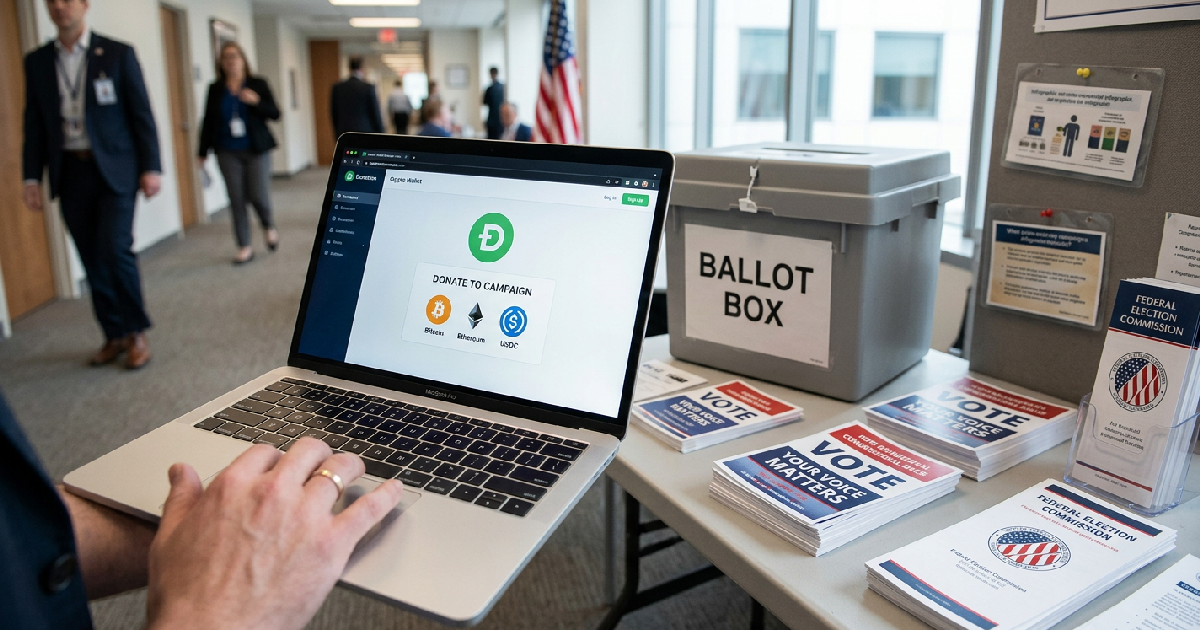

The Federal Election Commission (FEC) fundamentally altered the financing of American politics on May 9, 2014, when it officially ruled that political campaigns could accept cryptocurrency donations. By classifying these digital assets as “in-kind contributions,” the commission established a regulatory framework that required mandatory disclosure of donor names, addresses, and occupations. This administrative decision, though quiet at the time, laid the necessary groundwork for the industry to evolve into a dominant political force that has rapidly escalated its influence since 2020.
The 2014 ruling mandated that all received cryptocurrency must be converted into US dollars, preventing campaigns from holding the volatile assets directly. It placed digital contributions in the same category as donated equipment or securities. This move provided the legal clarity needed for early tech-focused candidates to begin experimenting with blockchain-based fundraising without fear of regulatory reprisal.
Evolution of cryptocurrency influence in American elections
Since that initial FEC decision more than a decade ago, the role of digital assets has shifted from a novel fundraising experiment to a professionalized lobbying apparatus. The industry has increasingly focused on supporting candidates who favor clearer regulatory structures for decentralized finance. This sustained engagement has started to have visible effects on Capitol Hill as lawmakers navigate complex new frameworks.
Policy progress is becoming more concrete as the industry’s financial presence grows. For instance, the CLARITY Act advancement through congressional committees reflects a shifting tide toward formalizing rules for the sector. This legislative momentum suggests that political spending by crypto-connected entities is achieving its goal of moving digital assets toward mainstream institutional acceptance.
The nature of this spending has also matured. Initial contributions were largely driven by individual enthusiasts, but today’s landscape is dominated by large-scale infrastructure and corporate treasuries. These groups target specific races where the outcome could influence the leadership of critical financial committees.
Market signals and political forecasting trends
Beyond direct campaign contributions, the 2026 election cycle is being heavily influenced by crypto-native prediction markets. Platforms like Polymarket and Kalshi are being used as real-time gauges of public opinion, often reacting faster than traditional polling data to news events. These markets allow participants to trade on the probability of specific political outcomes, creating a financial incentive for accuracy.
Current data from these prediction platforms shows high engagement with future political cycles. For example, Democratic Presidential Nominee 2028 markets currently list Gavin Newsom with a 25.2% probability. Such figures provide an alternative data stream for analysts who are wary of the lag time associated with standard telephone or online surveys.
The integration of these markets into the political discourse is happening even as broader economic pressures weigh on the sector. We have seen that political willpower often remains steady even when crypto liquidations rise alongside treasury yields, indicating that the industry’s long-term political strategy is not strictly tied to short-term market volatility.
Institutional growth and the regulatory outlook
The professionalization of crypto lobbying has effectively mimicked the strategies used by traditional Wall Street firms. By adhering to the FEC disclosure rules established in 2014, the industry has built a database of its own economic significance. This allows lobbyists to present a clear picture of a “crypto voter” demographic that is typically younger and highly motivated by digital privacy.
Looking ahead, the infrastructure built over the last twelve years is likely to remain a permanent fixture of Washington’s campaign finance system. Major financial institutions are also signaling increased comfort with the sector’s longevity. Reports showing that Italy’s largest bank exceeded $200M in Bitcoin exposure via ETFs highlight how digital assets are becoming entwined with the global financial establishment.
The 2014 FEC decision may have seemed like a niche administrative fix at the time, but its second-order effects have reshaped how power is projected in American governance. As the 2026 midterm cycle continues, the industry appears poised to remain one of the most significant and well-funded interest groups in the United States. Diversified spending across various political action committees ensures that digital asset policy remains a bipartisan priority.