
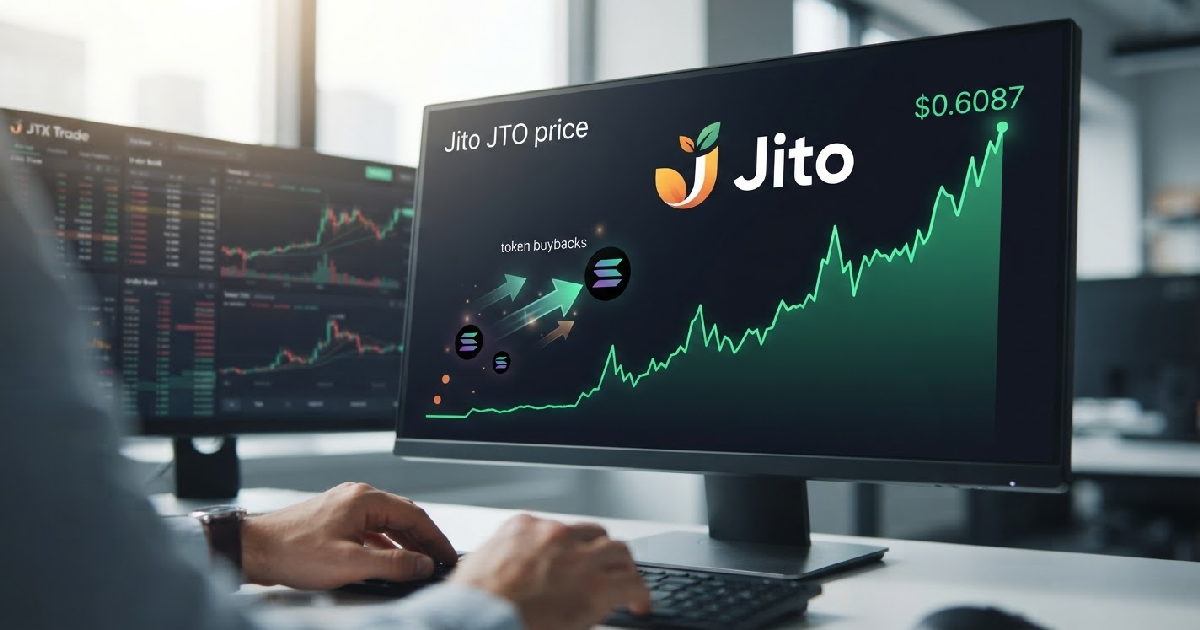

The Jito JTO price surged 11.59% in 24 hours, reaching $0.6087 by July 21, 2026. 59% over the past 24 hours, reaching $0.6087 as of July 21, 2026. This surge, pushing its market capitalization to $304.67 million, follows investor optimism for the recently approved JIP-38 proposal, impacting the Jito JTO price.
The proposal aims to establish Jito as a token-centric network through automated buybacks and token burns, alongside the launch of its JTX Trade platform. Such a move directly links network revenue to token value, addressing ongoing debates in the crypto space.
JIP-38 remakes Jito’s tokenomics
The JIP-38 proposal, officially approved and activated on July 13, 2026, marks a pivotal shift for the Jito Network. It mandates that 100% of the Jito DAO’s 80% revenue share from its new JTX Trade platform will go toward automated JTO buybacks and token burns.
This systematic approach aims to reduce supply over time, thereby enhancing JTO’s tokenomics by directly linking network revenue to the token’s inherent value. The remaining 20% of JTX fees will be reinvested directly into JTX development.
Buybacks and burns will be executed programmatically via a “Rev Splitter” mechanism. This system automatically purchases JTO tokens on the open market and removes them permanently from circulation, with all data publicly disclosed each epoch for transparency.
Initially, Jito’s Dev Council will manage the Rev Splitter. This strategy is committed for a minimum of one year, extending through Q4 2027, when token holders will vote on future allocation strategies.
Beyond JTX Trade, all major Jito Network revenues, including those from JitoSOL, the Block Assembly Marketplace (BAM), and Block Engine fees, now flow to the DAO. This change means JTO holders will govern these revenue streams, solidifying the token’s central role in the ecosystem.
JTX Trade platform powers value accrual
The newly launched JTX Trade platform is central to the JIP-38 strategy, having gone live on Solana on July 14, 2026. It initially opened to its first 1,000 waitlist users at 15:01 UTC on that date.
JTX Trade functions as a self-custodial trading terminal, specifically designed for “pro-retail” users. It aims to unify on-chain trading capabilities and compete with major centralized exchanges by offering a robust decentralized alternative.
The platform isn’t merely an additional service; it’s the direct engine fueling the new tokenomics. Its fee generation directly feeds the JTO buyback and burn mechanism, creating a clear link between platform utility and token value. This direct revenue-to-token-value pipeline is a key differentiator in the decentralized finance space.
Investor confidence boosts Jito JTO price
These positive fundamental shifts quickly translated into a strong performance for Jito JTO price. The token saw an initial jump of 8% on July 13, shortly after the JIP-38 proposal was first unveiled, signaling immediate market approval.
The latest surge of 11.59% to $0.6087 on July 21 further cemented this positive sentiment. Trading activity also accelerated significantly, with daily volume surging 142.17%, indicating aggressive buying.
Coinbase reported a 24-hour trading volume of $41.53 million, an increase of 189.98%, reflecting broader market engagement. Derivatives markets also showed renewed confidence, with Open Interest (OI) rising 14.53% to $52.05 million.
This increase suggests fresh positions entered the market, rather than simply existing contracts closing, indicating stronger conviction among leveraged traders. Rising OI alongside double-digit price gains often reflects robust market conviction from both spot and futures participants.
Positive sentiment surrounding Solana’s institutional adoption and capital rotation into Solana ecosystem tokens further supported JTO’s upward trajectory. However, expanding leveraged exposure also increases the probability of sharper volatility if sentiment reverses or profit-taking accelerates.
Navigating JTO’s future price outlook
With its recent momentum, JTO has been pushing towards the $0.6500 level, which analysts identify as the nearest significant resistance. If buyers can reclaim $0.6500, a retest of $0.8000 could follow, according to some predictions.
Market analysts offer varied predictions for JTO’s short-term future. CoinDCX, for instance, forecasts JTO’s July 2026 price to target $0.8200, within a range of $0.7600 to $0.8400, with a monthly close above $0.8400 confirming bullish momentum into Q3 2026.
Conversely, CoinLore’s short-term forecast, as of July 18, 2026, indicated a potential trading range between $0.4811 and $0.6059 for JTO over the subsequent 24 hours. CoinCheckUp also predicts a decrease of 25.00% to $0.4417 by August 10, 2026, based on technical analysis and a Fear & Greed Index of 26 (Fear).
These divergent outlooks highlight inherent volatility. While the programmatic buybacks from JIP-38 offer a fundamental tailwind, factors like expanding leveraged exposure could increase the probability of sharper price swings. Failure to hold above the $0.5332 level would likely expose JTO to another test of the $0.4054 support level.
Secondary factors such as intense social attention, new derivatives/perpetuals listings, and chatter around small upcoming JTO unlocks (approximately 300,000 tokens) have also influenced price movement. Such unlocks could potentially add short-term sell pressure.
Broader implications for token economics
Jito’s decision to implement JIP-38 and directly link JTO value to network revenue via programmatic buybacks and burns sets an important precedent. This move formalizes a direct value accrual mechanism for the token, potentially influencing how other decentralized autonomous organizations (DAOs) manage treasury revenues.
The transparency inherent in the “Rev Splitter” mechanism, combined with public disclosure of buyback and burn data, offers a model for accountable decentralized governance. It provides a clear, auditable pathway for value distribution to token holders, moving away from more opaque spending models.
This strategy directly addresses debates about where value should ultimately reside – within the protocol’s native tokens or retained by development entities. By prioritizing token value through supply reduction, Jito is making a clear statement about its commitment to its token holders.
As the industry matures, the implementation of such structured and transparent tokenomics could become a key factor in investor confidence and project sustainability. Jito’s approach with JIP-38 represents a significant step toward embedding long-term value creation directly into its protocol design.