
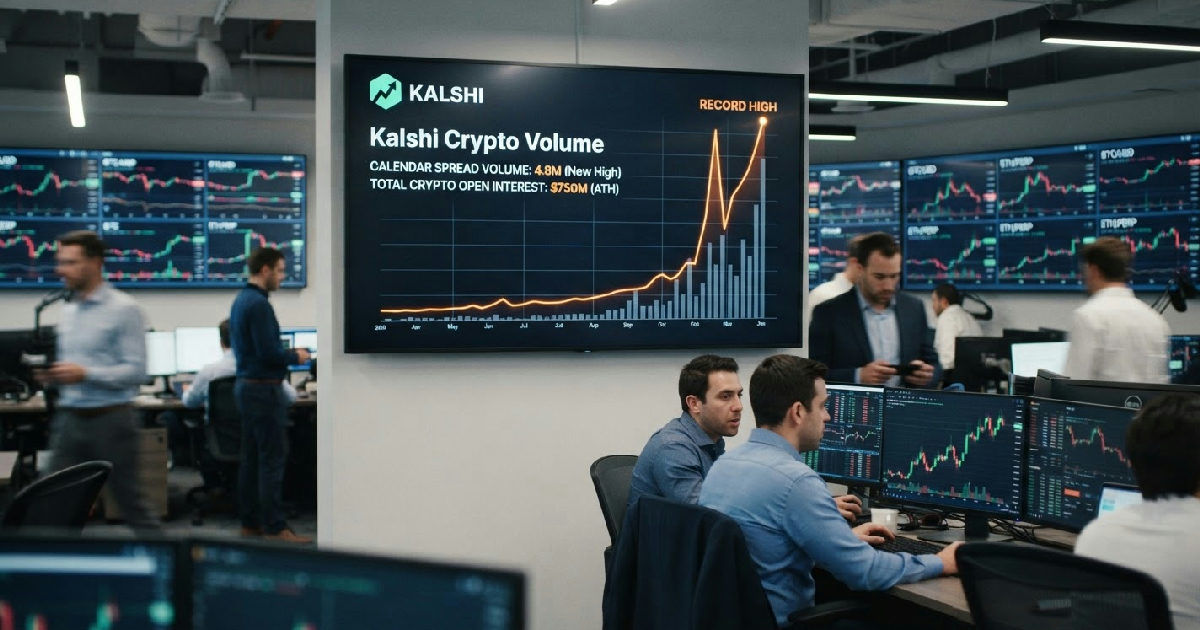

On August 19, Kalshi crypto volume surged to record highs, coinciding with a massive market-wide rally and the largest short liquidation event in crypto history.
S.-regulated prediction market Kalshi set new records for its cryptocurrency products on August 19, a day marked by a massive market-wide rally and the largest short liquidation event in crypto history. This surge in Kalshi crypto volume indicates significant market activity.
As over $2.7 billion in bearish bets were wiped out across the industry, activity on Kalshi surged, with its crypto-based event contract volume hitting an all-time high of $268.89 million and its perpetual futures open interest reaching a new peak of $18.69 million.
Dissecting the Kalshi crypto volume data: attention versus conviction
The spike in activity coincided with a sharp bullish turn that added approximately $313 billion to the total cryptocurrency market capitalization, pushing it from $2.19 trillion to $2.5 trillion in just three days. These record figures from Kalshi, while modest compared to offshore giants, underscore a growing appetite for regulated, U.S.-based crypto derivatives.
This trend is closely watched by institutional and retail traders alike, especially as the crypto market matures and seeks clearer regulatory frameworks.
The two records set on Kalshi, while both related to crypto, tell different stories about trader behavior. The first, a daily spot volume of $268.89 million, pertains to the platform’s crypto-based event contracts.
These are not traditional spot trades but rather binary “yes/no” questions about whether an asset’s price will be above a certain level by a specific time. High volume in these contracts primarily measures attention and engagement during periods of high volatility, not necessarily a one-sided bullish or bearish conviction.
This is supported by past performance. Kalshi previously set a volume record in early June during a day of heavy liquidations, indicating that traders flock to these products when the market moves sharply in either direction. The volume metric serves as a barometer for market excitement, confirming that the August 19 rally captured significant trader interest on the platform.
The second record—$18.69 million in daily perpetual open interest (OI)—offers a clearer signal of directional sentiment. Open interest represents the total value of futures contracts that have not been settled, meaning traders are holding them overnight.
A record OI during a powerful rally suggests that traders were using leverage to bet on a continuation of the upward trend, rather than simply day-trading the volatility. This reflects a deeper conviction in the market’s new direction, particularly for traders navigating market shifts where Ethereum price movements can be significant.
A regulated foothold in the vast crypto derivatives landscape
While the growth is notable, it’s important to place Kalshi’s figures in perspective. The platform’s record $18.69 million in perpetual open interest is a fraction of the activity on major offshore exchanges.
For instance, a venue like Hyperliquid regularly posts open interest figures in the billions, with its $11.7 billion in 24-hour OI on August 12 dwarfing Kalshi’s entire book. A single large position on an offshore platform can exceed Kalshi’s total crypto OI.
However, Kalshi’s unique position is what makes its trajectory significant. As an exchange regulated by the Commodity Futures Trading Commission (CFTC), it offers U.S. traders an onshore, legally compliant venue for trading leveraged crypto products. This is a crucial distinction in an industry where regulatory uncertainty remains a primary concern, highlighting the importance of secure platforms to prevent issues like crypto application scams.
Kalshi’s crypto perpetuals, which first launched on June 3 with Bitcoin and have since expanded to 13 assets including Ethereum, Solana, and XRP, are the first of their kind cleared by the CFTC for U.S. traders.
The steady climb in open interest from roughly $2 million on June 4 to over $18 million in just eleven weeks shows consistent demand for these regulated products. This growth provides a legitimate alternative to offshore markets, complete with transparent pricing and regulatory protections.
Expanding from niche bets to mainstream financial products
The recent records are part of a broader strategic shift for Kalshi. The platform, which built its brand on event contracts for politics, sports, and economic data, is aggressively moving into core financial markets. By offering perpetual futures, Kalshi is now competing directly with crypto-native exchanges rather than operating in an adjacent niche. This move signals a clear ambition to become a comprehensive derivatives marketplace.
This strategy extends beyond cryptocurrency. Kalshi has already applied with the CFTC to list perpetuals tied to the US500 stock index and the price of copper, indicating its intent to challenge established players in traditional finance.
This expansion is backed by significant investor confidence, with reports that Kalshi is in talks to raise another $750 million at a formidable $40 billion valuation from venture capital firm Sequoia Capital and asset manager Wellington Management.
The platform’s ability to attract capital and trading volume is a a powerful proof-of-concept for the domestic crypto derivatives market.
Kalshi’s growing dominance in the prediction market
Within the U.S. prediction market sector, Kalshi has already established a dominant position. In July, the platform processed $37.7 billion in trading volume, a 14% increase month-over-month. This represented the lion’s share of the combined $50.59 billion traded across Kalshi and its main competitor, Polymarket. Over June and July, Kalshi captured approximately 83% of the notional trading volume among approved U.S. platforms.
While sports betting has historically been a massive driver of this volume—accounting for nearly 90% of a $3.4 billion week in April—the rapid growth of its new crypto products is changing the narrative. The platform has successfully diversified its product suite by offering 13 crypto assets for perpetual futures, including BTC, ETH, HYPE, SOL, SUI, ZEC, XRP, DOGE, NEAR, LTC, BCH, LINK, and KSHIB.
Ultimately, the story of Kalshi’s recent records is one of trajectory over absolute size. The platform is proving that a regulated, onshore model for crypto derivatives can not only exist but thrive in the United States.
As traders increasingly seek regulatory clarity, the steady migration of interest and capital to platforms like Kalshi may be one of the defining trends in the maturation of the American crypto market.