
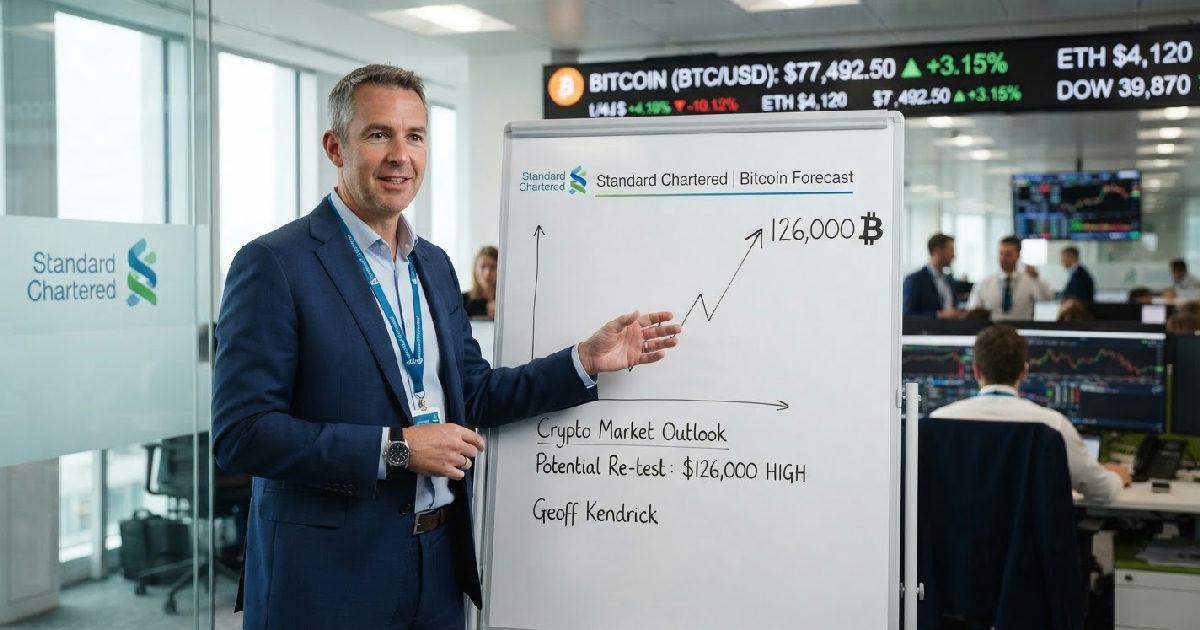

Geoff Kendrick, Standard Chartered’s global head of digital asset research, has indicated that Bitcoin could retest its previous all-time high of $126,000 before the close of 2026. This assessment, shared in a note with crypto media on Friday, August 21, 2026, suggests the bank’s official year-end forecast of $100,000 might now be too conservative following Bitcoin’s recent rally to approximately $77,000.
Kendrick stated, “For the first time this year there is now a risk my end year forecast (of USD100k) is too low.” This marks a notable shift from the bank’s earlier, more cautious outlook after Bitcoin struggled with momentum during parts of the year.
Standard Chartered Bitcoin forecast indicates a more bullish outlook
Standard Chartered hasn’t formally replaced its $100,000 year-end target. Kendrick’s analysis instead highlights the $126,000 figure, Bitcoin’s all-time high set in October 2025, as a plausible upside if the market’s current momentum persists. This renewed optimism from a major financial institution signals a significant development in digital asset research.
This shift follows a challenging summer for Bitcoin, which consolidated for weeks after experiencing lower prices. The latest surge, which saw BTC climb approximately 24% over the past week from around $77,000 as of August 21, has broken that range. The market’s focus has shifted from previous support levels to the potential for a broader recovery toward historical highs.
Kendrick’s current bullish perspective is particularly notable given the bank’s earlier revisions. In February 2026, Standard Chartered cut its 2026 Bitcoin target from $150,000 to $100,000, citing weak ETF flows and tougher macroeconomic conditions. The current signal of potential upside to that same target implies a material improvement in underlying market dynamics, including a return of institutional demand.
Short liquidations fuel the move
Kendrick identified short liquidations as a primary catalyst for Bitcoin’s recent rally. Traders who had positioned for further declines were compelled to close out losing positions, forcing them to buy Bitcoin. This additional demand pushed prices higher, triggering further liquidations, a classic short squeeze effect.
However, forced buying alone can’t sustain a rally indefinitely. Once these positions are closed, Bitcoin requires fresh demand to continue its upward trajectory. This is where U.S. spot Bitcoin ETFs become crucial for the next phase of the rally, providing a more stable source of demand.
Inflows into these products are recovering after a period of weakness. SoSoValue reported $1.62 billion in inflows into US spot Bitcoin funds over four sessions leading up to August 21, reversing a prior week of net outflows. Kendrick also pointed to relatively low open interest in the crypto market, allowing investors to rebuild positions without immediately creating vulnerable leverage.
A history of revised price targets
Standard Chartered’s digital assets research desk has a history of adjusting its forecasts in response to evolving market dynamics. The bank held a $300,000 year-end 2026 Bitcoin target as recently as mid-2025. This target was later reduced to $150,000 in December 2025 due to stalled corporate treasury buying, then further cut to $100,000 in February 2026.
Even with recent volatility, some analysts warn the current rally might be premature given broader economic uncertainties. Still, Standard Chartered maintained its $100,000 forecast when Bitcoin dipped in June. Kendrick explicitly reaffirmed the $100,000 target in July 2026, when Bitcoin traded near $64,000, viewing it as a buying opportunity.
This pattern of recalibration lends weight to the latest, more optimistic assessment, suggesting it stems from new data rather than a fixed bullish stance. The bank also maintains a $500,000 long-term Bitcoin target, with the timeline shifted to 2030.
The path back to a record high
For Bitcoin to challenge its $126,000 all-time high, it must first consolidate its recent advances. A key test involves establishing the previous resistance level around $70,000 as a new floor of support. Should it sustain above $80,000, the bank’s official $100,000 target would then come sharply into focus.
Kendrick also noted October 6 as a date of particular interest. This marks the anniversary of Bitcoin’s 2025 market peak, which preceded a prolonged downturn. The analyst suggested the recovery could accelerate beyond this date, potentially serving as a psychological marker for investors to look past the previous cycle’s top towards new potential highs.
The journey from Bitcoin’s price of approximately $76,844 at the time of the report to $126,000 would require a further gain of around 64%.
While this represents a significant move, such gains are not unprecedented in Bitcoin’s history, especially when market sentiment turns decisively. The crypto market will now observe whether the current momentum, bolstered by institutional interest, can sustain the breakout and potentially see Bitcoin climbs past $69,000 and beyond.