
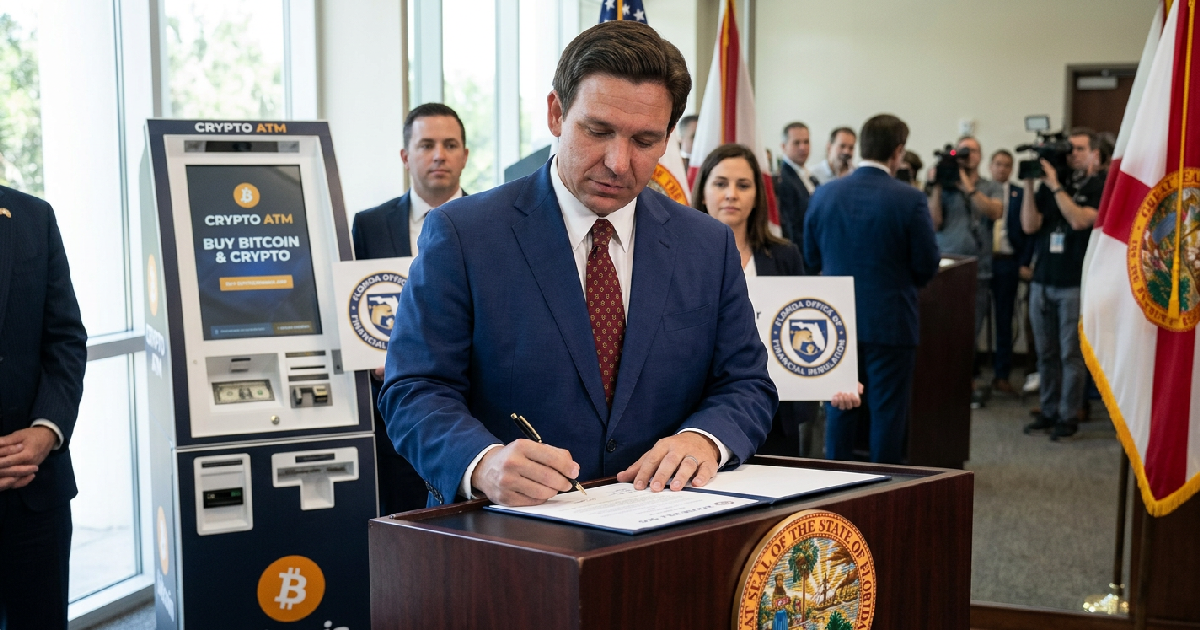

Governor Ron DeSantis has signed House Bill 505 (HB 505) into law, a move that establishes a strict regulatory framework for virtual currency kiosks in Florida. Now designated as Chapter 2026-178, the legislation introduces mandatory conditional refunds for fraud victims and sets daily transaction limits to curb escalating cryptocurrency scams.
The law aims to protect vulnerable populations, particularly seniors, who have increasingly been targeted by scammers using these terminals.
Florida sets new transaction caps for virtual currency kiosks
The new rules shift the financial burden of criminal activity onto kiosk operators by requiring them to issue full refunds under specific conditions. To qualify, a customer must report alleged fraud to both the kiosk business and a governmental or law enforcement agency within 60 days of the transaction.
If the customer provides proof of the scam, such as a notarized affidavit or a police report, the operator must reimburse the funds within 72 hours for the customer’s first transaction.
A central pillar of HB 505 is the implementation of tiered transaction limits designed to interrupt high-value scams before they cause irreversible damage. The law distinguishes between “new customers,” who have transacted with a business for fewer than seven days, and “existing customers.”
Key details
New users are barred from transacting more than $2,000 per calendar day, while those with a history of seven or more days are restricted to $10,000 daily.
State Representative Dan Daley (D-Coral Springs), a co-sponsor of the bill, noted that the previous absence of limits allowed victims to lose tens of thousands of dollars in single afternoons. These caps apply across all locations owned by a single operator, meaning a user cannot bypass the restriction by visiting multiple kiosks in one day.
While shifting investor sentiment often drives crypto activity, these physical terminal limits focus strictly on consumer protection.
The legislation received unanimous support in the Florida House, passing with a 108-0 vote on February 17, 2026. State Representative Michael Owen (R-Apollo Beach) sponsored the bill, with further support from the AARP and the Florida Bankers Association. Lawmakers argued the oversight was necessary as kiosks have become frequent tools for financial exploitation and money laundering.
Registration requirements and operational safeguards
Under the new law, every virtual currency kiosk business must register with the Florida Office of Financial Regulation (OFR). Existing businesses operating before January 1, 2027, have until January 31, 2027, to submit their registration applications. New entrants must complete their registration before beginning operations, a requirement that officially starts on March 1, 2027.
Most other provisions of the act take effect on January 1, 2027.
The law also mandates that kiosks display explicit fraud warnings before any transaction begins. These warnings must instruct users to stop if they are acting on the direction of someone they do not know personally, including those claiming to be bill collectors or government agents.
Following a transaction, operators must provide a physical or electronic receipt detailing the exchange rate, total fees, and the specific refund policy mandated by Chapter 2026-178.
This push for transparency mirrors broader industry efforts to combat fraudulent schemes. For instance, fraudulent recovery schemes proliferate across the digital asset space, requiring increased vigilance from both regulators and service providers. Florida’s receipt requirements ensure a clear paper trail for the OFR to investigate suspicious financial patterns.
Key details
The necessity for HB 505 is underscored by data from the FBI Internet Crime Complaint Center, which recorded 1,213 complaints involving crypto kiosks in Florida during 2025. These incidents resulted in $32.8 million in adjusted losses within the state.
National figures from the Federal Trade Commission also show a sharp rise, with fraud losses at Bitcoin ATMs reaching $65 million in the first half of 2024, a 540% increase from 2020.
Michael Duffey, Special Agent in Charge of the FDLE Cyber and Technology Bureau, emphasized that these machines are frequently used in online scams where funds are moved to hard-to-trace wallets. By forcing operators to share the risk of fraud, Florida officials hope to incentivize better security protocols.
Unlike the Clarity Act which faces an uncertain path at the federal level with a 60.5% “No” prediction for 2026, Florida’s state-level action provides immediate, localized mandates for the retail market.
Representative Dan Daley maintains that savvy investors rarely use these high-fee kiosks, and the law serves primarily to protect the vulnerable from “devastating” financial loss.