
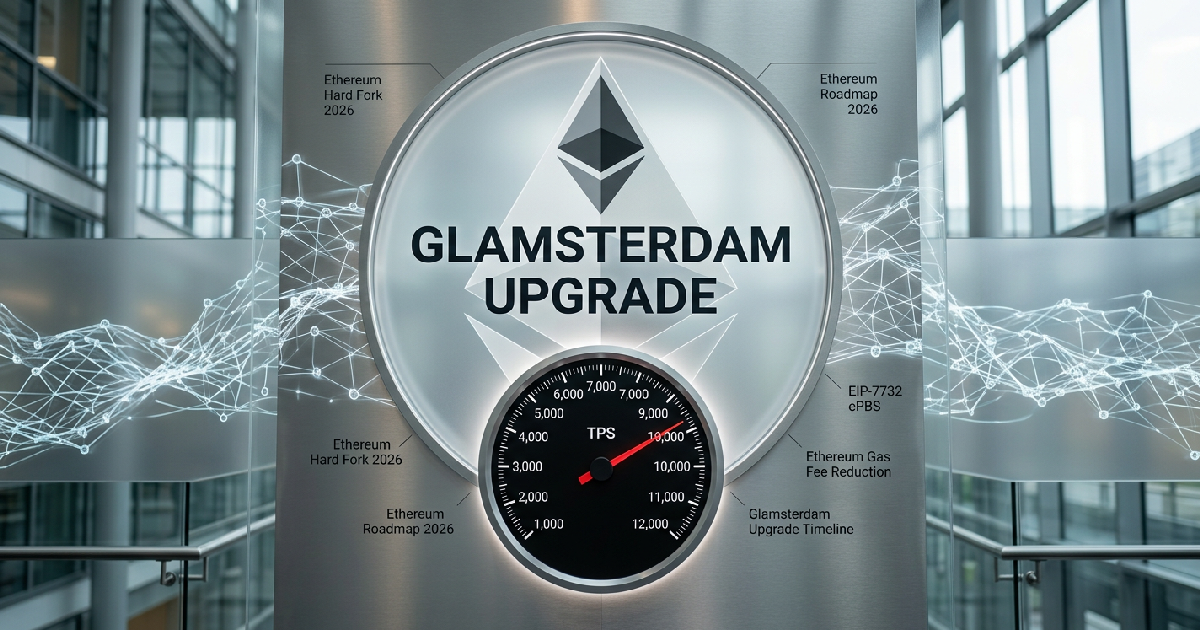

Ethereum core developers and the Ethereum Foundation are preparing for a major hard fork known as the “Glamsterdam Upgrade,” currently expected to launch in Q3 2026. This network enhancement combines the “Gloas” consensus layer and “Amsterdam” execution layer updates to fundamentally reorganize how transactions are processed and how the chain’s database is managed.
By bundling 11 unique Ethereum Improvement Proposals (EIPs), the upgrade aims to scale Layer 1 (L1) throughput toward 10,000 transactions per second (TPS) equivalent under realistic workloads.
The transition introduces structural changes to the Ethereum engine through “enshrinement,” moving complex processes that currently occur off-chain directly into the protocol. Jayanthi, an Ethereum Foundation developer and DevOps engineer, described Glamsterdam as “probably the largest fork we’ve had since the Merge.” The primary goals include improving data discoverability, preventing sync failures caused by rising message sizes, and hardening the base layer’s decentralization.
For users and developers, the upgrade is expected to alter the economic structure of the network significantly. Projections indicate that Glamsterdam could reduce existing L1 gas costs by up to 78%. While bitcoin supply on exchanges continues to impact broader market liquidity, Ethereum’s focus on L1 efficiency represents a shift toward optimizing execution and gas economics for long-term scalability.
Enshrined separation and reforms to protocol security
A major technical pillar of the upgrade is EIP-7732, or Enshrined Proposer-Builder Separation (ePBS). This proposal integrates the division between block builders and block proposers directly into the Ethereum consensus layer. It replaces current trusted off-chain relays, such as MEV-Boost, with in-protocol bids and payments. This move is designed to reduce centralization pressure and censorship risks that emerge from relying on external infrastructure.
The upgrade is also expected to achieve up to 70% less Maximal Extractable Value (MEV) extraction. This reduction is anticipated to lead to fewer “sandwich attacks” and less frequent front-running of user transactions. By moving these processes into the core protocol, developers aim to make block production more trustless and improve the overall integrity of the L1 execution environment.
These security and decentralization efforts are part of a broader trend in the digital asset space where infrastructure stability is becoming paramount. Similar concerns regarding network resilience have been noted in other ecosystems, such as discussion around a potential doomsday protocol for the XRP Ledger. For Ethereum, the Glamsterdam fork serves as a foundational step to protect users from predatory extraction while scaling capacity.
Parallel execution through block-level access lists
To boost throughput, Glamsterdam introduces EIP-7928, which creates Block-Level Access Lists (BALs). These lists allow nodes to see which accounts a transaction will interact with before it is fully executed. This enables nodes to perform parallel disk reads and process multiple transactions simultaneously rather than one by one, which is a major shift from the current serial execution model.
Accompanying this change is EIP-8159, which upgrades the peer-to-peer networking protocol to allow nodes to share these access lists. This facilitates faster syncing and allows for “executionless” state updates. Additionally, EIP-7954 will increase the maximum contract size from roughly 24KiB to 32KiB, allowing developers to deploy larger and more complex applications directly on the L1.
Developers are also introducing a deterministic factory predeploy through EIP-7997. This feature provides a built-in factory contract that allows developers to deploy applications and smart contract wallets to the exact same address across all participating EVM chains. This improves cross-chain consistency and user experience as the Ethereum ecosystem continues to expand across multiple layers.
Gas repricing and testing the 150 million limit
The Glamsterdam upgrade will fundamentally change the cost of actions on the network. According to Jayanthi, “high-level compute gets cheaper and state gets more expensive.” EIP-2780 is expected to make standard ETH transfers between existing accounts up to 71% cheaper. Furthermore, preliminary estimates suggest an efficiency gain of 20-30% for complex smart contract executions specifically due to gas repricing reforms.
Core developers are currently conducting devnet testing with a reference block gas limit of 150 million. The long-term goal is to move the current 60 million gas limit toward a 200 million floor. This increase in capacity is designed to handle the growing demands of decentralized finance and other resource-intensive applications without compromising the network’s ability to remain decentralized.
The timeline for the upgrade shifted recently. While the original target was the first half of 2026, the conclusion of the Soldøgn interop devnet on May 2 led developers to view Q3 2026 as a more realistic window.
Testing is ongoing, and public testnets will be the next critical milestone before a mainnet schedule is finalized. This meticulous approach ensures that the network remains stable while market confidence remains sensitive to large-scale technical transitions.
Future outlook for Ethereum holders and stakers
Despite the complexity of the hard fork, standard ETH holders do not need to take any action. Account balances will remain intact, and no “new” tokens are being issued. Users are cautioned to ignore any instructions to “upgrade” their ETH, which are likely fraudulent. However, stakers and node operators must update both their execution and consensus clients to compatible versions before the fork occurs.
Institutional interest appears to have increased following the details of the upgrade. According to Coinfomania research, Ethereum ETF inflows averaged $180 million weekly in the month post-upgrade, representing a rise from the $95 million average seen in the prior quarter. This flow of capital suggests that the market is responding to the structural improvements intended to make Ethereum a more efficient platform for global settlement.
Looking ahead, the Glamsterdam upgrade clears the path for the next generation of scaling. By enshrinining proposer-builder separation and optimizing gas economics, the Ethereum Foundation is setting a foundation for a more parallelized, trustless Layer 1. The focus now turns to the successful completion of devnets and the upcoming launch of public testnets later this year.