

Vitalik Buterin, co-founder of Ethereum, has unveiled a significantly revised development roadmap for the blockchain, placing quantum computing defenses, enhanced privacy, and native rollups at its forefront. The updated plan, reported on August 10, 2026, signals a major departure from Ethereum’s prior strategic direction, charting a course toward a more secure and user-centric network.
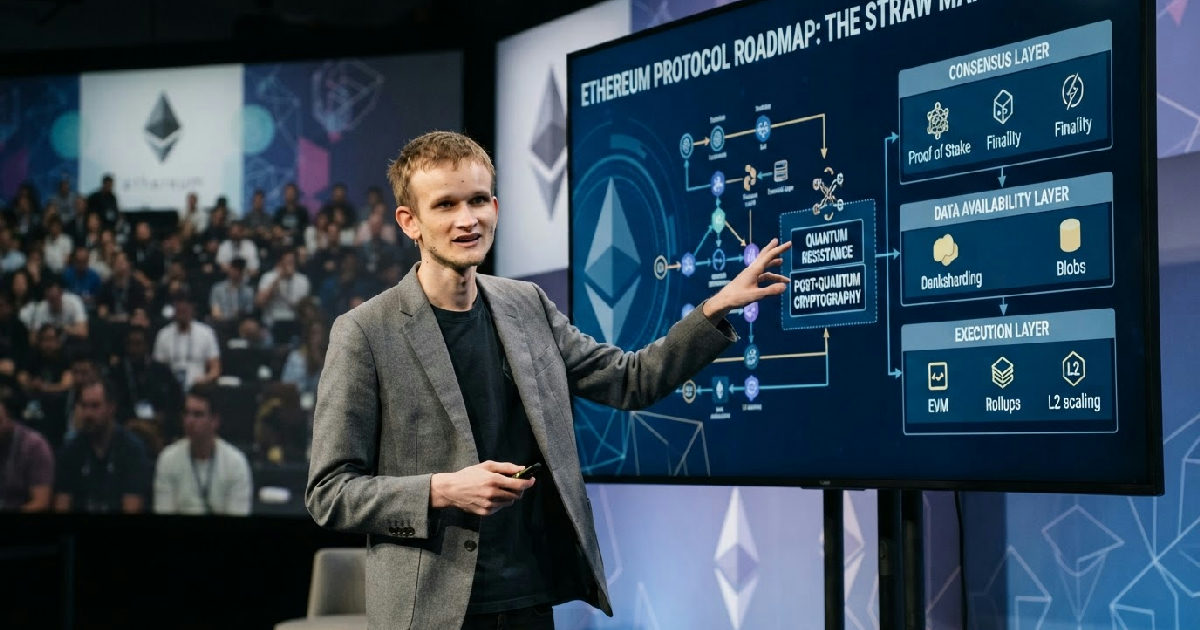
This strategic pivot replaces the blockchain’s previous six-phase upgrade schedule, which would have progressed from “The Merge” to “The Splurge.” Instead, the Ethereum Foundation’s latest “Strawmap” outlines a new architectural blueprint focused on three distinct layers: consensus (CL), data (DL), and execution (EL).
Elevating Quantum Resistance and Privacy Measures
It’s a recognition that fundamental challenges, like the threat of quantum computers and the need for stronger user privacy, demand immediate and integrated solutions.
Buterin’s shift in priorities underscores a pressing need to safeguard Ethereum against future threats and enhance its utility for users. He pointed out that critical elements like robust quantum security and comprehensive privacy features were conspicuously absent from the 2023 roadmap. Now, they’re central to Ethereum’s evolution, reflecting a maturation in the understanding of long-term blockchain resilience.
The network is moving to treat strong privacy as a core requirement, not just an optional add-on. This includes mechanisms designed to obscure user activity and balances, such as “privacy pools,” and innovative designs like “wormholes” that let users move value without exposing their full transaction history. These features aim to prevent unapproved data harvesting and pervasive surveillance that often plague public blockchains.
Integral to this privacy push are elements of Fork-Choice Enforced Inclusion Lists (FOCIL), slated as a headline upgrade for Ethereum’s planned Hegota hardfork. FOCIL, alongside other improvements like keyed nonces and recent roots, is part of a broader strategy to achieve an end-to-end privacy model on Ethereum, encompassing “private reads,” “private writes,” and “private proving.”
Protecting Ethereum from Quantum Threats
The threat of quantum computing, capable of breaking current cryptographic standards, has prompted Ethereum to prioritize comprehensive quantum-resistant solutions. The roadmap explicitly calls for the integration of post-quantum cryptography (PQC) solutions. These include quantum-resistant signatures, post-quantum scaling solutions, and lattice-based cryptography.
Specific quantum-resistant signature schemes under consideration include Lamport, XMSS, SPHINCS+, and Winternitz signatures. Ethereum 3.0, projected for launch in 2027, is set to introduce robust quantum-resistant protocols, cementing the network’s security against what many see as an inevitable technological advancement. This proactive stance aims to shield the blockchain’s cryptographic foundations from future computational breakthroughs.
The focus on quantum resistance isn’t just about preventing attacks; it’s about ensuring the long-term viability and trustworthiness of the entire ecosystem. Without these protections, the foundational security assurances of current cryptographic systems could be undermined. The integration of advanced zero-knowledge proof technology, particularly STARKs, also plays a crucial role in these scaling and security efforts, enabling more complex operations with reduced exposure.
Redesigning for Scalability and Efficiency
Beyond privacy and quantum resistance, the updated roadmap introduces significant changes to Ethereum’s scaling and efficiency models. Native rollup support is now a key component, aiming to dramatically increase transaction throughput and reduce costs. Buterin noted that zero-knowledge tools, especially SNARKs, weren’t mature enough in 2023 to consider such ambitious scaling efforts, but they are now central.
New mechanisms like blob and gas futures are also being integrated, designed to offer more predictability and efficiency in transaction pricing. This move acknowledges the network’s evolution and the varied demands placed upon it by different applications.
The gas limit itself has seen a substantial increase, moving from 30 million to 60 million between the Pectra and Fusaka upgrades in 2025, with intentions to scale it “toward and beyond” 100 million in 2026.
A “Lean-ification” of Ethereum is also underway, a catchall term for upgrades that could eventually replace or heavily revise nearly every core piece of the protocol. This means rethinking the Ethereum Virtual Machine (EVM), potentially swapping it for alternative computing formats like RISC-V and leanISA. This could lead to a more efficient and adaptable execution environment, one that is less cumbersome and easier to audit.
A New Architectural Blueprint and Computational Sovereignty
The move away from the “Merge, Surge, Scourge, Verge, Purge, Splurge” framework marks a fundamental architectural shift. The new blueprint, dividing the protocol into consensus, data, and execution layers, allows for more focused development and clearer upgrade paths. It also facilitates a strategic shift towards specialization for specific use cases.
This includes optimizing parts of the network for token transfers, trading, and privacy protocols, recognizing that a one-size-fits-all approach no longer serves Ethereum’s diverse applications. The ambition extends to achieving “computational sovereignty,” where individuals and institutions can interact on the blockchain free from unapproved data harvesting, surveillance, or centralized censorship. This goal frames the entire reorientation of the roadmap, emphasizing user autonomy and control.
Ideas like Verkle Tree are evolving into a unified Binary Tree, simplifying data structures, while state expiry is transitioning to a new state-type design. These changes aim to streamline the network’s backend, making it more robust and easier to maintain. Buterin also highlighted that “modern AI” will be crucial, assisting in the formal verification of all Ethereum code, enhancing security and reliability.
Underpinning the Vision with Organizational Shifts
The significant reorientation of Ethereum’s technical roadmap hasn’t occurred in a vacuum. The Ethereum Foundation (EF) has undergone its own internal adjustments, including a 20% workforce reduction in June 2026. This restructuring led to a reorganization around five core clusters, each dedicated to advancing the foundation’s CROPs mandate: censorship resistance, open source, privacy, and security goals.
Around the same time, new organizations emerged to support Ethereum’s development. EthLabs, a non-profit, now contributes research and development work alongside the EF. Additionally, EthSystems, a for-profit entity spun out of the EF’s former Institutional Privacy Task Force, is focused on building institutional-grade privacy technology. These organizational changes reflect a more targeted and specialized approach to fulfilling Ethereum’s ambitious new vision.
This combination of technical re-prioritization and organizational streamlining indicates a focused effort by Buterin and the Ethereum Foundation to address the most pressing challenges and opportunities facing the network. Their goal remains to build a robust, private, and quantum-safe global computing platform that can serve diverse needs for decades to come.