
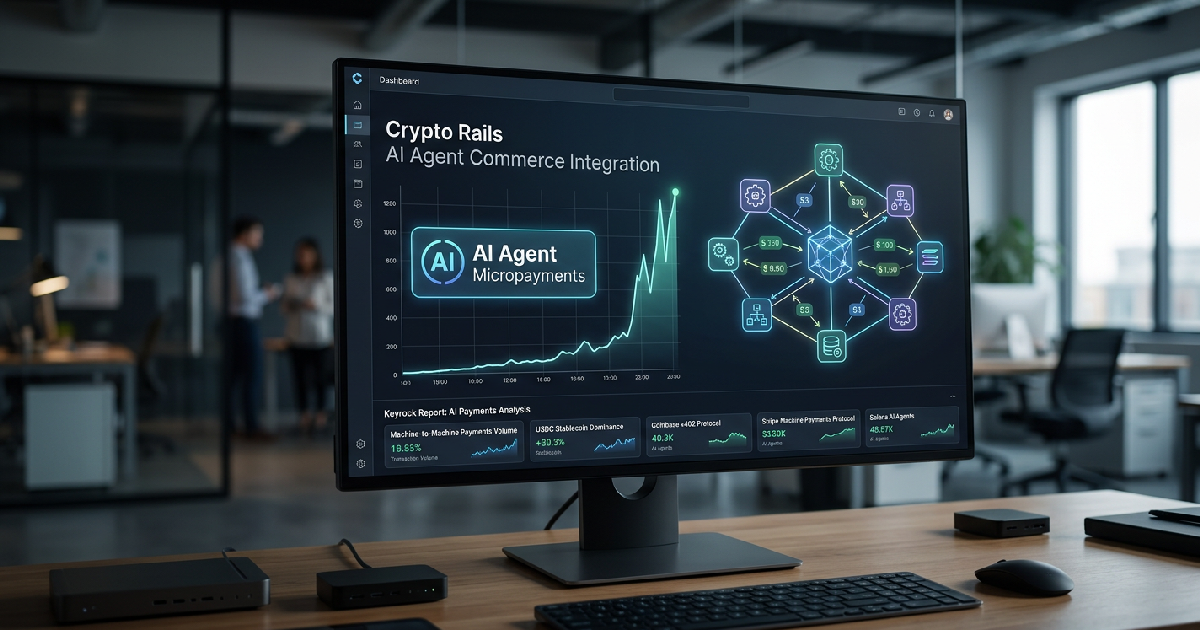

Artificial intelligence agents settled over $73 million across approximately 176 million blockchain transactions between May 2025 and April 2026, marking a significant shift toward crypto rails as the default settlement layer for machine commerce. A new report by Keyrock, published on May 24, 2026, reveals that stablecoins on blockchain networks are becoming the go-to payment infrastructure as traditional card systems struggle to handle the high volume of machine-driven micropayments.
The core friction driving this transition is the economic model of legacy banking. Traditional card payment networks typically impose a fixed-fee floor of $0.30 per transaction. This fee structure is impractical for AI agents that frequently purchase data, cloud computing, or API access in tiny increments. Keyrock found that 76% of agent transactions fall below this $0.30 threshold, with most payments ranging between just $0.01 and $0.10.
In contrast, stablecoin settlement on blockchains such as Base and Tempo costs only fractions of a cent. While the total volume remains small compared to the $14.5 trillion processed annually by Visa, the report argues that the rapid formation of the infrastructure stack signals the market is moving past its experimental phase. As software increasingly consumes digital services autonomously, blockchain is emerging as the only viable layer for these sub-dollar transfers.
Major tech firms build machine payment infrastructure
Global technology and finance leaders are now racing to deploy competing systems for machine-to-machine payments. Coinbase has introduced its x402 protocol, which enables AI agents to pay for services like cloud infrastructure or blockchain analytics directly using USDC. This protocol eliminates the need for agents to manage traditional subscriptions or manual accounts, facilitating a more native digital economy for software entities.
Stripe has joined the fray by developing the Machine Payments Protocol (MPP), which has recently seen integration support from the Solana network. Google and Visa are also rolling out competing frameworks, with Google introducing AP2, a system focused on delegated spending authorization, and Visa extending its network with tokenized credentials designed for AI-driven commerce.
com/ethereum-price-prediction-analysis-dex-growth-trends/”>Ethereum network outlook that emphasizes the growing role of decentralized applications, though much of the current high-throughput activity is shifting toward specialized high-speed chains.
Solana has emerged as a critical hub for these autonomous applications due to its transaction finality of under one second and fees typically below one cent. During the first quarter of 2026, the ecosystem moved toward measurable economic activity, termed “Agent GDP.” For example, the multiplayer game PlayBabylon recorded roughly 490,000 transactions by 1,171 AI agents within just five days of its launch, demonstrating the scale of machine-driven demand.
USDC dominance and risks of stablecoin concentration
While the infrastructure is diversifying, the currency used for settlement remains highly concentrated. Keyrock confirms that 98.6% of machine payments currently settle in USDC, the stablecoin issued by Circle. While this solidifies Circle’s importance in the global crypto payment landscape, it also introduces a concentration risk by creating an intense dependency on a single issuer for the entire machine-to-machine economy.
This reliance on a single stablecoin occurs as market sentiment shifts in response to upcoming global regulations. Frameworks like the EU AI Act, the U.S. GENIUS Act, and the MiCA regulation in Europe are expected to take effect around mid-2026. However, the Keyrock report notes that none of these laws adequately address the legal identity of AI agents or the liability issues associated with autonomous transactions. This regulatory vacuum remains a potential bottleneck for long-term growth.
Beyond the legal hurdles, technical security remains a priority as AI speed increases. Protocols like NEAR are positioning themselves as decentralized compute layers for AI, focusing on the intersection of machine learning and blockchain security. The NEAR team recently announced plans to integrate post-quantum cryptography into its account infrastructure to defend against AI-accelerated threats that could eventually break traditional encryption methods.
Long-term forecasts for the agentic commerce market
The potential for “agentic payments” has prompted massive growth forecasts from major consultancy firms. Gartner projects that AI agents could intermediate up to $15 trillion in purchases by 2028. Meanwhile, McKinsey estimates that retail agentic commerce alone could reach between $3 trillion and $5 trillion by 2030. These growth rates are expected to outpace the early years of the stablecoin market as more industries adopt autonomous software agents.
For now, the market is characterized by rapid infrastructure deployment by firms like Stripe and Coinbase. Even if these systems remain a tiny fraction of the global payment market today, the economic efficiency of blockchain rails makes them the “default” choice for the next generation of automated trade. Analysts suggest that if the cost of settlement continues to decline, the economic value produced by these agents will soon become a visible and permanent fixture of the global financial system.