
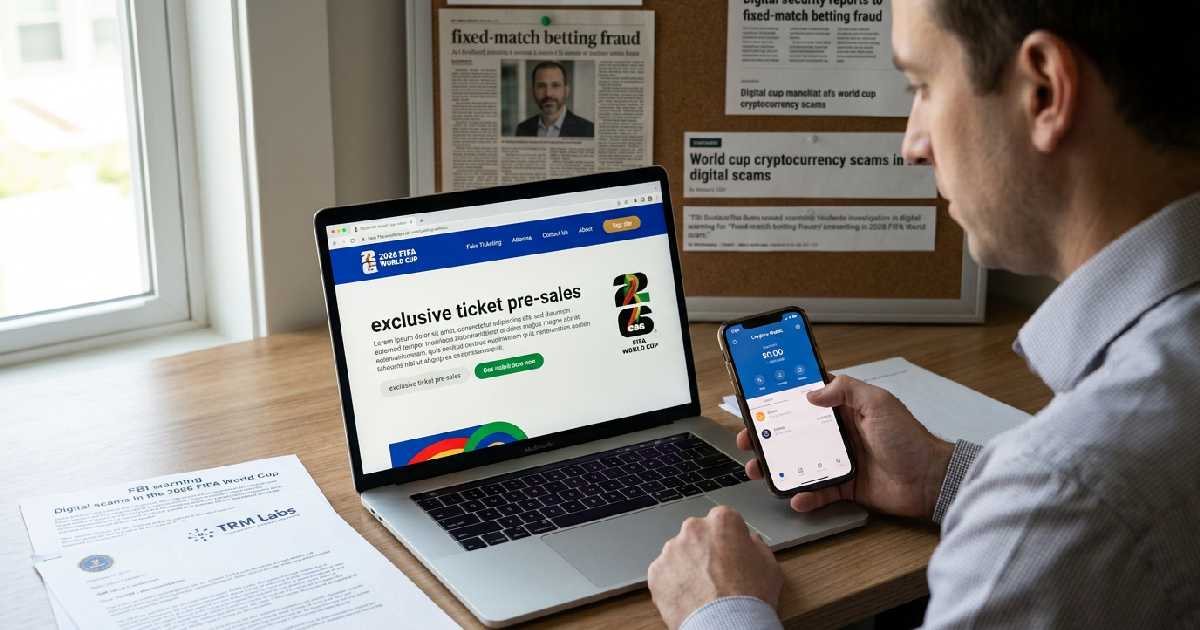

As the 2026 FIFA World Cup gets underway across North America, blockchain intelligence firm TRM Labs has identified several active cryptocurrency scams targeting the tournament’s global fanbase. Investigators found three distinct fraud operations involving fake ticketing websites and fixed-match betting schemes linked to four specific digital wallet addresses.
The tournament officially began on Thursday, June 11, 2026, with an opening match between Mexico and South Africa in Mexico City. While the event is expected to draw 6.5 million fans over its 39-day duration, criminals began positioning their digital infrastructure weeks before the first kickoff.
Total receipts across the identified scam addresses currently sit under $1,700, a figure TRM Labs describes as low. This suggests the operations are in an early stage, with scammers typically scaling their activity as public attention peaks during the later stages of the competition.
TRM Labs identifies ticketing and betting fraud operations
The investigation by TRM Labs revealed two fraudulent ticketing platforms and a “fixed-match” betting pitch. In the ticketing schemes, funds reportedly move from the Polygon network into Tron. Conversely, the betting scam sends payments directly to a custodial exchange deposit address, likely to facilitate a quick cash-out.
One specific address on the Polygon network linked to a ticket scam received $1,562, with most of those transactions occurring as early as April 1, 2026. This timeline aligns with observations from Ari Redbord, Global Head of Policy at TRM Labs, who noted that criminals do not wait until kickoff to exploit major cultural moments.
Beyond direct theft, speculative commemorative tokens have appeared on exchanges like LBank. TRM Labs flagged the “$WORLDCUP” token as a high-risk asset lacking any official FIFA affiliation. These types of investor risks in the altcoin market are common during global events, often resulting in pump-and-dump scenarios.
Federal and local authorities issue warnings to fans
Public agencies were monitoring these threats well before the tournament began. In May 2026, the Federal Bureau of Investigation (FBI) warned that threat actors were spoofing official FIFA websites. These clones focus on collecting personal information and selling fake tickets or products.
FIFA has issued its own strict guidance, stating that tickets obtained through unofficial channels may be deemed invalid. Fans who bypass official platforms risk having their tickets canceled without notice. The LA County Sheriff’s Department has also issued warnings about crypto-related scams targeting tournament attendees.
The risk of falling for a ticketing scam remains high despite the availability of legitimate seats. As of June 9, official resale portals still listed approximately 176,000 unsold tickets for the group stage matches. This data contradicts the common scammer narrative that high-profile matches are entirely sold out.
Transparency of blockchain payments aids investigation
While the threat of fraud is persistent, the “onchain” nature of cryptocurrency provides a trail for law enforcement. Ari Redbord noted that the transparency of these payments allows compliance teams to act earlier, potentially limiting losses before they escalate as the tournament progresses.
The 2026 FIFA World Cup is the largest in history, featuring 48 teams and 104 matches. U.S. team captain Tim Ream described the scale by comparing the tournament to “a Super Bowl every single day for five weeks.” This sustained interest provides a lengthy window for malicious actors to operate.
As the structure of the digital asset market continues to evolve, investigators are keeping a close watch on the movement of funds towards custodial exchanges. The final match is scheduled for July 19 at the New York New Jersey Stadium, and fraud activity is expected to ramp up through that date.
Fans are encouraged to use only the official FIFA website for ticket purchases and match information. Verifying the authenticity of tokens and avoiding “guaranteed” betting returns can mitigate the risk of financial loss during this summer’s tournament. Additionally, monitoring price movements on networks like Tron can help users spot unusual activity in the assets often used by these scam operations.