
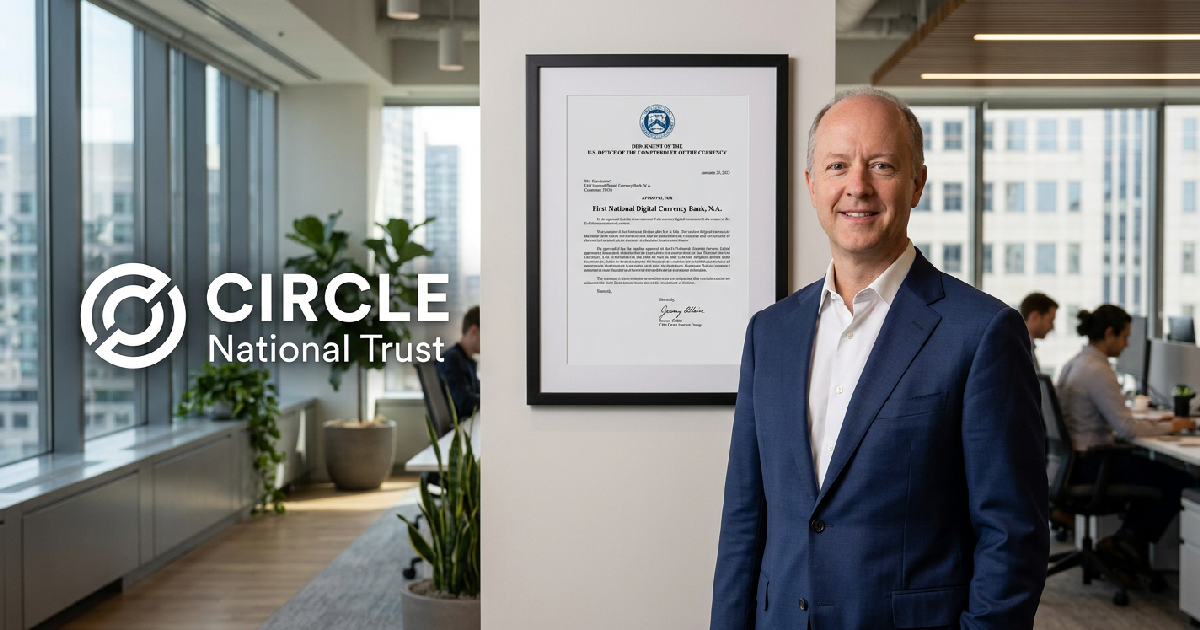

Circle Internet Group, Inc. (NYSE: CRCL) has secured final approval from the U.S. Office of the Comptroller of the Currency (OCC) to establish a national trust bank, a landmark decision that brings the issuer of the USDC stablecoin under direct federal supervision. Announced today, July 10, 2026, the regulator cleared the company to charter First National Digital Currency Bank, N.A., which will operate as Circle National Trust.
The charter marks the culmination of a regulatory process that began with Circle’s application on June 30, 2025. Following a conditional approval in December 2025, the final decision arrives as the industry prepares for the implementation of the Guiding and Establishing National Innovation for U.S. Stablecoins Act, or the GENIUS Act (S. 1582), enacted in July 2025.
The new bank will initially provide fiduciary custody services for digital assets held by Circle and its affiliates. Under the business plan approved by the OCC, the bank may eventually extend these services to a limited group of institutional customers, specifically targeting other banks and regulated derivatives organizations.
Strategic shift to federal oversight for USDC
By transitioning to a national trust bank, Circle aligns its digital asset infrastructure with long-standing fiduciary standards. Unlike traditional commercial lenders, national trust banks do not take deposits or issue loans; instead, they focus on safeguarding client assets. This structure provides a federal framework for Circle’s operations, moving beyond the patchwork of state-level licenses like the New York BitLicense it received in 2015.
The charter is designed to enable the management of the USDC reserve, which currently stands at a market capitalization of $73.3 billion. Bringing this pool under federal oversight strengthens the role of USDC as regulated digital-dollar infrastructure for global payments and capital markets. This is particularly relevant as Tether is urged to transfer frozen USDT in offshore jurisdictions, highlighting the growing divide between federally supervised and unregulated stablecoins.
Jeremy Allaire, co-founder, chairman, and CEO of Circle, called the approval a “defining step” for the financial system. He noted that federal oversight sets a new standard for transparency and scale, allowing large financial institutions to engage with public blockchains with greater confidence. This sentiment is echoed by broader market trends where Italy’s largest bank exceeds $200M in Bitcoin exposure, signaling a rising institutional appetite for regulated crypto assets.
Market reaction and CRCL stock performance
Investors reacted positively to the news, driving CRCL shares up as much as 14% on the day of the announcement. The stock had been under pressure, trading near a three-month low, but rebounded to approximately $73 after closing the previous session at $63. While the gains later settled to around 5%, the rally provided a boost to other crypto-linked entities, with Coinbase and Strategy rising near 5% this morning.
Institutional backing for Circle remains visible despite recent market volatility. On July 9, 2026, Cathie Wood’s ARK Invest purchased $13.7 million worth of Circle shares. The stock still faces technical hurdles, sitting roughly 24% to 26% below its 50-day and 200-day simple moving averages, with key resistance noted at the $77 mark. Still, the OCC’s final approval serves as a significant fundamental catalyst for the firm’s valuation.
The move also places Circle in a select group of five firms—including Ripple, BitGo, Fidelity Digital Assets, and Paxos—that received conditional approvals last December to pursue national trust charters. Anchorage Digital Bank N.A. was the first to receive such a charter in 2021. As the GENIUS Act moves toward full implementation in early 2027, the mandate for OCC supervision of large stablecoin issuers will become a central requirement for the industry.
Future utility in the tokenized economy
The establishment of Circle National Trust allows the firm to support the role of the U.S. dollar in the digital global economy more effectively. The OCC has previously clarified the authority of national banks to facilitate blockchain payments and riskless principal transactions. These capabilities ensure that Circle’s infrastructure can meet the fiduciary requirements of sophisticated financial institutions and derivatives organizations.
Circle’s expansion into federal banking complements its existing global presence. The company currently holds licenses in the United Kingdom, Singapore, Bermuda, and Abu Dhabi. In 2024, it became the first global stablecoin issuer to comply with the European Union’s Markets in Crypto-Assets (MiCA) framework. This global regulatory footprint, combined with a U.S. federal charter, positions the company as a primary settlement layer for digital assets.
As the financial landscape evolves, the integration of public blockchains into the core banking system appears to be accelerating. The permanent supervisory presence of the OCC will ensure that Circle National Trust adheres to strict risk management and governance protocols. For the broader market, this approval represents a shift toward a future where digital assets are managed under the same rigorous standards as traditional financial instruments.