
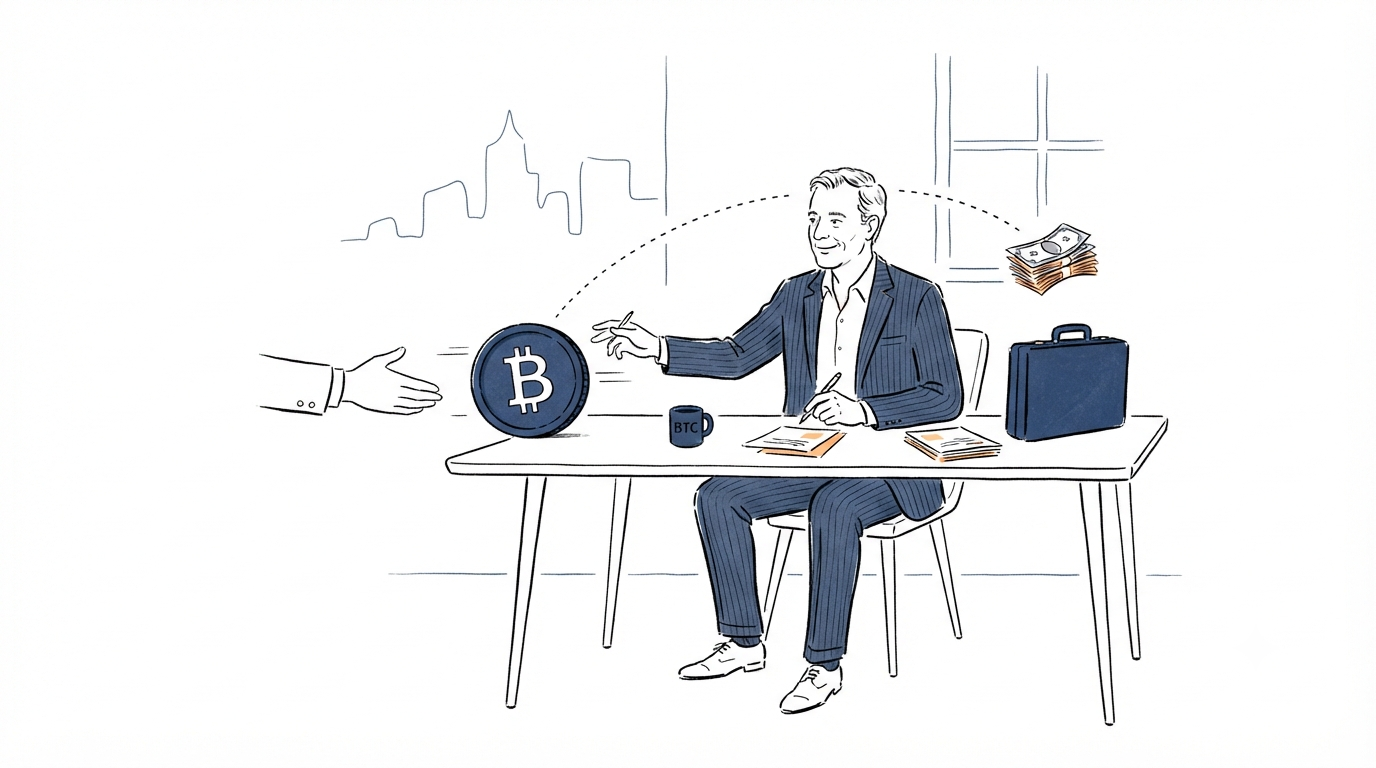

Getting into crypto is easy. The industry has spent over a decade streamlining the onboarding experience, creating slick user interfaces, one-click buy buttons, and Apple Pay integrations designed to turn sovereign currency into digital assets in seconds. The lobby of the crypto ecosystem is wide open, brightly lit, and incredibly welcoming.
The exit, however, is a different story.
Converting digital assets back into traditional fiat currency — and safely landing those funds in a bank account — is where the conceptual simplicity of blockchain meets the messy reality of traditional finance. For many investors, cashing out crypto is treated as an afterthought, a simple administrative task to be figured out whenever the time comes.
But in practice, the off-ramp is a gauntlet of technical friction, psychological traps, and hidden costs.
The asymmetric friction of the crypto exit gate
The first reality check of cashing out crypto is realizing that selling your assets and withdrawing your money are two fundamentally different operations. It sounds obvious, but confusing the two is one of the most common friction points for intermediate investors.
- The Sale: This is a purely digital transaction where you trade a cryptocurrency (like Bitcoin or Ethereum) for a fiat currency (like US dollars or Brazilian Reais) or a stablecoin. This transaction occurs entirely within the ledger of a platform.
- The Withdrawal: This is the bridge. It is the physical movement of those fiat funds out of the crypto environment and into your custody via a traditional bank account.
This separation matters because each phase is governed by different rules, processing times, and financial overhead. While a trade happens almost instantly, the actual transfer of fiat money to a bank account relies on traditional banking networks. Depending on the platform and the payment rails used, this process can introduce delays that expose you to counterparty risk — the risk that the platform holding your funds faces issues before the money actually reaches your bank.
The quiet toll booths of the blockchain
When you buy crypto, the thrill of the trade often masks the friction of transaction fees. When you sell, however, those fees directly impact your bottom line, and they are rarely as straightforward as a single flat rate.
Most platforms make money by charging a premium for convenience, and the cashing out crypto process is where these premium fees are most heavily concentrated.
1. The Convenience Premium (Slippage and Spreads)
If you use the “Instant Sell” or simplified conversion buttons found on most consumer-facing wallet and exchange apps, you are paying a premium. These features prioritize speed and ease of use over pricing efficiency. To guarantee your transaction goes through immediately, the platform will buy your crypto at a slightly lower price than the actual market rate. This difference is the spread, and on larger transactions, it can quietly eat away several percentage points of your profits without ever appearing as an explicit “fee” on your receipt.
2. Execution Fees (Maker vs. Taker)
To avoid the spread, experienced users utilize advanced trading interfaces where they can place specific order types. Here, fees are split into maker fees (for adding liquidity to the order book via limit orders) and taker fees (for taking liquidity via market orders). Limit orders, which execute only when the asset hits a specific price, are almost always cheaper, though they require patience.
3. Network and Withdrawal Fees
Before you can even click sell, you have to get your assets to the point of sale. If you hold your assets in a self-custody wallet, moving them to an exchange requires paying blockchain network fees (gas). Once the sale is complete, the exchange will likely charge a flat or percentage-based fee to process the bank wire or transfer.
Comparing platforms solely on their advertised trading fees is a common mistake. The true cost of cashing out is cumulative, representing the total friction from the moment the asset leaves your wallet to the moment the cash settles in your bank.
Choosing your exit vehicle: Convenience vs. Sovereignty
How you choose cashing out crypto is a direct reflection of your security posture. There is no single “best” route; instead, there is a spectrum of trade-offs between speed, cost, and control.
| CENTRALIZED EXCHANGES (CEXs) | SELF-CUSTODY OFF-RAMPS |
| – High liquidity, low trading fees – High counterparty risk – Requires KYC/identity checks | – High privacy and autonomy – High transaction/gas fees – Direct control of assets |
Centralized Exchanges: The Liquidity Hubs
For the vast majority of investors, centralized exchanges like Binance or Coinbase are the default exit route. They offer deep liquidity, meaning you can sell large amounts of crypto without drastically moving the market price, and they have established integrations with local banking systems.
The trade-off is custody and compliance. To use these platforms, you must comply with Know Your Customer (KYC) regulations, meaning your transactions are fully linked to your real-world identity. Furthermore, keeping your assets on an exchange while waiting to sell means trusting a third party with your keys — a practice that runs counter to the foundational ethos of blockchain.
Direct Wallet Off-Ramps: The Sovereign Path
For those who prioritize autonomy while cashing out crypto, many modern self-custody wallets now offer integrated off-ramp services. These allow you to sell your crypto directly from your wallet, using third-party payment processors to send fiat straight to your bank account.
While this eliminates the step of transferring funds to an exchange (and the associated custody risk) when cashing out crypto, it’s historically the most expensive option. You are paying for the luxury of keeping your private keys secure until the very moment of liquidation, absorbing both network gas fees and the partner processor’s convenience markup.
The psychological trap of the “perfect” peak
Even with a flawless technical setup, the hardest part of cashing out crypto isn’t navigating the fees or choosing the right platform. It is managing the psychology of the exit.
The human brain is poorly wired for volatile markets. When prices are crashing, fear urges us to panic-sell to protect what is left. When prices are skyrocketing, greed — disguised as optimism — convinces us that the asset will go up forever, delaying our exit in search of the elusive “market top.”
The Paradox of Maximization: The investors who try to squeeze every last dollar of profit out of a bull run are often the ones who end up holding their assets all the way back down. Seeking the perfect exit often leads to no exit at all.
To counter this, seasoned market participants rely on systematic, unemotional frameworks rather than market intuition.
Fractional Profit-Taking
Instead of viewing the exit as an all-or-nothing decision, strategic selling involves scaling out of positions incrementally. By setting predefined price targets — for example, selling 10% of a position every time an asset doubles — an investor secures realized gains while keeping a portion of their portfolio exposed to potential future upside. This mitigates the pain of FOMO (Fear of Missing Out) and ensures that even if the market reverses, the entire cycle wasn’t spent on paper profits alone.
Portfolio Rebalancing
Sometimes, the decision to sell has nothing to do with market predictions and everything to do with risk tolerance. If an investor decides that high-risk digital assets should make up only 10% of their total net worth, a massive crypto rally can easily push that allocation to 30% or 40%. Selling the excess to buy more stable, traditional assets is not “giving up” on crypto; it is the healthy, disciplined maintenance of a broader financial strategy.
The administrative reality check
No strategy is complete without acknowledging the paperwork. Cashing out crypto is a taxable event in almost every major jurisdiction.
Traditional financial systems operate on clear paper trails, and banks are legally obligated to flag large, sudden inflows of cash from crypto platforms. Attempting to hide these movements is a losing battle. The most effective way to protect your profits is to maintain meticulous records of your cost basis (the price at which you originally acquired the assets), the dates of your transactions, and the fees paid.
When you cash out, you aren’t just transferring money; you are transferring liability. Treating record-keeping as a continuous habit rather than an end-of-year chore is what separates amateurs from professionals.
Redefining what it means to win
The narrative surrounding cryptocurrency often celebrates the “HODL” mentality — the idea that true believers never sell, holding their assets through every storm. But assets are only as valuable as the utility, security, or freedom they ultimately provide to your life.
An exit strategy is not a sign of weakness or a lack of faith in the technology. It is the realization of the asset’s value. Whether you are selling to rebalance your portfolio, pay off debt, fund a major life goal, or simply secure your peace of mind, cashing out safely and efficiently is the final, essential step in taking control of your financial future.
The ultimate goal of investing is not to own a portfolio of high numbers on a screen; it is to have the resources to live your life on your own terms. And that requires knowing not just how to enter the market, but exactly how to walk out.