
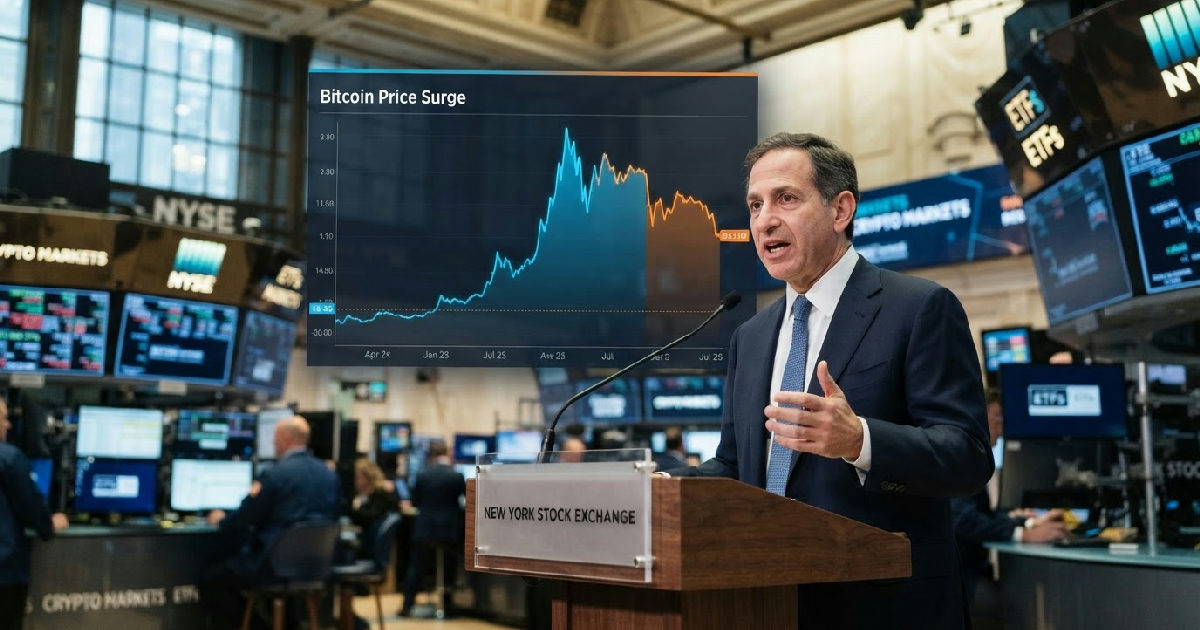

Bitcoin’s impressive rally hit a snag on Friday, August 28, with the cryptocurrency’s price pulling back sharply after Federal Reserve Chair Kevin Warsh signaled ongoing efforts to combat inflation. The leading digital asset dropped more than 3% over 24 hours, trading at $77,379 in New York.
This reversal followed a significant Bitcoin price surge fueled by over $3 billion in inflows into U.S. spot exchange-traded funds (ETFs).
Federal Reserve chief dampens Bitcoin momentum
The market now finds itself at a crossroads, navigating a tug-of-war between strong institutional demand for Bitcoin investment products and a tightening monetary policy outlook. Fed comments often carry substantial weight for risk assets like Bitcoin, quickly shifting sentiment despite underlying bullish trends.
The immediate catalyst for Bitcoin’s downturn was remarks made by Federal Reserve Chair Kevin Warsh during his first major speech leading the central bank. Warsh stated on Friday that he had “more work to do” to fight inflation, a declaration interpreted by investors as a strong signal against imminent interest rate cuts.
Such hawkish commentary typically puts downward pressure on Bitcoin’s price. The cryptocurrency often thrives in environments of lower interest rates, where the cost of borrowing is cheaper and traditional yielding assets become less attractive. Warsh’s stance effectively dimmed expectations for a near-term policy pivot, prompting some investors to reduce their exposure to riskier assets. This shift sometimes triggers Bitcoin short liquidations across derivatives markets.
Bitcoin had reached a weekly high of $81,281 earlier this week. However, following Warsh’s speech, it quickly retreated below the $80,000 threshold. The more than 3% decline erased a portion of the nearly 20% gains Bitcoin had enjoyed last week, climbing from the low-$60,000s.
Inflation fight implications for crypto markets
The Federal Reserve’s determined focus on taming inflation suggests that a high-interest rate environment could persist longer than some market participants hoped. This scenario can make non-yielding assets, including Bitcoin, less appealing compared to government bonds or savings accounts offering better returns.
Historically, Bitcoin has shown sensitivity to macroeconomic cues, particularly those emanating from the world’s largest central bank. A prolonged period of higher rates could continue to cap Bitcoin’s upside, even as other fundamental drivers remain strong.
Over $3 billion in ETF inflows fueled recent Bitcoin price surge
Despite Friday’s price correction, the underlying narrative for Bitcoin over the past two weeks remains one of robust demand, primarily channeled through spot Bitcoin ETFs. These regulated investment vehicles have attracted over $3 billion in net inflows since August 17, demonstrating a renewed appetite among institutional and retail investors for Bitcoin, Ethereum ETFs.
This week alone, U.S. spot Bitcoin ETFs recorded a substantial $1.14 billion in new capital. This marks a continuous nine-day streak of net positive inflows. The consistent demand points to growing conviction for Bitcoin exposure via accessible, regulated products.
ETF performance highlights shifting investor preferences
BlackRock’s iShares Bitcoin Trust (IBIT) has consistently led the pack, capturing the majority of fresh capital. On Thursday, August 27, IBIT alone brought in $277.6 million. It had also absorbed approximately $1.3 billion last week, underscoring its dominant position in the burgeoning ETF market.
Other funds also saw significant interest. Ark Invest and 21Shares’ ARKB added $29.7 million on Thursday, while Bitwise’s BITB attracted $21.7 million the same day. However, not all funds experienced growth. Fidelity’s FBTC saw an outflow of $83.6 million on Thursday, and Grayscale’s GBTC registered $27.2 million in withdrawals.
These varied flows indicate a market that is not just expanding but also undergoing consolidation, with investors favoring certain funds. The recent surge in inflows represents a crucial turning point for U.S. spot Bitcoin ETFs, which remained in a net outflow position for much of 2026.
The August inflows have clawed back about half of the $2.5 billion in net outflows observed between May and July, suggesting a potential shift in market dynamics.
“Debasement trade” drives investor interest
Beyond the immediate ETF activity, analysts point to a broader macroeconomic trend, often dubbed the “debasement trade,” as a key driver for Bitcoin’s recent strength. This strategy involves investors buying assets perceived as hedges against currency devaluation, particularly amid rising government spending and national debt.
The United States’ national debt crossed the $40 trillion threshold for the first time this month, fueling concerns about the long-term purchasing power of the dollar. In this environment, assets like Bitcoin, gold, and other precious metals become more attractive as stores of value. Investors are seeking protection from what they view as excessive governmental fiscal policies.
US Treasury policy bolsters non-yielding assets
Adding to the bullish sentiment was the U.S. Treasury’s announcement last week regarding its liquidity-support buyback operations. The Treasury plans to at least double the size of its buybacks for longer-dated Treasuries, increasing them from $2 billion to $4 billion per operation.
These expanded buybacks, scheduled to run from September 9 through November 4, are expected to inject significant liquidity into the financial system. This move tends to depress the dollar’s value, which in turn can benefit non-yielding assets like Bitcoin. The policy essentially makes holding fiat currency less appealing, pushing investors towards alternatives, such as taking a Bitcoin as hedge position.
The confluence of these factors illustrates Bitcoin’s evolving role as both a speculative growth asset and a potential hedge against macroeconomic instability. However, the influence of central bank policy remains a critical variable, capable of tempering even the strongest rallies from new regulated trading environments.