
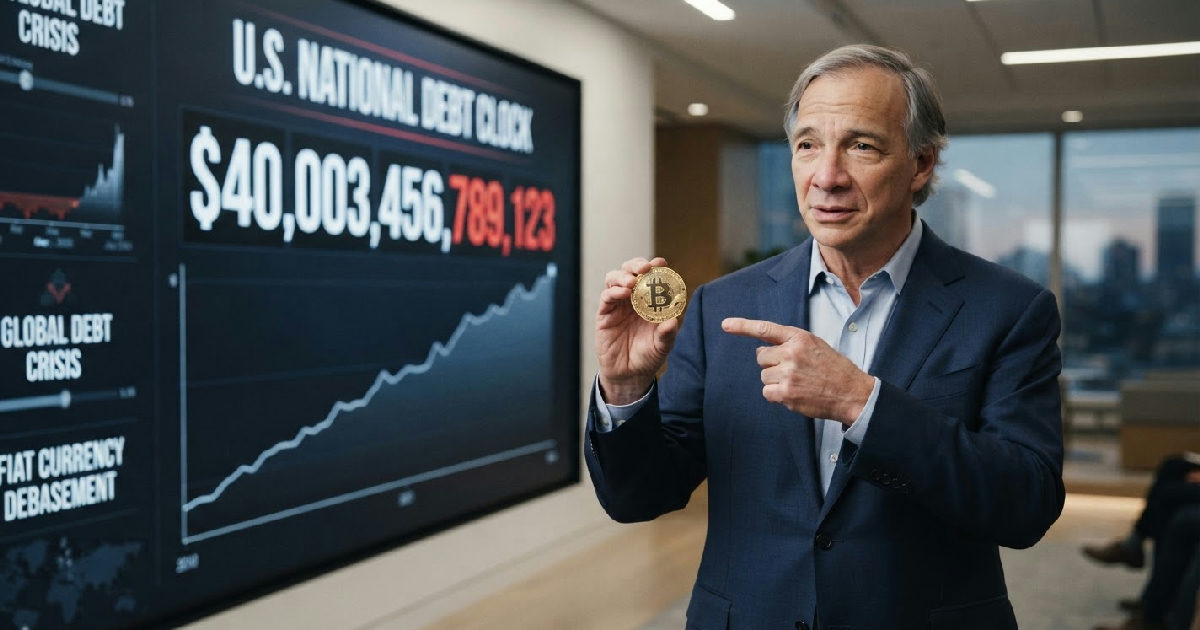

Ray Dalio believes Bitcoin will perform well amid a global debt crisis, offering his most direct endorsement yet. The founder of Bridgewater Associates made the comments on August 21 in a LinkedIn post analyzing the precarious state of global government finances.
Dalio’s central argument is that the world is entering a critical phase of a long-term debt cycle. The U.S. national debt recently crossed the $40 trillion mark, underscoring the scale of this challenge. He advises investors to overweight assets like gold and include “a bit of Bitcoin” as a hedge against the inevitable debasement of fiat currencies.
Ray Dalio Bitcoin: a macroeconomic case
In his recent social media posts, Dalio outlined a classic macro investor’s thesis for holding hard assets. He pointed to several indicators of growing financial pressure on major governments, including weakening demand for their debt, a corresponding rise in long-term bond yields, and persistent monetary expansion. These factors, he argues, aren’t unique to the United States.
“Most economies have similar debt and deficit problems,” Dalio wrote, specifically naming the UK, European Union, Japan, and China as facing comparable challenges. With U.S. government debt service costs now running at approximately $1 trillion per year, the financial strain is becoming increasingly difficult to ignore. Dalio believes this environment creates a clear use case for alternative stores of value.
He draws a historical parallel to the periods of 1930-1940 and 1970-1980, when fiat currencies lost significant value against hard assets. “Crypto is now an alternative currency that has its supply limited,” Dalio explained. He argues that as the supply of dollars increases or demand falls, a mathematically scarce asset like Bitcoin becomes an attractive option for preserving wealth.
This perspective frames Bitcoin not as a speculative tech asset, but as a rational response to predictable, cyclical economic forces. With only 21 million coins ever to be created and 20 million already in circulation, its programmatic scarcity stands in stark contrast to the open-ended printing capacity of central banks. It is this dynamic that underpins Dalio’s cautious but clear optimism.
A skeptic’s evolving view on Bitcoin
Dalio wasn’t always a proponent of Bitcoin. His journey reflects a gradual, evidence-based shift in thinking that many traditional finance veterans have undertaken. As far back as 2020, he acknowledged that Bitcoin had established itself as an “interesting gold-like asset alternative.” By May 2021, he confirmed for the first time that he personally owned some Bitcoin.
His position continued to evolve throughout 2025. During an appearance on the Master Investor podcast, he reiterated his preference for gold but suggested that an investor could allocate a “ whopping 15%” of their portfolio to gold or Bitcoin as a protective measure against currency debasement.
This recommendation highlights a significant shift from his earlier more cautious stance, especially for those considering borrowing against Bitcoin for retirement planning.
By November 2025, he provided more specific detail, disclosing that Bitcoin had accounted for roughly 1% of his personal portfolio for years. This small but significant allocation demonstrated that he had moved beyond theoretical appreciation to practical application, integrating the asset into his own diversification strategy.
Some market analysts suggest that a Bitcoin short squeeze could be triggered by such shifts in institutional and high-net-worth allocations.
However, his endorsement has never been without caveats. Dalio has consistently warned that governments could try to suppress Bitcoin if it becomes too successful. He has also highlighted risks including a lack of financial privacy, the long-term threat of quantum computing, and its notorious price volatility, which he believes makes it function more like a risky tech stock than stable money.
Dalio’s influence and the broader context
While his personal allocation is small, Dalio’s strategic advice is what captures the market’s attention. In a recent post on X, he gave clear guidance: “diversifying well in asset classes and countries that have strong income statements and balance sheets… underweighting debt assets like bonds, and overweighting gold and a bit of Bitcoin.”
This counsel is significant because it comes from one of the world’s most successful and respected macroeconomic investors. Dalio founded and, for decades, ran Bridgewater Associates, the largest hedge fund on the planet.
His opinions are highly influential in institutional investment circles, lending credibility to ideas that were once dismissed as niche or radical, especially as institutional interest grows, as evidenced by a recent Bitcoin ETF position disclosure.
His argument that sovereign debt is becoming untenable resonates with broader discussions within the financial industry. Dalio has consistently highlighted how soaring U.S. government debt service costs and fresh borrowing needs erode confidence in traditional assets. This makes alternative assets like Bitcoin more appealing to a growing number of investors.
He has also been careful to manage expectations, noting during an August 17th appearance on the All-In podcast that Bitcoin remains a “relatively small market that’s a relatively controllable market,” especially when compared to gold. This suggests he sees its role as a component within a diversified portfolio, not as a replacement for the entire financial system.
What this endorsement really means
The immediate market impact of a billionaire’s comments is often fleeting. Yet, the substance of Dalio’s argument provides a durable narrative that supports Bitcoin’s long-term value proposition. His analysis validates the core thesis held by many Bitcoin advocates: that in a world of unrestrained money printing, a provably scarce asset is an essential financial tool.
His statements come as Bitcoin has rallied to nearly $80,000 for the first time since May, fueled by a mix of macroeconomic concerns and market-specific dynamics. While Dalio’s words alone didn’t cause the rally, they provide a powerful framework for understanding why investors are increasingly looking for alternatives to traditional bonds and currencies.
Ultimately, Dalio’s opinion matters less as a price prediction and more as an intellectual validation. It signals that the conversation around Bitcoin has matured, moving from the fringes of the internet to the center of global macroeconomic strategy. It is an acknowledgment that the problems Bitcoin was designed to solve are now too big for the world’s most powerful investors to ignore.