
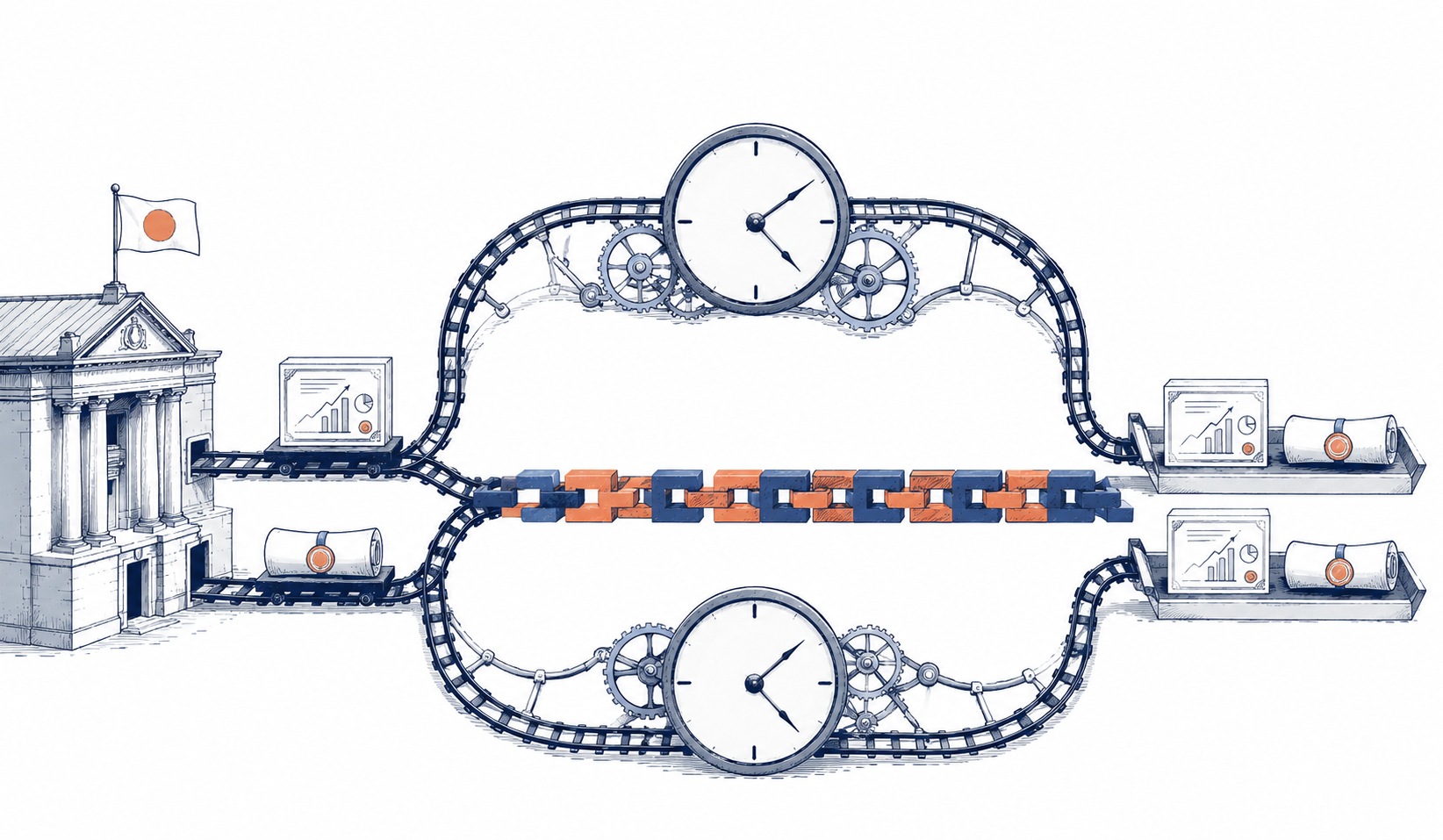

The most important part of Japan’s latest blockchain proposal may not be putting stocks or government bonds on a distributed ledger.
It may be putting central-bank money there with them.
Japanese regulators, the Ministry of Finance, the Bank of Japan and financial institutions are preparing to study a new settlement architecture that could eventually use blockchain to complete securities transactions much faster than today’s market infrastructure allows.
One option under consideration would digitally represent part of the reserves commercial banks hold at the BOJ, allowing central-bank money to interact with securities on compatible infrastructure.
That changes the nature of the experiment. Financial institutions have spent years proving that bonds, funds and other assets can be represented on blockchains. But a market is not created simply because an asset becomes a token. Someone still has to pay for it, ownership still has to become final, and the infrastructure has to ensure that money and securities reach the correct parties.
Japan is beginning from that harder problem.
Its equities currently settle two business days after trading, while government bonds generally settle after one. A blockchain-based system could potentially bring the transfer of the asset and the payment much closer together.
The project remains preliminary. A detailed plan is expected by early 2027, and any eventual implementation could still be years away.
But Japan is no longer asking only whether financial assets can exist on blockchain.
It is examining what would have to change for an actual market to operate around them.
A Tokenized Bond Still Needs Something to Pay for It
The distinction is easy to miss because tokenization has largely been discussed from the perspective of issuance.
A bank puts a bond on-chain. An asset manager tokenizes a fund. Investors gain access to a digital representation of a traditional security.
Those experiments can change how an asset is issued, held or transferred, but settlement introduces a second requirement: cash.
If a tokenized security moves instantly while its payment remains trapped in a separate system, the transaction still depends on coordination between two infrastructures.
That is why central-bank money matters.
Commercial banks already hold reserves at the BOJ to settle obligations within the financial system. Making some form of that money compatible with tokenized securities could allow both sides of a transaction to move together.
The technical concept is familiar to capital markets: delivery versus payment. Securities are delivered if and when the corresponding payment occurs.
What changes is the infrastructure capable of coordinating those movements.
The BOJ has already been experimenting with different ways to make central-bank money available for transactions involving distributed ledgers. One approach could place it directly within a blockchain environment; another could connect existing payment systems to networks where tokenized securities circulate.
Japan’s new initiative brings those experiments closer to a much larger question: whether such architecture could eventually support mainstream markets rather than isolated tokenization projects.
The Biggest Obstacle to Instant Settlement May Be Liquidity
Speed makes the proposal easy to sell.
If a trade can become final almost immediately instead of remaining unsettled for one or two days, counterparties spend less time exposed to the possibility that something goes wrong before completion.
Yet financial markets do not wait two days simply because their technology is slow.
Settlement cycles also give institutions time to net obligations.
A bank may owe money on one group of transactions while receiving it on another. Rather than funding every trade independently, those positions can offset each other before final settlement, reducing the amount of cash and securities that must be available at any particular moment.
Move everything closer to real time and some of that efficiency can disappear.
The result is a counterintuitive trade-off: faster settlement can reduce counterparty exposure while increasing the amount of liquidity institutions need immediately.
For a small blockchain experiment, that problem can be manageable. For a national securities market particularly one connected to Japan’s enormous government bond market it becomes fundamental.
A new settlement system therefore cannot win simply because it is faster.
It has to prove that speed is worth the changes it creates elsewhere in the financial system.
Japan Is Testing Infrastructure, Not a Crypto Product
That distinction also explains why this experiment belongs to a different stage of blockchain adoption.
A tokenized fund can exist at the edge of the financial system. So can an experimental bond issuance. Their success does not require the surrounding market to change.
Settlement infrastructure does.
It has to connect banks, custodians, securities markets and central-bank money. It needs legal finality. It has to keep operating during periods of stress, when liquidity becomes scarce and transaction volumes can surge.
Japan is not alone in confronting that challenge. European and U.S. institutions are also exploring ways to combine tokenized securities with new settlement systems and central-bank money, while Japanese institutions such as MUFG are testing tokenized government bonds and delivery-versus-payment structures.
The competition is therefore becoming less about proving that blockchain can host financial assets.
That has already been demonstrated repeatedly.
The harder question is whether distributed ledgers can become dependable enough to support the infrastructure beneath markets that move enormous amounts of capital every day.
Japan has not answered that question. It has not even decided that blockchain will ultimately be the technology it uses.
But the experiment reveals where institutional attention is moving.
Tokenization proved that financial assets can live on blockchain. Japan is now testing what it would take for the market around those assets to live there too.